


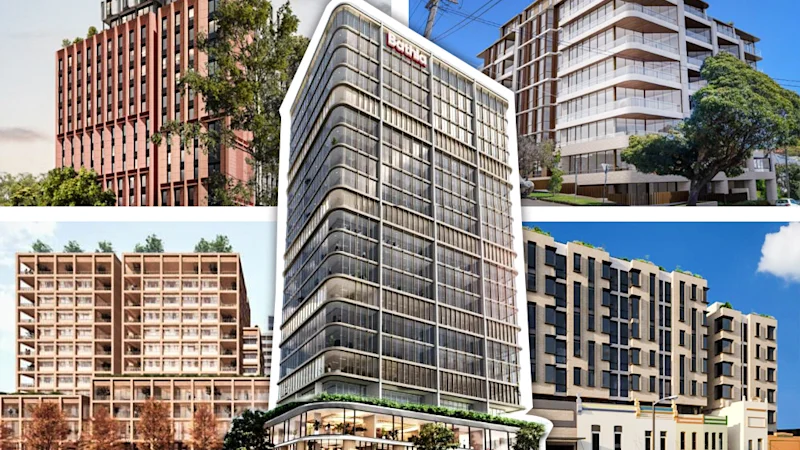
Record numbers of planning disputes are reaching the NSW Land and Environment Court, with developers increasingly challenging council decisions as residents become caught between the drive for more housing and concerns about what is built in their suburbs.
The court finalised 1,108 development-related appeals in 2025, the highest annual total since published records began in 2006. That amounts to more than three cases a day.
An analysis of 743 publicly available judgments found that 706 appeals ended in approval, including cases resolved through court-directed conciliation, while only 37 were refused.
The disputes have involved proposals ranging from luxury homes on the site of an affordable Paddington boarding house to a coastal retirement estate, a fast-food precinct and a 20-storey office tower in Blacktown.
Planning appeals and housing supply
More than half of the appeals – 54 per cent – followed councils’ failure to determine applications within statutory deadlines. Standard applications must generally be assessed within 40 days, while larger proposals have a 60-day deadline.
Under NSW planning law, applicants can appeal when an application is treated as refused because the deadline has expired.
The figures have increased scrutiny of councils as the state government seeks to expand housing in established suburbs and has warned local authorities they could lose planning powers if assessment times do not improve.
Department of Planning data shows 67 per cent of development applications are being assessed within its expected timeframes. However, the rate is below 30 per cent at several councils, including Burwood, Strathfield, Willoughby, Lane Cove and Hunters Hill.
There were 1,635 applications refused by councils across NSW in 2025-26. Canterbury-Bankstown recorded the most, with 161, followed by Georges River with 87, Woollahra with 86, Sutherland with 82 and Ku-ring-gai with 66.
Planning Minister Paul Scully said delays were particularly concerning during a housing supply crisis.
“Projects which fit within planning controls should not end up in the Land and Environment Court, wasting ratepayers’ money and adding thousands to the cost of new homes,” he said.
“It’s disappointing that some councils are continuing to stand in the way of much-needed housing supply.”
Developers, councils and local opposition
Woollahra recorded the highest number of appeals in NSW last year, with 59, followed by Northern Beaches on 41, Central Coast on 40, Georges River on 37, and Liverpool and Inner West on 36 each.
When measured against population, the highest rates were recorded in Woollahra, Hunters Hill, Mosman, Waverley, Willoughby and North Sydney. Fairfield and Camden each had six appeals, while Campbelltown had eight.
Nicole Gurran, a professor of urban planning at the University of Sydney, said the concentration of appeals in wealthier areas could be linked to the financial value of development sites.
“The more valuable the site, the more likely a developer is to push the envelope and propose something that might not otherwise be permissible under council planning controls,” she said.
“Developers can then effectively engage in ‘decision shopping’ by appealing refusals in court in the hope of securing a more favourable outcome.”
Woollahra mayor Sarah Dixson rejected the suggestion that the figures showed the council was refusing applications disproportionately. She said many proposals went well beyond existing planning rules.
“Every application is assessed on its merits, but there are a lot of applications which go far beyond the scope of council controls that are not appropriate,” she said.
Dixson said recent state planning reforms allowing greater building heights and density had made applications more complicated and statutory deadlines harder to meet. She said the council preferred to settle disputes through conciliation where possible, while acknowledging concerns over the confidentiality of those discussions.
Concerns over court-approved developments
Among the projects approved on appeal was the demolition of a 32-room Paddington boarding house, despite opposition from residents and a previous refusal by the City of Sydney Council over the loss of affordable accommodation and the displacement of tenants.
Other approvals included an $80 million over-55s estate with 146 homes on coastal land in Yamba, a Kariong precinct including McDonald’s, KFC and Guzman y Gomez outlets, and a Deniliquin solar farm with more than 9,000 panels.
The court also approved a 20-storey office tower by the Bathla Group in Blacktown and a development of 204 units across five buildings on Burelli Street in Wollongong.
Tom Forrest, chief executive of the property industry group Urban Taskforce, said prolonged legal disputes could add tens or hundreds of thousands of dollars in legal fees and holding costs, threatening projects’ financial viability and delaying new homes.
Community groups argue that the increasing use of appeals risks sidelining local knowledge about infrastructure and the effects of development. Dennis Mentzines, of the Drummoyne Responsible Development Group, pointed to a nine-storey waterfront scheme approved after Canada Bay Council rejected it.
The proposal was lodged under new state reforms permitting larger buildings in areas that had previously been restricted to lower-density housing.
“Local councils have a very good understanding of their own unique infrastructure constraints – schools, roads and hospitals – and the impacts on the local area,” Mentzines said.
“The courts are now looking at one-size-fits-all statewide planning changes across suburbs that are all completely different to one another.”
Local Government NSW has called for the rules governing deemed refusals to be reviewed, arguing they can send disputes to court before councils have enough time to resolve technical issues or complete complex assessments.
Across all its jurisdictions, the court finalised 1,671 cases in 2025, a 6 per cent increase on the previous year. Tree disputes also rose, increasing by 14 per cent to 154 during the 12-month period.
