


Rugby league eligibility rules have been extended to allow players to represent a nation where one of their eight great-grandparents was born, in a move International Rugby League chairman Troy Grant said would strengthen the international game.
The change was announced in Sydney as the Pacific and the United States were confirmed as hosts of the 2030 World Cup. It follows an application from the Cook Islands and their coach, Karmichael Hunt.
Players had previously been able to qualify through the country of birth of a parent or grandparent. The new regulations extend that connection by one generation, taking the sport beyond the eligibility rules used by governing bodies including World Rugby, Fifa and World Athletics.
Grant rejected suggestions that the change could damage the credibility of international competition.
“It may not be as pure as some people may think it should be, or fit their mindsets. I don’t really care about that,” he said.
“I care about growing the game and giving every player the opportunity to represent their nation and I care that the fans are getting the best outcomes, which we have seen during this World Cup.”
Canberra fullback Kaeo Weekes is among those who could benefit from the revised rules. Grant said Weekes would have been able to play for the Cook Islands at the current World Cup had the provision been in place earlier.
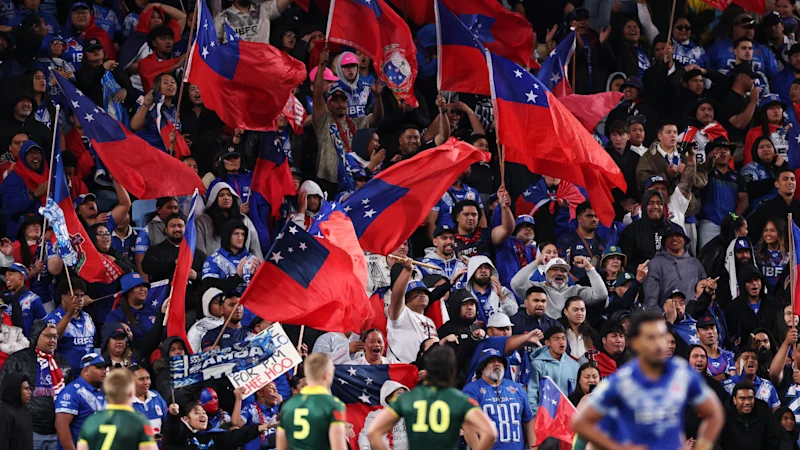
The decision comes as Pacific nations have become increasingly influential in international rugby league. Tonga and Samoa have emerged as major forces, with the two sides having met in a high-profile pool match at CommBank Stadium.
Grant said the IRL board had also committed to exploring whether Tonga and Samoa should be elevated to tier-one status.
“They’ve lit up international rugby league like we haven’t seen before and we’re enormously grateful for that,” he said.
2030 World Cup to travel between Australia and the US
The 2030 tournament will be organised and staged by the Australian Rugby League Commission in a Magic Round-style format, with a full programme of men’s and women’s pool matches played across three days at one stadium before moving to another venue.
Group-stage matches are expected to be spread across as many as five venues in Australia and the US. Potential locations include Sydney, Brisbane, Auckland, Hawaii and Utah.
Despite the tournament’s Pacific focus, limited stadium and hotel infrastructure means it is considered unlikely that the travelling group-stage format will reach Fiji, Tonga or Samoa.
Grant said the IRL hoped to stage the 2034 World Cup in Europe and Africa.
The latest eligibility change follows a separate State of Origin ruling made nine months ago, which allowed New Zealand internationals to play for New South Wales or Queensland. That decision enabled Queensland star Kalyn Ponga to declare for New Zealand.
