


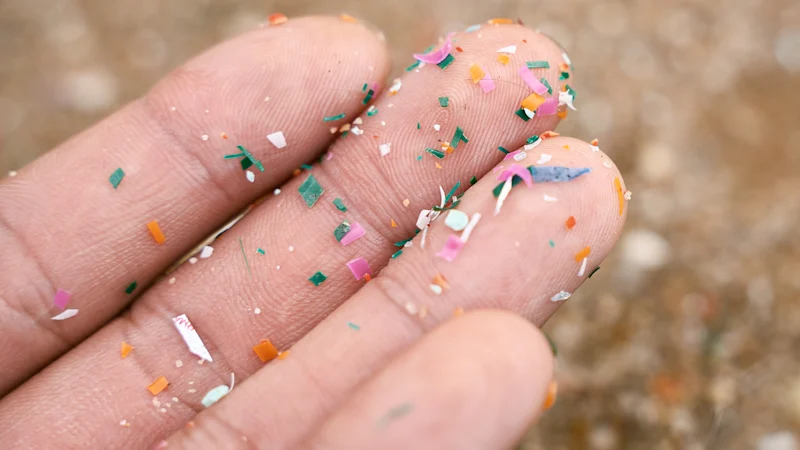
At-home microplastics blood tests are being sold to increasingly concerned consumers, but leading researchers warn that the results may be inaccurate, unvalidated and of little practical use.
Several companies now offer tests that claim to measure plastic particles in the body, with some available in Australia for up to $750. The market follows a growing body of research examining possible links between microplastics and human health.
Microplastics are tiny particles formed as plastic waste breaks down. They can be inhaled, eaten or consumed in drinking water, but scientists have not reached a consensus on what their presence in the body means, or whether they cause specific diseases.
American longevity influencer Bryan Johnson helped bring the tests wider attention last year when his company, Blueprint, announced what it described as the world’s first at-home microplastics blood-testing kit, priced at US$135.
Johnson later claimed that the number of microplastic particles found in his semen had fallen from 165 to zero over 18 months. He attributed the change to regular sauna sessions, a reverse-osmosis water filter and removing plastics from his home.
But experts say consumers should be cautious about paying for tests that have not been properly validated.
Why microplastics blood tests are difficult to interpret
Oliver Jones, a professor of analytical chemistry at RMIT, said the tests and the biomarkers they examine had not been validated.
“The information you would potentially be getting is inaccurate, so there is nothing you can do with it. It’s meaningless,” he said. “No knowledge is no power.”
One of the central problems is distinguishing plastic particles from substances naturally present in blood. Microplastics can resemble fat compounds, raising the possibility of false-positive results.
Mark Green, an associate professor in reproductive biology at the University of Melbourne, said this made accurate measurement extremely difficult.
“It is very, very hard to measure a small piece of plastic, which is made up of carbon and hydrogen, from a human matrix, which is also made up of carbon and hydrogen,” he said.
Professor Kevin Thomas, director of the Queensland Alliance for Environmental Health Sciences at the University of Queensland, questioned whether an at-home test could reliably achieve what researchers struggle to do with sophisticated laboratory equipment.
“I find it difficult to understand how you could do an at-home test when we struggle with some of the most advanced instruments available to make the same measurements,” he said.
Thomas also raised concerns about studies that have reported higher levels of microplastics in people with certain illnesses. A small study found that people who had suffered a serious heart attack had higher levels of micro- and nano-plastics in their blood, while another study reported that people with lung cancer were more likely to have high levels in their lungs.
“It is just as plausible that endogenous lipids in the blood are being misidentified as plastics,” Thomas said of the heart attack research. “The headline could just as well read: ‘Patients who suffer heart attacks have more lipids in their blood’.”
Research has also suggested associations between microplastics and reproductive, digestive and respiratory problems, as well as possible links to colon and lung cancer. However, an association does not establish that the particles caused the illness.
The authors of the lung cancer study acknowledged that diseased or inflamed lungs might be more likely to trap particles breathed in from the air.
Green said studies linking microplastics with health outcomes were worthy of further investigation. He said the particles were foreign to the body and could have an effect, including by increasing inflammation markers, but stressed that more accurate methods were needed before claims about specific diseases could be assessed.
“As to whether they cause specific diseases, that’s a different thing, and we need the methodology to be more accurate before we can ask those questions,” he said.
How to reduce exposure to microplastics
Researchers say that even if particles could be measured accurately, there is currently no proven way to remove all microplastics from the bloodstream.
Jones said some businesses were selling both microplastics tests and so-called detox treatments, but warned: “We have all these people selling microplastics tests or microplastic detoxes online and none of them remove anything except your money.”
Experts instead recommend reducing potential exposure where possible, without relying on a blood test. Measures include avoiding plastic bottles, not storing or heating food in plastic containers and replacing plastic cutting boards, utensils and containers with wood, glass or stainless steel.
People can also consider replacing non-stick pans with stainless steel or cast iron, using a water filter, avoiding cling film and single-use plastics, and wearing fewer synthetic clothes.
Thomas said the kitchen was a particularly useful place to start. He also recommended regular vacuuming to reduce household dust, which can contain plastics and chemicals associated with them.
Alongside these steps, the experts advised maintaining general health through exercise, a balanced diet, adequate sleep and moderation with alcohol and smoking.
