


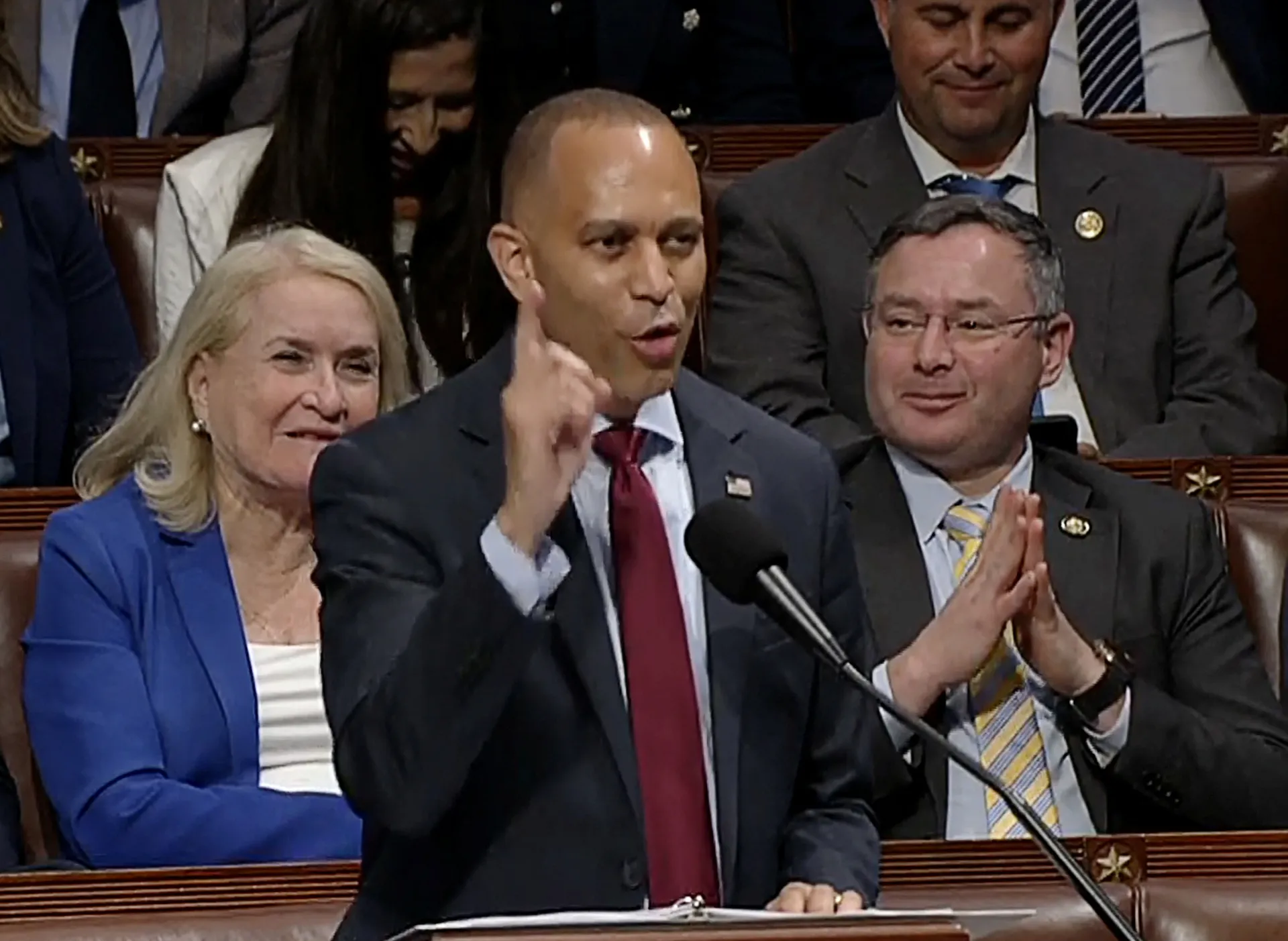
Democrats are set to choose their leaders for the incoming US Congress, with Hakeem Jeffries expected to secure the party’s nomination for speaker of the House of Representatives.
Mr Jeffries, a New York Democrat who succeeded Nancy Pelosi as his party’s House leader in 2023, has no declared challenger. If he wins the full House vote on January 3, he would become the first Black speaker in US history.
His expected elevation follows Democratic gains in the November 3 midterm elections, which ended two years of Republican control of the House under President Donald Trump. Democrats have won 257 of the chamber’s 435 seats, while Republicans have won 171, with seven races still undecided.
Democrats prepare to take control of the House
House Democrats will also select the rest of their leadership team. Katherine Clark of Massachusetts is seeking the post of majority leader, which would make her the first woman to hold the position, while Pete Aguilar of California is running for majority whip.
The speaker presides over the House and decides which bills come to a vote. The role is also second in the presidential line of succession, after the vice president.
The majority leader helps set the House agenda and steer the governing party’s legislation, while the minority leader leads the opposition. Party whips count votes and seek to keep their members in line.
Republicans have chosen Jim Jordan of Ohio as minority leader and Tom Emmer of Minnesota as minority whip. The outgoing speaker, Mike Johnson, did not seek the position.
Although some progressive Democrats, particularly newly elected members, have withheld support while seeking commitments on halting US military aid to Israel and pursuing campaign finance reform, no one has entered the race against Mr Jeffries.
Ayanna Pressley of Massachusetts, whose petition on the party’s agenda prompted speculation that she might challenge him, said on Monday that she would not run. Mr Jeffries has called for a recorded vote rather than approval by acclamation, meaning any opposition within his party will be recorded.
How the House speaker is elected
The process involves two separate votes. First, each party selects its nominee in a secret ballot held behind closed doors. That result does not make the candidate speaker.
The full House then votes on January 3, with members announcing aloud the name of their preferred candidate. A candidate must win a majority of votes cast for a named person — 218 votes if all 435 members participate.
Members who vote “present” or are absent reduce the number required. If no candidate wins a majority, further ballots are held, and the House cannot swear in its members or pass legislation until a speaker has been chosen.
Kevin McCarthy required 15 ballots over four days to win the speakership in January 2023. He was removed from the post by a House vote in October that year, leaving the chamber without a speaker for three weeks.
Mr Jeffries is not expected to face a similar contest because Democrats hold a large majority behind him.
The changeover on January 3
At noon on January 3, the old Congress ends and the new one begins. The speaker election takes place first in the House chamber at the US Capitol.
Once the winner has been sworn in, the new speaker swears in all House members. The chamber then sets its rules for the next two years, while the parties’ leaders formally take up their posts.
In the Senate, Vice President JD Vance will swear in newly elected senators. The chamber will also choose a president pro tempore, usually the majority’s most senior senator, to preside when the vice president is absent.
The handover will mark a period of divided government, with a Republican president and a Democratic Congress. Democrats will be able to block Mr Trump’s agenda and investigate his administration, while the president can veto legislation. Overriding a veto requires a two-thirds majority in both chambers.
