


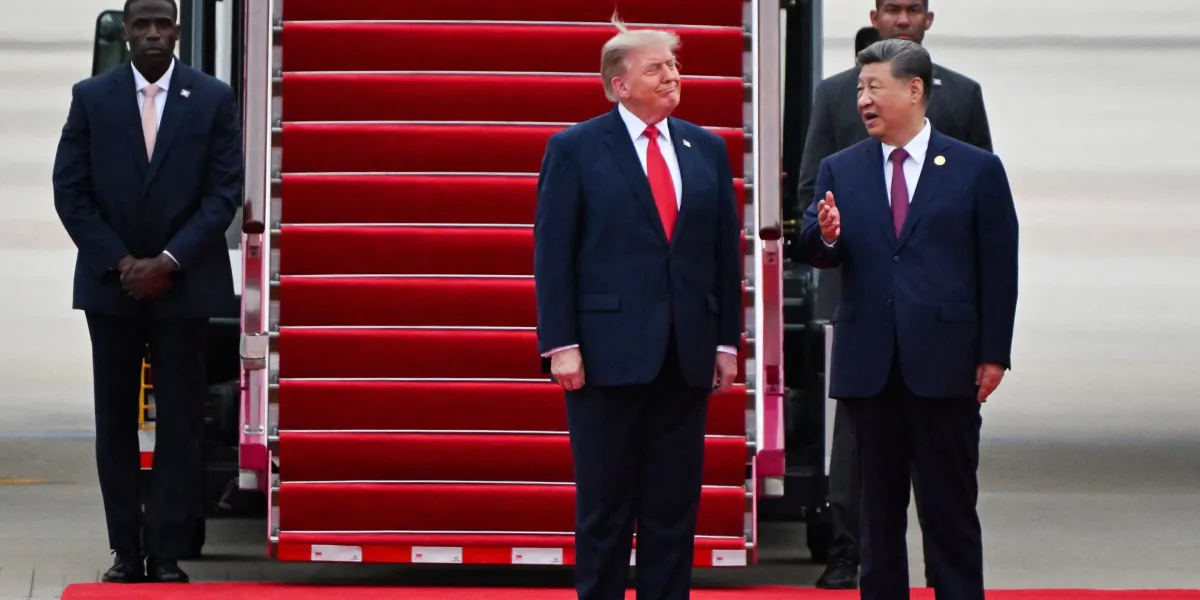
Donald Trump is due to hold talks with Chinese President Xi Jinping and Russian President Vladimir Putin in Shenzhen, with a fragile US-China trade truce and tensions in the Middle East expected to dominate the discussions.
The three-way meeting is taking place during this year’s Asia-Pacific Economic Cooperation forum, after Mr Trump travelled to China following meetings on the sidelines of the Association of Southeast Asian Nations summit in Manila.
Chinese Foreign Ministry spokesperson Mao Ning said the leaders would “exchange views in depth on safeguarding world peace and promoting strategic stability in major-power relations”.
The meeting comes as Washington and Beijing approach the January 10 expiry of an agreement reached at last year’s APEC summit in South Korea. Under the truce, the US agreed to lower tariffs while China pledged to crack down on fentanyl precursors, resume soybean purchases and pause restrictions on rare-earth exports.
Scott Bessent, the US Treasury Secretary, said in September that the arrangement had been extended until January 10. Scott Kennedy, a senior adviser in Chinese business and economics at the Center for Strategic and International Studies, said the key question was what conditions would be needed to prolong the ceasefire.
Mr Kennedy said the leaders might continue negotiating until the deadline rather than reach a final agreement in Shenzhen. Mr Trump and Mr Xi are also expected to meet at next month’s G20 summit in Florida.
Export controls threaten US-China trade truce
The focus of the dispute has increasingly shifted from tariffs to restrictions on strategic goods. The United States has blocked exports of advanced artificial intelligence chips and chipmaking equipment to China since 2022, while Beijing introduced licensing requirements for several rare-earth materials in April 2025.
Those minerals are important to industries including semiconductor and car manufacturing, and the resulting supply disruption threatened production in the US and Europe. Both countries agreed to suspend some export-control measures under last year’s truce.
But days before Mr Trump’s meeting with Mr Xi, the US Commerce Department expanded rules covering the use of advanced AI chips. Companies seeking to export the chips to Singapore, Malaysia, Thailand, Indonesia and Brazil will require licences, as will data-centre operators providing large amounts of computing power to Chinese clients.
The department said the measures were intended to prevent restrictions on sensitive American technology being bypassed through remote-computing arrangements involving data centres in third countries. China’s commerce ministry expressed “strong dissatisfaction” and warned: “If the U.S. persists, China will take countermeasures.”
Middle East tensions also on agenda
The US war in Iran could provide another focus for the talks. Mr Kennedy said Washington clearly wanted to leave Iran and could benefit from help from Russia and China, both of which have close ties with Tehran.
He said the two countries might help secure Iran’s commitment not to charge vessels tolls or fees to pass through the Strait of Hormuz. They could also help contain oil prices, which have risen amid Iranian attacks on commercial ships in the waterway, adding to cost-of-living pressures.
Victor Shih, a China expert at the University of California San Diego’s School of Global Policy and Strategy, said the midterm elections had sent a clear message about voters’ concerns over the cost of living. He suggested the Middle East could be the main subject of discussion because China and Russia had “considerable leverage” there.
Chinese ships, along with vessels from India, Qatar and Iraq, are exempt from restrictions Iran has imposed on shipping through the Strait of Hormuz.
