


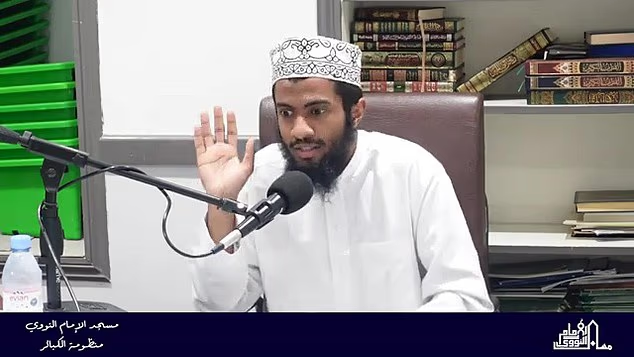
Imams at mosques in London and Birmingham have been recorded telling Muslim men that they may hit their wives for refusing sex or disobeying their husbands, prompting calls for police and charity regulators to investigate.
The sermons include advice that physical punishment should be used against women who refuse intercourse, as well as claims that wives should not leave the home without permission. Domestic abuse charities and campaigners have warned that such preaching could encourage coercive control, marital rape and violence against women.
One video features Yasin Munye of the Hackney Islamic Community Centre in east London telling a congregation that husbands should “discipline them physically… lightly hitting them to show them who is in charge”. He cited a wife “disobeying the husband when it comes to calling her to bed” as a reason for such punishment.
Another preacher at the same mosque, Abu Sa’ad Muhammad, said wives in Britain had been turned against their husbands and suggested that women knew “if you slap them once, they will call the police”.
The Metropolitan Police said it was assessing a complaint relating to the Hackney mosque. The Charity Commission said it had warned the centre in 2024 about extremist speakers and opened a further investigation last month after receiving videos involving Mr Munye and Mr Muhammad.
Preachers accused of endorsing violence against women
At An-Noor Masjid and Community Centre in Birmingham, Mahamed AbdurRazaq told listeners that a husband could hit his wife if she continued to refuse intercourse.
“If a wife continues to refuse to have intercourse… her husband [can] hit her,” he said, adding that the blow should not bruise or break bones.
The Charity Commission had already issued “formal guidance” to the mosque not to invite extremist speakers. A spokesman for the regulator said: “Anyone who advocates violence against women has absolutely no place in charity. When concerns are raised with us, we assess each case carefully and take strong regulatory action where necessary.”
At Green Lane Masjid in Bordesley Green, Birmingham, imam Aqeel Mahmood delivered a 47-minute lecture on marriage in December. He said a husband had the right to “discipline his wife in case of rebellion” and that it was not permissible for a wife to leave the house without her husband’s permission.
Mr Mahmood described physical discipline as a last resort, on the condition that it did not cause “pain, injury, fear and humiliation”. The National Secular Society, which obtained the video, complained to the Charity Commission and the regulator is understood to have given the mosque “advice and guidance”.
A former imam at Green Lane, Abu Usamah at-Thahabi, attracted controversy in 2023 after saying “homosexuality is not permissible”. The Government subsequently cancelled a £2 million grant. Another preacher at the mosque, Abu Rayan, had earlier told worshippers that a wife should make herself sexually available to her husband at all times.
Green Lane Masjid said: “Green Lane Masjid unequivocally rejects violence, domestic abuse, coercion and all other forms of violence and abuse.”
In west London, Abdur Rahman Hassan of Darussalam Mosque in Southall told his congregation that a woman who wore perfume outside her home was a “fornicator”. The Charity Commission said it would investigate evidence relating to the sermon.
The regulator’s response came as campaigners warned that women may be deterred from reporting abuse because of pressure from relatives or their wider communities. Domestic abuse charity Jeena International said such preaching reinforced the belief in some Asian communities that rape could not happen within marriage.
Its founder, Rani Bilkhu, said: “These preachers are using religion for coercive control of women… and are giving the go-ahead for sexual violence and domestic abuse.”
Asked whether such sermons could prevent Muslim women from reporting rape and domestic violence, Ms Bilkhu said they were “a factor”, alongside reluctance to come forward and language barriers. She added: “This is not a woke issue, this is a safeguarding issue.”
Calls for police and charity action
Megan Manson, head of campaigns at the National Secular Society, said the sermons could “encourage domestic violence and marital rape”. She said religious charities had to be held accountable and described the material as evidence of a “religious manosphere” taking hold in Britain.
Hitting a wife, even lightly, can amount to common assault and be prosecuted as domestic abuse. The Domestic Abuse Act 2021 covers physical abuse and violent or threatening behaviour, and a single incident may qualify. Police could also consider whether a preacher had intentionally encouraged or assisted an offence under the Serious Crime Act 2007.
Rakib Ehsan, an author and commentator on social integration, said Britain’s approach to multiculturalism had failed women in segregated communities. He claimed that limited policing and a failure to engage with insular areas had allowed preachers to promote attitudes contrary to British law and customs.
Journalist and commentator Khadija Khan, who said she grew up in a Muslim household where her father beat her mother for disobeying him, described the situation as “a stain on Britain’s conscience”. She accused successive governments of failing to challenge misogyny and violence against women and girls taught in mosques.
Birmingham MP Jess Phillips, a former safeguarding minister, said she was “utterly appalled and disgusted that people think they can preach and influence populations to do this”. She added that the preachers “should not be allowed to speak to anyone in my constituency or in my city”.
Shadow home secretary Chris Philp described the speeches as “disgusting and misogynist” and said they directly incited domestic violence, assaults on women and rape. He called for police investigations and urgent action from the Charity Commission.
Former home secretary Priti Patel said the practices described by the preachers were unacceptable and that there should be “no tolerance” of domestic violence or the abuse of women.
A Government spokesman said: “The Government condemns all acts of psychological, emotional, physical and sexual abuse, as well as acts of coercive control, including where they occur in a religious setting or context.”
