


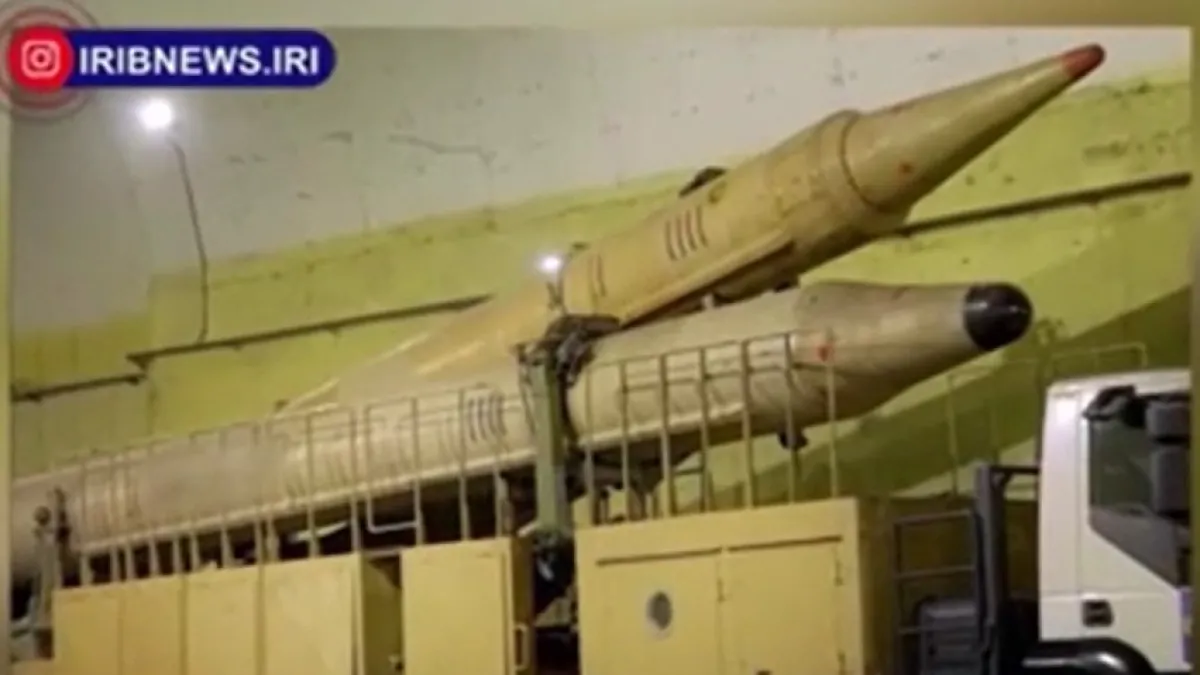
Iran has unveiled a dual-missile launcher capable of firing two liquid-fuelled missiles simultaneously, as it displayed upgraded weaponry and underground military facilities in a defiant demonstration of its remaining capabilities.
The system was shown during a tour of an underground facility by Major-General Ahmad Vahidi, commander of the Islamic Revolutionary Guard Corps (IRGC), on Saturday. State television footage showed commanders inspecting missiles, launchers and other military equipment belonging to the IRGC aerospace force.
Iran displays new dual-missile launcher
The launcher is designed to carry and fire two liquid-fuelled missiles at the same time, according to Iranian state media. Such missiles are launched vertically and allow their speed to be controlled, a feature officials said could help them overcome air-defence systems.
State media also claimed that newer generations of Iranian missiles had improved range, accuracy and guidance systems that could operate independently of the US Global Positioning System.
The display comes after previous rounds of fighting involving US and Israeli forces. Iranian officials said the country had strengthened its missile and air-defence capabilities since then, despite the attacks.
Inside Iran’s underground missile facilities
The tour followed the IRGC aerospace force’s announcement on November 10 of a new underground complex. Iranian officials have said such facilities are intended to allow weapons production and storage to continue even during heavy bombardment.
The IRGC has also said it moved missile and drone production lines from the surface into underground sites. Footage broadcast on Saturday showed kilometres of tunnels containing hundreds of missiles and launchers, including double launchers.
It was not clear when the footage was recorded. A Tehran-based correspondent said the presentation appeared intended to show foreign governments that Iran had sufficient ammunition and launchers to continue military operations if fighting resumed.
Rami Khouri, a public policy fellow at the American University of Beirut, said underground facilities could be used to store spare parts, raw materials and chemicals needed to manufacture missiles and drones, as well as completed weapons.
“So there’s no doubt that Iran has stored an enormous amount of all of this,” he said. “They’ve shown … they’re prepared to stand sanctions and keep fighting.”
Message to the US and Israel
Rob Geist Pinfold, a lecturer in international security at King’s College London, said Iran was using the display to assert its military capabilities and suggest that the United States had been discouraged from widening the conflict.
Khouri said the gradual presentation of Iran’s technical and military capabilities was intended to demonstrate that its weapons could evade Western defence systems while reaching targets in countries it chose to attack.
Iran is also facing mounting economic pressure from a US naval blockade of its southern ports, which has disrupted oil exports. Pinfold said the country’s economy was already in recession and that very little, if any, oil was currently leaving Iran.
He said the pressure had left Iran feeling backed into a corner and contributed to its decision to escalate its military messaging. The missile display therefore serves both as a demonstration of capability and an attempt to restore deterrence.
