


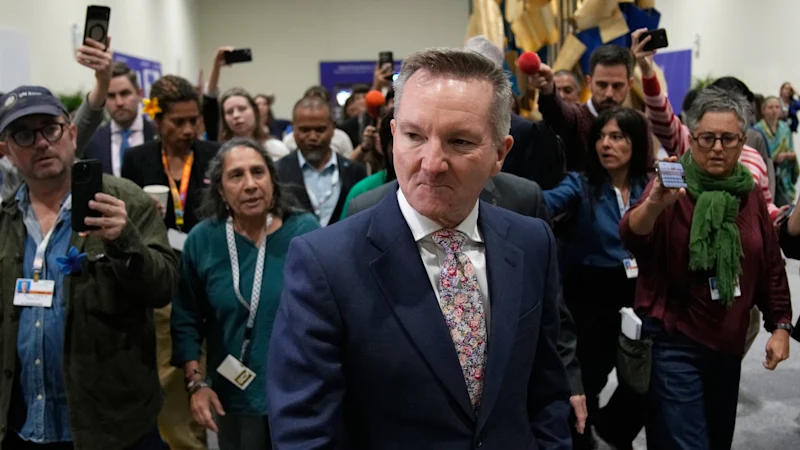
UN climate talks in Turkey have ended without agreement after a confrontation between oil-producing nations led by Saudi Arabia and countries demanding stronger action on climate change. Chris Bowen, Australia’s Climate Change and Energy Minister and president of the negotiations, said there were “unbridgeable red lines” between the parties.
The proposed final text, known as a cover decision or the Antalya Pact, included a call to move away from fossil fuels. It was rejected by the Saudi-led group, backed by Russia, while the European Union said it could not support a deal that failed to address the need for a fossil-fuel transition.
Other countries objected to language promoting carbon capture and storage, as well as the failure of developed nations to offer more financial support to poorer countries facing the worst impacts of climate change. Decisions at UN climate conferences must be agreed by consensus.
European Union rejects climate talks agreement
Darragh O’Brien, Ireland’s Minister for Climate, Energy and the Environment, rejected the draft on behalf of the EU during the final plenary session.
“We will not endorse a cover decision, or an Antalya Pact, that does not even mention fossil fuels, which is the key driver of climate change,” he said. “We will not accept negotiating backward in time, and we will not accept a COP that greenwashes fossil fuel.”
Mr O’Brien praised Mr Bowen and the Turkish presidency for their efforts but said the text did not begin to address the climate emergency. “It is unconscionable that we would have a climate act that makes no reference to fossil fuel, no reference to transitioning away from fossil fuel either,” he said.
Panama also rejected the proposal, arguing that it repeated existing commitments without closing the gap between government promises and what science required. Its delegation criticised the emphasis on carbon capture and storage and said the wording weakened provisions agreed at previous talks.
A representative of the Marshall Islands said the country had been failed by all sides. “We were presented with the worst possible response to overshoot, a response to enhance oil and gas,” she said. “We will not compromise our future to benefit fossil fuel interests.”
She added that developing countries had received little financial help despite rising costs and growing climate risks. “We cannot do this on our own. We cannot survive on empty promises. People are dying, seas are rising, ecosystems are collapsing,” she said.
Chris Bowen defends efforts to reach consensus
Mr Bowen said delegates had worked through the night in an attempt to secure an agreement, but described the geopolitical situation surrounding the talks as the most complicated and fraught in living memory.
He also pointed to worsening climate impacts, including hot northern hemisphere summers and El Niño, saying issues that had previously been manageable in negotiations had become “a red line” for some countries.
Mr Bowen had attempted to avoid a direct standoff over fossil-fuel language by referring to the agreement reached at earlier talks in Dubai, where countries pledged to “transition away from fossil fuels”. The approach failed to win consensus.
Russia said it supported the goals of the Paris Agreement but objected to making a rapid phase-out of fossil fuels central to the conference. A Saudi representative said Arab League countries accounted for less than 2 per cent of historical greenhouse gas emissions and argued for a tripling of climate finance from wealthy countries to poorer nations.
China expressed reservations about parts of the text but accepted it in the interests of maintaining unity, calling on all parties to show the necessary spirit of compromise. The failure to secure consensus nevertheless dealt a major blow to the conference process, involving almost 200 parties to the Paris Agreement.
Australia had hoped its leadership of the negotiations would strengthen ties with Pacific island nations, which regard climate change as an existential threat. Fiji’s environment minister, Lynda Tabuya, said Mr Bowen’s commitment and determination had been clear, and that responsibility for the failure rested collectively with all parties.
Mary Robinson, the former president of Ireland and a member of the Elders, criticised the outcome, saying recognition of climate “overshoot” should have prompted greater urgency. She accused the Turkish and Australian co-presidencies of showing a “shameful lack of urgency and leadership” and said the talks had been undermined by attacks on climate science from those defending fossil-fuel interests.
