


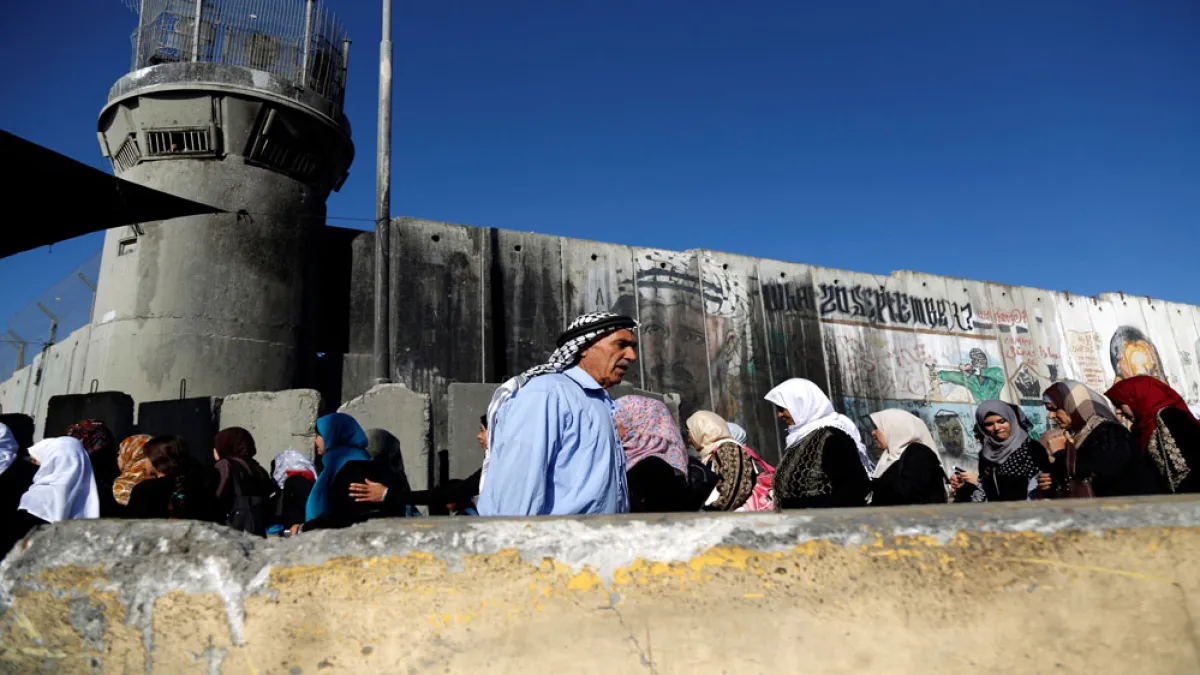
Israel has closed crossings into the occupied West Bank for a week, further restricting Palestinian movement and access to holy sites during the Jewish holiday of Sukkot.
Defence Minister Israel Katz ordered the closure on Sunday following a recommendation from the military. It is due to remain in force until Saturday, with existing checkpoints and barriers tightened across the territory.
The restrictions affect access to the Al-Aqsa Mosque in occupied East Jerusalem and the Ibrahimi Mosque in Hebron. They also prevent most Palestinians with permits to work in Israel or Israeli settlements from entering.
Only workers classified as essential are being allowed into Israeli industrial zones in the West Bank, according to the information available.
Israeli forces blocked roads and sealed entrances to the towns of Turmus Aya, Aboud, Nabi Saleh, Atara and Taybeh in the Ramallah and el-Bireh governorate on Sunday. Checkpoints were also established in Yabroud, Ein Siniya and Jaba, where soldiers searched vehicles and checked identity documents.
More than 300 checkpoints across the West Bank
Palestinians already face an extensive network of Israeli checkpoints and other obstacles, which restrict travel between towns, major roads and East Jerusalem.
The UN Office for the Coordination of Humanitarian Affairs says there are more than 300 checkpoints among 925 movement obstacles across the West Bank and East Jerusalem, affecting about 3.4 million Palestinians.
Of the checkpoints, 89 are permanently staffed, while 218 operate intermittently. Of those partial checkpoints, 152 have gates, with 90 usually open and 62 frequently closed.
The wider network also includes 232 road gates, 114 linear closures such as earth walls, road barriers and trenches, 167 earth mounds and 105 roadblocks.
The restrictions can force people to take longer routes to work and school and make it harder to reach medical care.
Key crossing points include Qalandiya, the main route between Ramallah and East Jerusalem; Checkpoint 300 between Bethlehem and Jerusalem; Eyal, used by workers from Qalqilya and the northern West Bank; Taybeh, south of Tulkarem; and Tarqumiyah, near Hebron.
Impact on Palestinian workers
Palestinians in the West Bank have long sought employment in Israel because of high unemployment and lower wages at home. Before the war in Gaza began in October 2023, about 160,000 West Bank Palestinians worked for Israeli employers, most inside Israel and the remainder in settlements, according to the Palestinian Institute for Economic Policy Research.
After Israel barred most permit holders from entering, the number had fallen to about 27,300 by the middle of 2024. Unemployment in the West Bank rose from 12.9% in September 2023 to 30.7% a year later, according to the Israeli rights group Gisha.
