


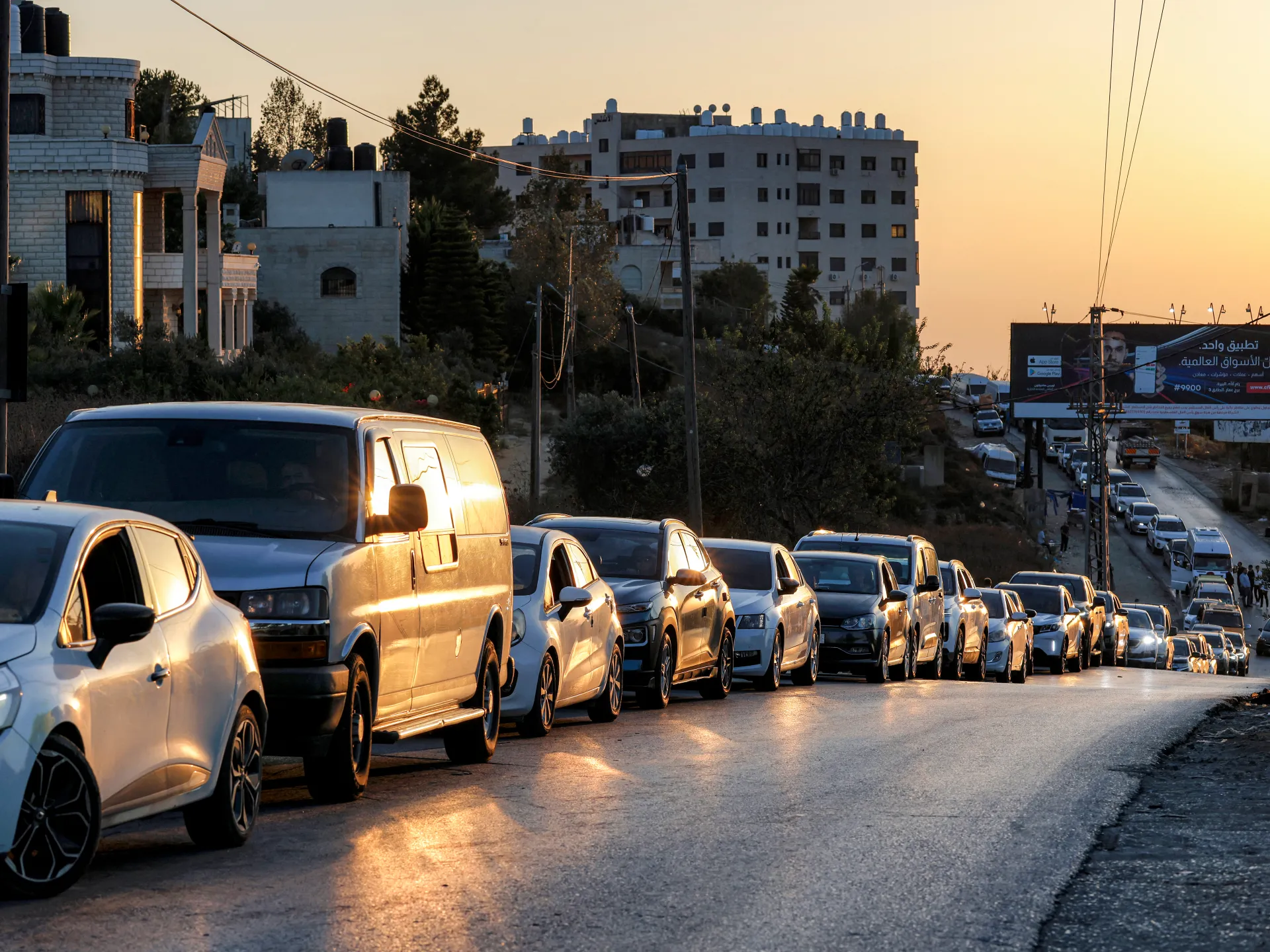
West Bank road closures have turned short journeys into lengthy ordeals for Palestinians, with families reporting stranded travellers, disrupted access to essential services and fatal delays in medical emergencies.
Mohammed Abu Hijleh said his 66-year-old mother, Zahriya, died after the ambulance taking her to hospital was unable to pass through an Israeli-controlled gate in the town of Deir Istiya, northwest of Salfit.
Zahriya collapsed at her niece’s wedding reception on September 20. A doctor at the local medical centre ordered her immediate transfer to Salfit Governmental Hospital, about eight minutes away by road.
But the ambulance requested by her son could not enter Deir Istiya because the iron gate at the town’s entrance was closed. A medical centre vehicle carried her to the gate, where she was taken off the stretcher, carried through on foot and placed in a second ambulance waiting on the other side.
Her family said medics later determined that she had suffered a pulmonary embolism and needed urgent treatment.
“My mother was breathing her last; had the gate been open, we wouldn’t have lost her on the way,” Mohammed said.
He added: “Sadly, she died due to the delay. She had no prior health issues other than diabetes.”
Checkpoints and closures divide communities
Military checkpoints and iron gates across the occupied West Bank regularly interrupt journeys to work, schools, universities and hospitals, according to Palestinian residents and organisations monitoring movement restrictions.
Israel periodically imposes wider closures across the territory, including during Jewish holidays. The current closure runs from September 27 to October 3 during the festival of Sukkot.
Palestinians say the restrictions are applied while Israeli settlers are able to travel between West Bank cities. They also allege that settlers have blocked roads serving Palestinian communities under the protection of Israeli soldiers.
Ibtihal Mansour, from Nablus, said her family became trapped while returning from the village of al-Janiya, near Ramallah, last Friday.
They left at 10am expecting the journey to take about 45 minutes, but found the Atara and Ein Siniya checkpoints closed. Attempts to use roads west of Ramallah also failed, she said, after the route between Ramallah and Nablus was blocked.
“We remained on the roads, trying to find any way through, until midnight, a span of more than 14 hours,” she said.
Mansour said her children were exhausted and crying after spending so long inside the vehicle. At a roadblock near Nablus, in the area of al-Lubban Asharqiya, she alleged that a soldier punched her 11-year-old son on the head when he failed to wake up.
“The scene was heartbreaking; I felt a deep lump in my throat and profound sorrow. Long hours of waiting in the vehicle ended with an assault like this, and the ordeal didn’t even end there,” she said.
The family was forced to turn back and spend the night at a relative’s home in Ramallah before continuing to Nablus the following morning, she said.
Other Palestinians caught by closures have been compelled to stay with relatives or in hotels. Some municipalities have turned wedding halls and mosques into temporary shelters, with residents providing food for people stranded near checkpoints.
The Colonization and Wall Resistance Commission recorded 942 checkpoints, closure points and other obstacles across the occupied West Bank on September 25. That figure was 793 in March 2024.
The combined length of the obstacles is about 107.7km, according to the UN Office for the Coordination of Humanitarian Affairs. The commission said the restrictions fragmented Palestinian communities and made access to work, education, healthcare and farmland dependent on whether roads and crossings were open.
Restrictions tighten in Hebron and East Jerusalem
In Hebron, where Israeli settlers live in the centre of the Old City, the Israeli army has closed the Ibrahimi Mosque to Palestinians and tightened restrictions at nearby checkpoints and gates until Wednesday.
Issa Amro, coordinator of the Youth Against Settlements group, said soldiers had closed checkpoints and imposed curfews in several neighbourhoods, making it harder for residents to reach the Old City and the mosque.
“The area west of the mosque contains settlements and closed zones, while access from the east is limited to a few roads. These measures make reaching the site both more difficult and more dangerous,” he said.
In occupied East Jerusalem, Palestinian activists said movement restrictions had also been imposed around the Al-Aqsa Mosque during the Jewish holidays. Fakhri Abu Diab said Israeli settlers and hardliners were able to enter the site or attend religious rituals while Palestinians were required to remain at home.
He said the closures had affected shops, schools and workplaces, as well as restricting movement through the city.
“Israeli police restrict the movement of Jerusalemites. Families and vehicles attempting to move about risk being attacked by extremists and settlers, while the latter are permitted to roam freely and dominate the streets,” Abu Diab said.
Israeli authorities had not responded to allegations about the closures and incidents described by Palestinians.
