


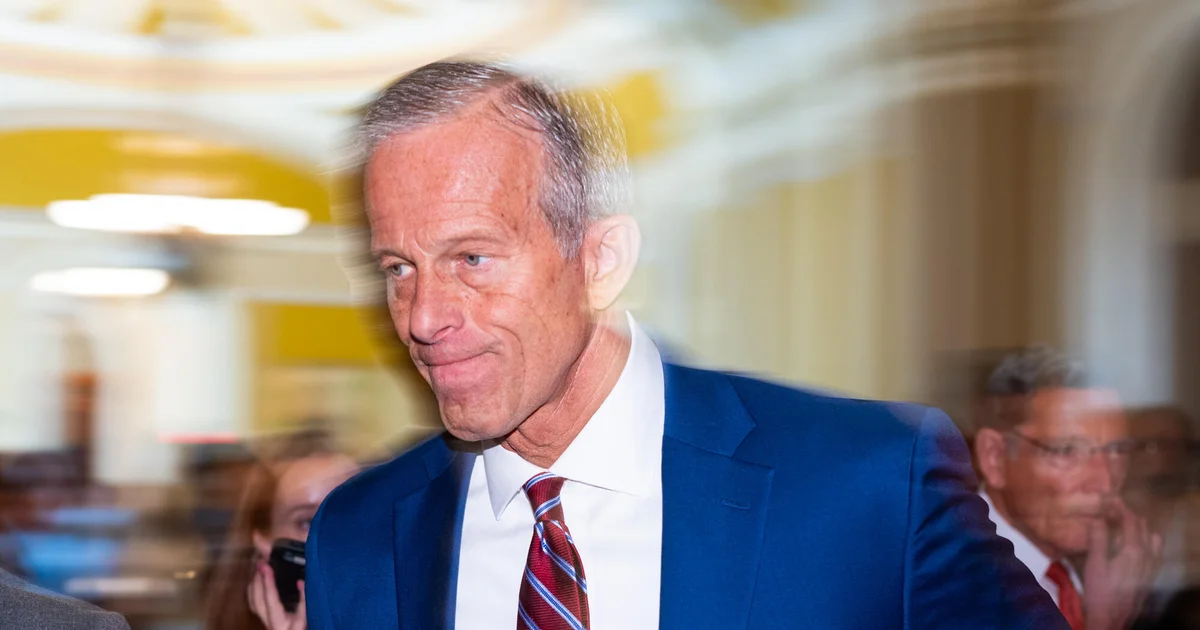
The US Senate midterm elections will test whether John Thune’s careful effort to advance Donald Trump’s agenda while protecting the chamber’s independence has worked, as Republicans fight to retain their majority.
Thune, the Senate majority leader, has spent almost two years navigating pressure from the White House, divisions within his own party and an increasingly difficult political climate shaped by the war with Iran and high petrol prices.
At a campaign event in Sioux City, Iowa, he stood alongside Republican representative Ashley Hinson, who is running for the Senate, as she defended her approach of supporting the president when she agreed with him and acting as “a thorn in his side” when she did not.
The exchange reflected the dilemma facing Republican candidates across the country. They must retain the support of Mr Trump’s political base while addressing voters’ concerns about the conflict and the cost of fuel.
Thune has argued that Republicans can campaign on the administration’s legislative record while allowing candidates to establish their own identities. “The president’s going to be a factor in every election,” he said. “But I think they need to be their own person, and I think that’s the best way to win.”
John Thune’s balancing act
The South Dakota Republican, 65, was chosen by his colleagues to replace Mitch McConnell as Senate leader after the 2024 election. He was seen as a pragmatic and restrained figure at a time when the Republican Party was increasingly shaped by Mr Trump’s more confrontational style.
Thune is a conservative who has helped pass much of the president’s programme, including tax, border security and defence measures. The Senate has also approved bipartisan legislation on housing, stablecoins, revenge pornography and fentanyl.
His leadership has involved repeated overnight voting sessions and difficult negotiations within a 53-member Republican conference, where he can afford to lose only three votes on most measures.
Colleagues from both parties have described him as calm, respectful and personally well liked. Senator Mike Rounds called him “steady” and said he did not lose his temper easily, while Ohio Republican Bernie Moreno described him as “a very kind human being”.
Yet Thune’s approach has angered some conservatives who want a more aggressive champion of the president’s priorities. Senator John Kennedy of Louisiana has criticised him as “too cautious”, while the South Dakota Republican Party considered a resolution accusing him of obstructing Mr Trump’s agenda. Delegates rejected the motion.
Thune has defended his record, saying Republicans had secured victories “pretty much at every turn”. He has also insisted that the Senate must not become a replica of the House of Representatives.
His defence of the legislative filibuster has been a particular source of tension with Mr Trump, who has repeatedly urged Republicans to remove the procedural rule. Thune has said Democrats might try to “steal the car”, but that Republicans were “not going to hand them the keys”.
The disagreement came into sharper view during a dispute over the SAVE America Act, a controversial elections bill which Thune believed did not have enough support to pass. Mr Trump pressed Republicans to back the legislation and publicly expressed frustration with the Senate leader.
On one occasion, the president cancelled a planned signing ceremony for a housing bill after demanding that the elections measure be approved first. He then attended a Republican Senate lunch, where he criticised members who had supported efforts to limit his war powers and clashed with Senator Bill Cassidy of Louisiana.
Thune has rarely confronted the president directly. His response has generally been to work privately with senators, assess whether measures have enough support and attempt to keep the Senate moving.
“We do things differently, which frustrates people, the president, for example, who wants to get his agenda done quickly,” he said. “That’s not the nature of the beast in the Senate.”
War and petrol prices reshape the Senate race
The Republican electoral map appeared favourable after the 2024 election, but the party now faces a far more uncertain contest. The war with Iran has damaged the political position of the administration and contributed to persistently high petrol prices, giving Democrats an opening in several competitive states.
Republican senators have largely remained united behind the president during more than a dozen votes seeking to restrain his war powers. Only a small number have broken with the White House, leaving the party exposed to criticism over its handling of the conflict and its economic consequences.
Senator John Curtis of Utah told constituents that Republicans had failed to address affordability, pointing specifically to high petrol and diesel prices. He warned that voters would make their views clear at the ballot box.
Thune has acknowledged the immediate difficulty but said the party’s economic agenda had created the conditions for future growth. He has urged voters to look beyond the current pressure on household budgets and consider what Republicans say they have achieved.
“Nothing’s a guarantee. There are no layups,” he said as senators prepared to leave Washington for the campaign trail.
Political analyst Kyle Kondik said Republicans faced a serious risk of losing the majority. In his assessment, a defeat would be more likely to reflect the president’s handling of Iran and the resulting petrol-price problem than a lack of Republican campaign funds.
Republican candidates under pressure
Thune has spent the final stages of the campaign supporting Republican candidates in states including Iowa, Michigan, Georgia, Minnesota, South Carolina, Florida, Nebraska, Kentucky and Mississippi.
He moved early to back Hinson in Iowa and Mike Rogers in Michigan, two contests opened by Senate retirements. He also helped secure Mr Trump’s endorsement for both candidates, despite their previous distance from the president’s 2024 campaign.
Other recruitment efforts were less successful. A bid to persuade Georgia governor Brian Kemp to enter the race failed, while the president’s decision to endorse Ken Paxton over Senator John Cornyn in Texas created a costly and divisive primary contest.
In North Carolina, the main Republican Senate political action committee reduced its spending on behalf of candidate Michael Whatley, suggesting that the party’s prospects there had weakened.
Alex Latcham, executive director of the Senate Leadership Fund, credited Thune with building a strong slate of candidates and securing a substantial financial advantage. But whether that will be enough remains uncertain.
The Senate leader has told candidates to run their own campaigns rather than rely entirely on Mr Trump. That strategy may allow vulnerable Republicans to distance themselves from the administration’s least popular policies, but it also risks appearing inconsistent after two years in which the Senate majority approved much of the president’s programme.
The question voters will answer is whether Republicans can support Mr Trump’s policies while separating themselves from the war, high energy prices and the controversies surrounding his administration.
Thune’s future after the midterms
The election will also help determine Thune’s position within the Republican Party. He has indicated that he expects to seek another term as Senate leader, although he has said the result will influence the decision of his colleagues.
There has been no clear sign that Republican senators intend to replace him. But a heavy defeat could intensify criticism of his leadership and invite intervention from the White House.
Mr Trump declined to endorse Thune for another term as leader in August, although he later defended him after a crowd aligned with the Make America Great Again movement booed his name at a Republican convention.
Thune has said he does not rely on presidential backing. Asked whether he expected Mr Trump’s support, he replied: “Hard to say. I don’t know. I mean, I don’t bank on it. But yeah, if he found his way to do that, that’d be great.”
His colleagues recognise the difficulty of managing a conference in which, as Mr Moreno put it, there are “53 Republicans with 175 ideas”.
Thune’s supporters argue that his low-key style has enabled the Senate to pass legislation despite the party’s narrow margin and the unpredictable demands of the White House. His critics believe he has not pushed the Republican agenda forcefully enough or resisted the president clearly enough.
With the majority at stake, voters are now set to judge both arguments. The result will determine not only which party controls the Senate, but also whether Thune’s restrained partnership with Mr Trump has secured his position or exposed its limits.
