


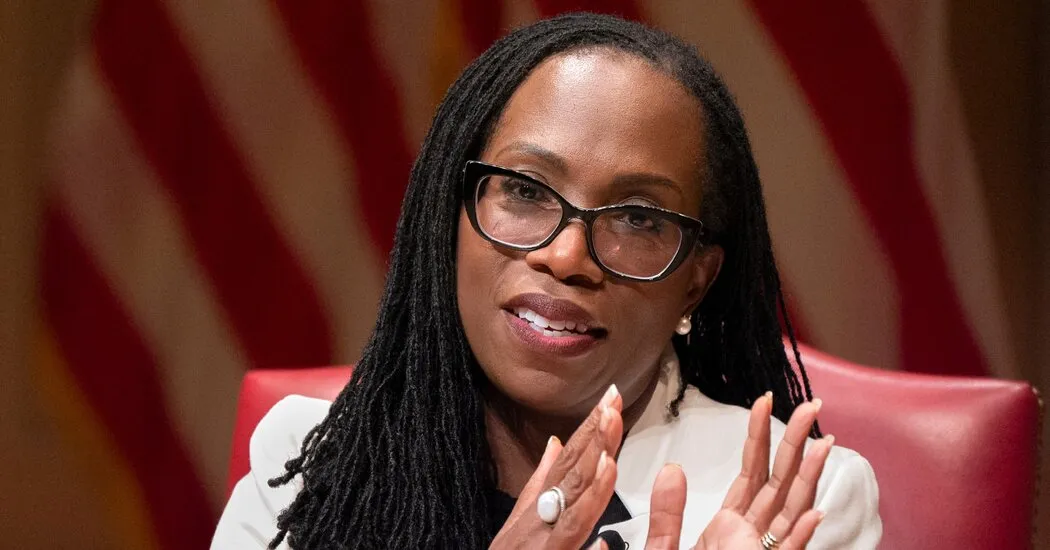
Justice Ketanji Brown Jackson has sharply criticised the Supreme Court’s emergency docket, warning that its increasingly rapid intervention in major cases could damage public confidence in the US judicial system.
Speaking at an annual civil rights and civil liberties lecture hosted by the University of the District of Columbia’s law school, Justice Jackson said the court could not expect the public to trust it if it repeatedly approved harmful actions “without clear explanation” and without a full hearing.
She said there was “a serious concern” that the way the emergency docket was being used was having “an enormously disruptive and potentially corrosive effect” on the federal court system. Her remarks were greeted by cheers and an ovation from an audience that included several hundred students from the historically Black law school.
The speech came roughly two hours after Justice Jackson had considered the latest high-profile emergency application, submitted by the Trump administration. It asked the Supreme Court to allow the rapid deportation of immigrants to countries other than their own to continue.
Justice Jackson did not refer directly to that application. Instead, she criticised a wider pattern in which the court has used “truncated procedures” to rule on consequential disputes before lower courts have completed their work.
Concerns over the Supreme Court’s emergency docket
Cases on the emergency docket are generally decided far more quickly than those on the court’s normal merits docket. They may be considered without the extensive written submissions and oral arguments that usually precede a full ruling.
The Trump administration has submitted about 30 emergency applications during President Trump’s first year in office. The court has granted many of them, enabling the administration to put policies into effect temporarily while their legality is examined by lower courts.
Justice Jackson said the court’s willingness to intervene early risked weakening the authority of those lower courts. Its “new approach”, she said, “often lacks any acknowledgment of the harms that follow when the Supreme Court consistently and casually divests the lower courts” of their power.
She called for a better system governing when emergency requests should be accepted and how they should be decided. The court, she suggested, should be prepared to wait for cases to progress through the lower courts, even when doing so was difficult.
“If we’re not careful, the emergency docket can and will become an end run around the standard review process, a special avenue that certain privileged litigants can use selectively,” Justice Jackson said. “Why is it that one party should get a fast pass to the Supreme Court of the United States when so many other parties are queued up, waiting patiently for the court’s attention?”
She noted that the court receives thousands of ordinary petitions for review each year but typically agrees to hear only about 60. That disparity, she said, raised the risk that the court could be seen as failing to provide equal justice.
All three liberal justices have criticised the handling of the emergency docket, although Justice Elena Kagan said this summer that she believed the court had improved its approach. More recent emergency rulings have included some reasoning, she noted.
Justice Jackson acknowledged that development, saying the court had “began to explain more”. But she added that the explanations were “still not the full kind of explanation” provided in cases on the regular docket, while describing the change as “a good and positive development”.
Appointed by President Joseph R Biden Jr in 2022, Justice Jackson is the court’s newest member and has become its most vocal public critic over the use of emergency procedures, both in speeches and in written opinions.
While she was addressing the issue in Washington, Chief Justice John G Roberts Jr and Justices Amy Coney Barrett and Brett M Kavanaugh were attending a White House state dinner for Chinese President Xi Jinping.
