


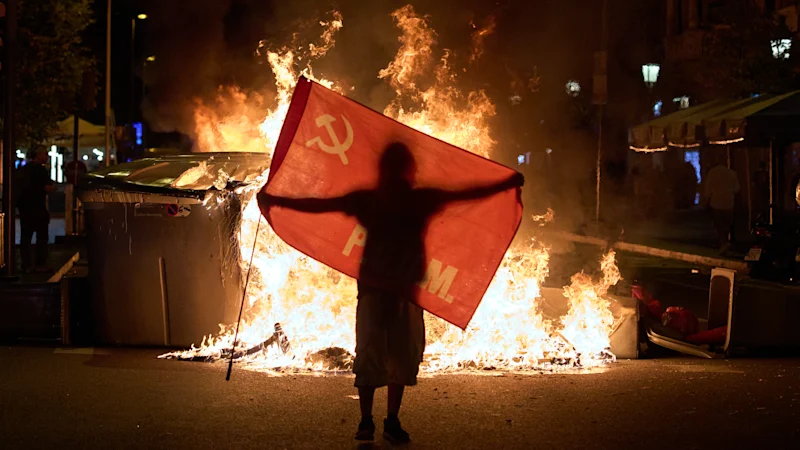
A protest over Spain’s housing crisis turned violent in Barcelona after masked demonstrators clashed with police, set fire to cars and rubbish bins, and confronted officers following Prime Minister Pedro Sánchez’s decision to call an early general election.
About 20,000 people attended the largely peaceful demonstration, according to Barcelona’s Guardia Urbana police, although organisers claimed the turnout was as high as 120,000. Police said 30 officers were injured and 13 people were arrested.
The unrest came a day after Mr Sánchez announced that Spaniards would vote on November 29, following the rejection of his government’s proposed housing reforms in parliament. The measures included rent caps and restrictions on corporate property purchases.
Violence broke out after many demonstrators had left the rally, when activists stepped up their actions around Passeig de Gràcia, one of the city’s main thoroughfares. Some protesters were seen waving banners linked to the Workers’ Party of Marxist Unification, or POUM, which traces its history to the Spanish Civil War.
Housing crisis dominates Spain’s election campaign
The demonstration was organised by Barcelona’s tenants union, the Sindicat de Llogateres, which called for a general strike over housing and urged governments to reduce rents and living costs.
The issue was pushed to the top of Spain’s political agenda after an attempted eviction involving an 87-year-old woman, Maricarmen Abascal, in central Madrid last month. Her building had been bought by a real estate firm, prompting nationwide protests over corporate ownership and rising housing costs.
Mr Sánchez, who has led Spain since 2018, said the country needed to keep advancing on affordable housing, public services and social rights. “It’s time to mobilise. It’s time to fight. On November 29, we’re going to make history. Again,” he said.
The Socialist leader enters the campaign behind the opposition People’s Party and its leader, Alberto Núñez Feijóo. Recent polls cited in the report put support for the People’s Party at about 33 per cent, compared with roughly 26 per cent for the Socialists.
Mr Feijóo has promised an alternative housing programme that would involve building 250,000 homes a year, which he said would help create 600,000 jobs. “If Spaniards give me their trust, my priority, my success, will be housing policy,” he said.
Despite the parliamentary setback, the Sánchez government plans to press ahead with its housing measures. Culture Minister Ernest Urtasun said decrees would be submitted to a reduced body of caretaker legislators remaining in place after parliament was dissolved for the election.
The housing decrees are expected to operate temporarily until a new parliament is formed, with the standing body of 69 members holding a slim majority in favour of the measures.
