


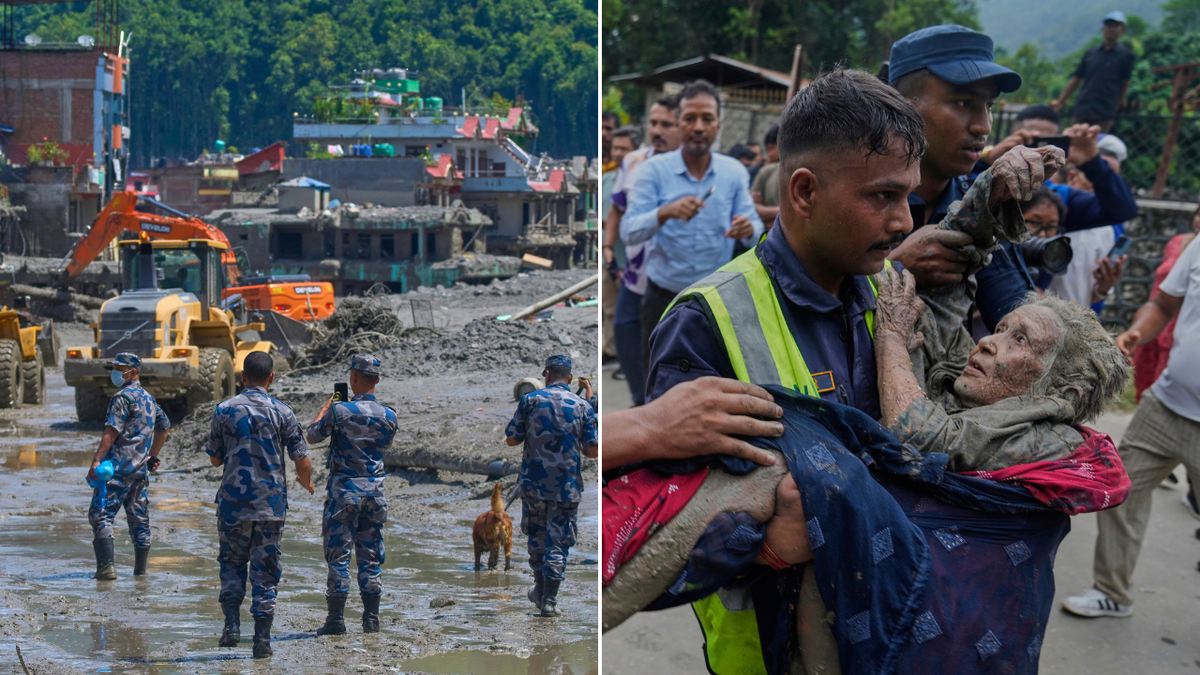
Mud-covered ruins, destroyed homes and heartbroken survivors paint a grim picture of the devastation left behind by Nepal’s catastrophic floods, as experts work to determine what caused the disaster.
Thirty-four Australians are missing and more than 350 bodies have been found along the Himalayan border after a wall of mud and rock collapsed into a river on Wednesday.
Rescue efforts to find hundreds more missing are ongoing to minimise loss of life and find those cut off from friends and family.
Know the news with the 7NEWS app: Download today Arrow
‘Exploded like a bomb’
For one survivor, Janak Bahadur it was a tale of disaster when a glacier high in the Himalaya rumbled loose sending a torrent of ice roaring down the mountain.
At one stage it registered as an earthquake, but it was a tsunami of water, ice and debris. It became clogged in waterways before the wall of terror burst through narrow valleys.
The mountains either side were so steep which created a flood of terrifying force rocketing into villages and homes along the river which reached levels higher than nine metres within 30 minutes.
“It (floods) came in suddenly and exploded like a bomb,” Janak Bahadur told Reuters.


“The river looked small from distance but it suddenly started overflowing and swept through this place.”
“We are facing a lot of challenges and the biggest one being blocked roads… as of now, we are not able to tell how many people are still stuck or buried under the debris as there is no way to reach the spot,” said another survivor.
Authorities said Friday morning that more than 1300 people are missing, including more than 700 foreigners. The latest body count was 359 with experts warning the death toll will likely continue rising.
Conditions in the Himalaya are changing rapidly
Experts are now trying to understand the “ice avalanche” that has caused such widespread destruction and devastation.
University of Auckland Associate Professor in River Science Jon Tunnicliffe explained the event was a “hazard cascade” where instability high on a glacierised slope becomes an ice–rock avalanche, it then can block a river, entrain water and sediment, and transform into a debris-laden flood travelling tens of kilometres downstream.
“There is an important climate-change context here, but we need to be careful about attribution. We do not yet know why this particular glacier failed,” Tunnicliffe said.


“What we do know is that conditions across the Hindu Kush Himalaya are changing rapidly.
“Glaciers are retreating, permafrost is degrading, new lakes are forming and steep slopes are being exposed and destabilised.
“Climate change can amplify hazards that already exist by altering the thresholds at which one process triggers another.”
What happens now?
Tunnicliffe explained that sediment is a crucial part of why this particular event became so destructive as once rocks, gravel and boulders became engulfed in the water flow it becomes a fast-moving tsunami of devastation.
It holds the power to destroy buildings, bridges and more infrastructure as seen in the Nepali disaster.
“A major event changes the landscape in ways that can generate further hazards over the following days, weeks and sometimes years,” he said.


Although the conversation now remains around rescue efforts and finding those missing, Tunnicliffe says the event should raise awareness around monitoring hazard claims rather than individual hazards.
“Satellite monitoring can identify changing glaciers, lakes and unstable slopes and quickly establish what has happened after an event. That needs to be combined with seismic monitoring, river gauges and warning systems capable of detecting a cascade once it begins,” he said.


Swinburne structural engineer Dr Prashidha Khatiwada, whose home village Siddhalek has been badly affected, reiterated the need to look at each contributing factor as a whole to understand what happened.
“From an engineering perspective, the important lesson is that we cannot continue looking at climate change, earthquakes, landslides and floods independently,” he said.
“Nature does not separate these hazards: one event can trigger another and create a much larger cascading disaster.”
“Nepal needs better multi-hazard mapping, monitoring and early-warning systems, stronger land-use planning and infrastructure designed with these changing hazards in mind.
“Communities also need to know what warnings mean and how to respond. Nepal needs development, but if we rebuild without understanding why this event became so destructive, we risk rebuilding the same vulnerabilities.
“The goal should not simply be to rebuild what was lost, but to rebuild safer and more resilient communities.”
Australians waiting for news of those missing
Australian families are still waiting for news of those missing in Nepal including 15 people with a tour group in the country.
The group had been staying in a four-storey concrete building and had just finished breakfast when the disaster struck.
Tour operator Sagar Pandey has hired a helicopter to search for the missing group.
“All the buildings, all the hotels, all the civilisations, both on the Chinese and Nepal side, have been swept away and there is nothing is left,” Pandey told 7NEWS.


Chitrak Sharma from Sydney is waiting for news of his parents, Umesh and Krishna, who were among the group.
“I’m just trying to get in touch with my parents. I just want to know that they’re OK.
“I just want to hear their voice again. I just want to talk to them again. I want to see them again.”
With AAP, CNN.
