


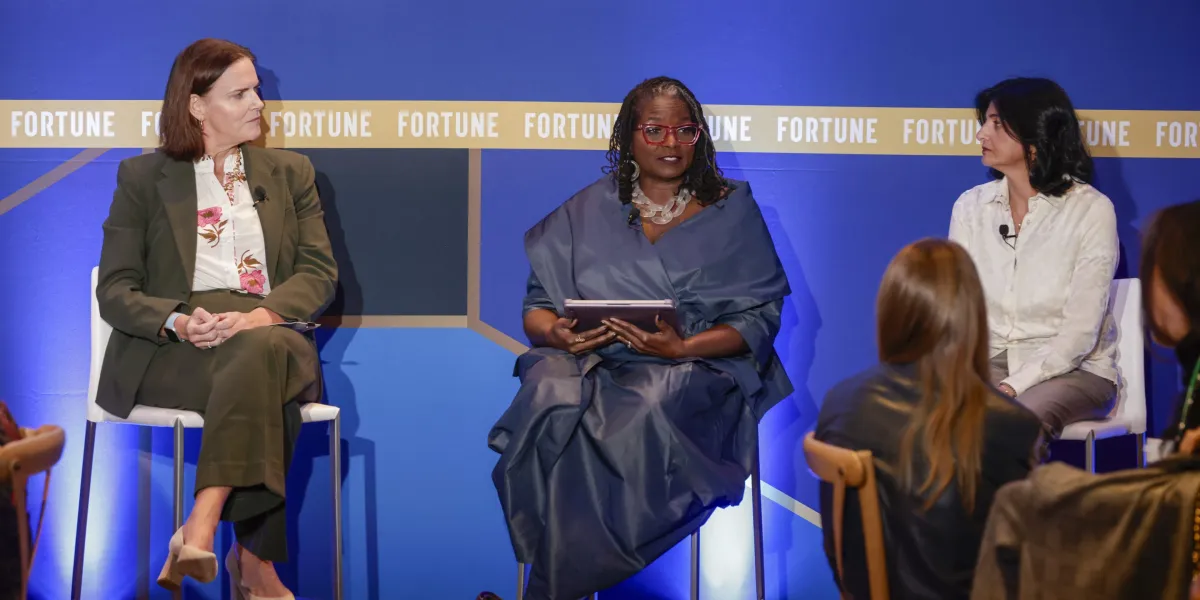
The Great Wealth Transfer is expected to reshape how money is invested and spent, with women set to receive a substantial share of the estimated $124 trillion passed down by 2048, executives said at a conference in Santa Barbara.
Beth Meagher, Deloitte’s US federal health sector leader, said around $54 trillion could go to women, while $52 trillion is expected to pass to children and $18 trillion to charity, citing estimates from Cerulli Associates.
She also highlighted the growth of women entrepreneurs, describing them as one of the fastest-growing sources of concentrated wealth after an increase of more than 125 per cent over the past decade. Women who have served in the military have also recorded growth of roughly 300 per cent over the past couple of years, she said.
“These trends are changing everything,” Ms Meagher told Diane Brady, Fortune’s executive editorial director. “I think we spend a lot of time on frontier models, and we probably spend a lot of time on geopolitical [issues]. And this shift is something that I think we have a tremendous opportunity to lead from the front of.”
Women investors seek greater influence and impact
Seema Hingorani, a managing director and senior client adviser at Morgan Stanley, said she identified a lack of women in investment management more than a decade ago while working at the New York City Pension Fund.
Asset managers visiting her had few, if any, women on their investment teams. When the imbalance was attributed to a “pipeline issue”, Ms Hingorani said she rejected that explanation and founded Girls Who Invest in 2011.
About 5,000 women at university have passed through the programme since then. It receives around 4,000 applications each year and supports 700 women annually.
Morgan Stanley has also operated an incubator for seven years to help invest in women founding technology businesses. Ms Hingorani said that as those companies grow into billion-dollar firms, their founders would be looking for women to help guide their financial decisions.
“[Women are] going to have all the wealth,” she said. “If you had a choice, would you want to have a woman financial advisor? A lot of firms out there are hiring all my women, because they get it.”
Carmen James Randolph, founding president and chief executive of the Women’s Foundation of the South, said the changing distribution of wealth was also altering expectations around philanthropy.
She said the South was one of the fastest-growing regions in the US and was home to 41.5 per cent of the country’s women of colour. In her view, newer recipients of wealth increasingly wanted to see a direct impact from their giving rather than treating philanthropy simply as charity.
“I’ve worked in philanthropy now for about 28 years, and I understand that at its best, philanthropy can be a catalyst for what’s possible,” Ms Randolph said. “They want to understand and see firsthand the impact that their dollars can have.”
Ms Meagher said women preparing to inherit substantial wealth were particularly focused on health, education and justice. Wealth advisers were also beginning to offer health services, she said, while Ms Randolph’s foundation was prioritising maternal healthcare in southern states where access to routine and emergency treatment could be difficult.
Ms Hingorani added that every trustee she worked with had shown an interest in affordable housing, even where that could produce a smaller return than a venture capital fund.
“Women are looking to pull their investments so that they can have an outsized impact,” Ms Meagher said.
