


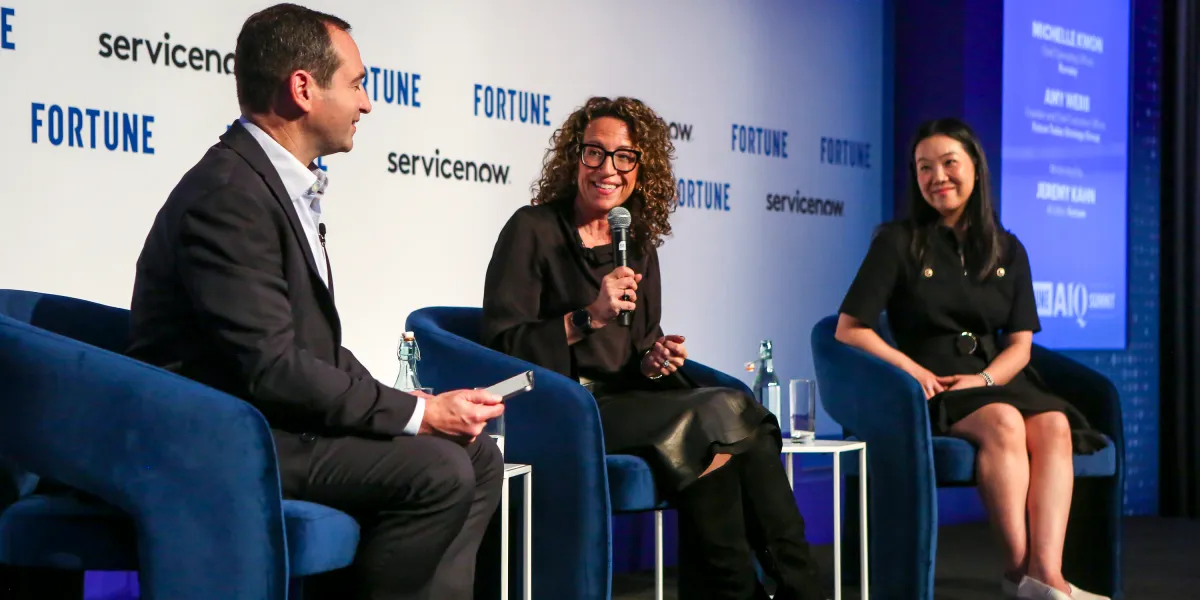
AI transformation will depend less on how many tools companies deploy than on whether they redesign the way work is done, business leaders told Fortune’s AIQ Summit at the New York Stock Exchange.
Executives from technology, finance, industrial operations, travel and human resources said organisations needed to combine process reform with workforce development, reliable data, effective governance and strict control of costs if they were to turn experimentation into measurable value.
From AI pilots to business transformation
Diana David, director of futures at ServiceNow, said the companies making the greatest progress were investing in people and operational discipline rather than treating access to software as evidence of maturity.
ServiceNow’s Enterprise AI Maturity Index found that 57% of so-called “pacesetters” invested in continuing AI skills development, compared with 4% of other organisations. The gap was also marked in the recruitment and retention of AI talent, at 68% for pacesetters against 10% for other companies.
“Talent investment. That was the biggest gap,” Ms David said.
She warned that giving employees access to AI tools did not automatically improve productivity. “95% of everybody has X, Y, Z,” she said. “But it is not translating into productivity, and it’s often not with training, and that doesn’t equal maturity.”
Paul Fipps, president of global customer operations at ServiceNow, said companies would gain more by rebuilding processes around AI than by simply automating existing procedures.
“If I just automate or drive autonomous agents to drive the current processes I have, that’s a choice that might get some productivity bump,” he said. “But the ones that are actually rethinking and reimagining the business processes … are really making the difference.”
He argued that businesses should apply AI across functions including human resources, legal and technology, rather than confining it to isolated departments. At Standard Chartered, he said, AI had helped deflect 77% of employee requests.
Amy Webb, founder and chief executive of Future Today Strategy Group, said many large companies had invested heavily in pilots without putting in place the strategy and leadership needed to make them deliver lasting benefits.
“Let’s be fair, Fortune 500 companies are pretty late to the party on this,” she said. “Artificial intelligence didn’t just show up a couple of years ago.”
The workforce challenge
Speakers said AI transformation was also a workforce transformation, requiring employees to learn new skills and reconsider processes that had previously been taken for granted.
Stacy Dillow, executive vice-president and chief people officer at HPE, said businesses risked achieving little if they simply inserted AI into existing systems.
“We’ve got to force ourselves to think differently, because if we’re not trying to change how we work, we’re just trying to retrofit and put AI in a process that isn’t going to give us a different answer,” she said.
Danielle Gonzalez, chief people officer at Palo Alto Networks, said a bespoke AI agent had cut IT tickets by 83% and was supporting work across human resources, finance and legal.
She said employers needed people who could adapt quickly, including workers able to question assumptions that no longer applied. “We’re looking for curiosity,” she said. “We’re looking for agency, and we’re looking for those people who can not only learn something at a fast rate … but also unlearn what they thought to be true, so that they can make space to move forward.”
Drew Holler, chief human resources officer at Lennar, said responsibility for developing those skills rested with employers and staff alike. “We’re going to give you all the tools, but it’s your responsibility to upskill yourself as well,” he said.
There were also warnings that the ability to create more content and products could generate fresh pressure on employees. Francis Shanahan, chief technology officer at Peloton, said staff were “inundated now because they can literally build anything”, with “burnout” becoming more of an issue.
Michelle Kwon, chief operating officer at Runway, said the volume of AI use should not be mistaken for improved performance. “Just because you are using AI, that is not a proxy for your productivity or for doing a good job at work,” she said.
Governance and trust
Executives at the summit said firms should not use AI simply because it was available, particularly where decisions involved financial, legal or operational risks.
Hari Gopalkrishnan, chief technology and information officer at Bank of America, said conventional technology could sometimes be the more effective answer.
“One of the biggest mistakes we see ourselves and others doing is rushing to AI as a solution, when deterministic models do a plenty good job,” he said.
Bank of America assesses projects against 16 risk areas, including privacy, bias, workforce impact and intellectual property. Mr Gopalkrishnan said the bank was concentrating on assistive systems in which people remained involved, rather than rushing towards fully autonomous operations.
Sally Moore, chief client officer and co-head of market intelligence at Kensho Data & Platforms, part of S&P Global, said the usefulness of AI depended on the quality and reliability of the information on which it was built.
Clients working in regulated environments needed accuracy, citations, auditability and the ability to trace information back to its source, she said. “Data is the currency within AI,” Ms Moore added.
Mr Fipps said governance should be viewed as a means of enabling innovation rather than delaying it. “I see governance and trust driving speed,” he said, pointing to a regulated bank that had created dozens of agents but was unable to deploy them because its leaders lacked confidence in the controls around them.
AI in industrial and regulated settings
The demands are particularly high when AI is used in buildings, factories, water systems and other environments where an error can cause immediate disruption or safety concerns.
Suresh Venkatarayalu, chief technology officer at Honeywell Technologies, said industrial customers required reliability of “99.9999%”, while frontier models “could be at 85%”.
He said the near-term goal was more likely to be a “semi-autonomous world” than one in which people were removed entirely from operations. In commercial buildings and industrial facilities, he said, human oversight remained essential because downtime could have immediate consequences.
AJ Wijesinghe, chief AI officer at Ecolab, said the cost of using the most advanced model for every task could quickly become uneconomic. When the company used “the best model that’s out there” for high-volume work, “the tokenomics go off the roof”, he said. “Sometimes it’s more expensive than having humans.”
Ecolab responded by adjusting how it used different models and reduced token costs by about 70% to 80%. Mr Wijesinghe said companies did not always need the most sophisticated available system: “Sometimes you don’t have to have the fastest car.”
Measuring returns and controlling costs
Business leaders said the next stage of AI adoption would be judged by measurable returns, rather than the size of pilot programmes or the amount of content produced.
Ewout Steenbergen, executive vice-president and chief financial officer at Booking Holdings, said uncertainty over returns remained widespread, including among the major technology companies investing hundreds of billions of dollars in large language models.
For Booking, he said, the focus was on redesigning processes “from a white sheet”. Customer-service costs were slightly down while bookings were growing at a high-single-digit rate, he said, and customer satisfaction had increased.
The company’s approximately 9,000 engineers were also getting about 30% more code into production, based on merge requests that passed testing and quality controls.
“The returns will be there for those processes that are being redesigned end to end,” Mr Steenbergen said, “but you also have to make sure that those costs on the other hand are not going out of control.”
Booking uses lower-cost models for simpler tasks and reserves more expensive systems for work requiring greater reasoning capability, an approach Mr Steenbergen described as effective model cost routing.
He said AI could also help travel companies improve planning, booking and responses to disruption. While “the hotel is still the hotel, and the airline is still the airline, and the rental car is still the rental car”, he said, better-connected services could create “more loyalty, more trust, and more brand value”.
The discussions at the AIQ Summit pointed to a common conclusion: successful AI adoption will depend on organisations changing how they operate, while investing in their people, maintaining oversight and ensuring that the financial and practical benefits can be demonstrated.
