


The Trump administration has suspended Microsoft from the US labour programme used by employers to sponsor foreign-born staff for permanent residency, preventing the company from filing or progressing new applications for green cards.
Vice President JD Vance announced the move on October 8, naming Microsoft alongside Adobe and six IT services companies: Cognizant, Infosys, Tata Consultancy Services, Wipro, HCL Technologies and Capgemini.
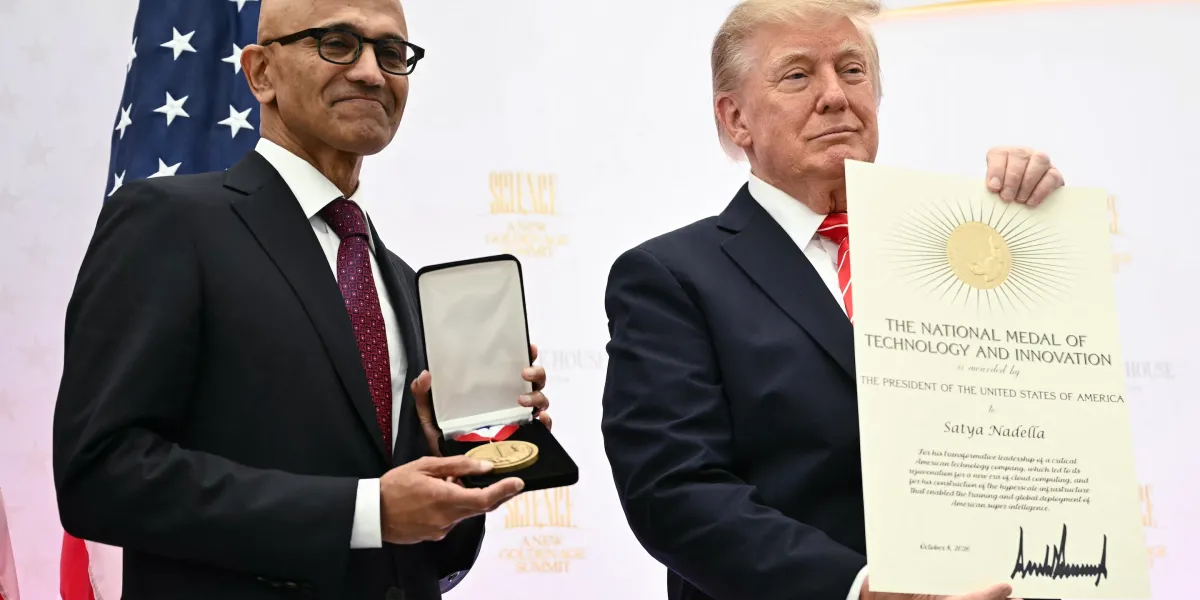
The decision came hours before President Donald Trump presented Microsoft chief executive Satya Nadella with the National Medal of Technology and Innovation, one of the country’s highest honours for innovation.
What the Microsoft PERM suspension means
The Labour Department said it would not accept new applications from the eight companies under the Permanent Labour Certification programme, known as PERM, or process applications already in the pipeline.
PERM is generally the first stage of an employer-sponsored green card application. Companies must advertise a role and demonstrate that no qualified and available US worker can fill it before seeking permanent residency for a foreign employee.
The suspension does not affect H-1B visas, which are temporary work permits overseen by US Citizenship and Immigration Services. Many applicants for permanent residency are already employed in the US on H-1B visas.
Microsoft was the programme’s biggest user, with the Labour Department ruling on 3,161 of its PERM applications in the financial year ending in September 2025.
Asked how long the suspension would remain in place, Mr Vance said it would “last as long as it needs to”, adding that the administration had “a number of tools to suspend it indefinitely”.
Doug Rand, a former senior adviser to US Citizenship and Immigration Services, described the measure as “incoherent”, arguing that a green card allows a worker to stop depending on a single employer for their immigration status.
Vance accuses Microsoft of abusing the system
At a White House news conference, Mr Vance said the H-1B visa was the route by which workers entered the country, while PERM was the mechanism that allowed them to remain permanently.
“Now there has been no company in the United States, unfortunately, that has abused the system more than Microsoft,” he said.
Mr Vance claimed Microsoft had laid off 6,000 American workers while benefiting from 6,300 H-1B visas and almost 3,000 green cards. He said that amounted to replacing “for every worker that Microsoft laid off” with “one and a half foreign indentured servants”.
The White House has not provided evidence of fraud by Microsoft. Federal figures show the company received 6,258 H-1B approvals in the 2025 financial year, placing it third behind Amazon and Meta, neither of which was suspended.
About two-thirds of Microsoft’s approvals were for people already working at the company. Mr Vance acknowledged that Microsoft was “a great American company” and said the administration had “a great relationship with them”, but added that it would block permanent residency applications until the firm showed it was serious about putting American workers first.
Microsoft said the “vast majority” of its US employees were American and that it looked forward to providing the administration with further information.
Of roughly 6,000 H-1B applications submitted by the company in the last financial year, 80 per cent were to extend or change the status of existing employees, Microsoft said. The remaining applications concerned new employees who were already legally in the US and represented 1 per cent of its US workforce.
The company also rejected any suggestion that its visa holders were underpaid, saying it paid them the same as other employees doing comparable work and that its wages were among the highest in H-1B filings. Microsoft did not directly address the PERM suspension.
Nadella’s route to the top of Microsoft
The decision has particular resonance for Mr Nadella, who was born in Hyderabad, India, and moved to the US in 1988 to study computer science. He joined Microsoft in 1992 after working at Sun Microsystems and became chief executive in 2014.
In his 2017 memoir, Mr Nadella wrote that he gave up his green card in 1994 so his wife, Anu, could join him in the US after her visa application was rejected because she was married to a green card holder.
He reverted to an H-1B visa, later regained permanent residency and eventually became a US citizen. The PERM programme did not exist at the time, but the broader route from temporary work visa to employer-sponsored residency is followed by many foreign-born Microsoft employees.
Mr Nadella has not publicly commented on the suspension. He thanked Mr Trump for the medal on X, saying he was “humbled to stand alongside so many giants of American innovation”.
Presenting the award at the Golden Age of American Innovation Summit, Mr Trump called Mr Nadella “a key figure in the transformation of Microsoft”, praising the company’s software and its impact on businesses, students and consumers worldwide.
Mr Nadella shared the technology medal with Michael Dell. Mr Trump also awarded the National Medal of Science to Elon Musk, Sergey Brin, Jensen Huang and Lisa Su. Only Mr Dell among the six recipients was born in the US.
