


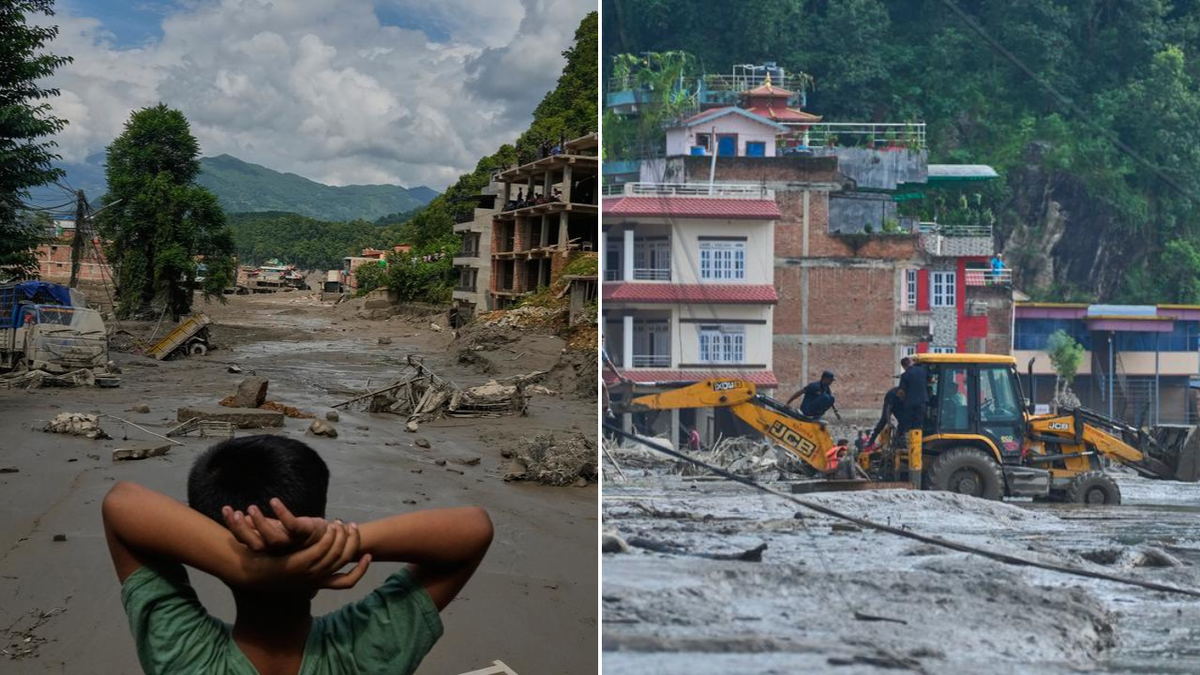
The number of Australians missing in the catastrophic Nepal-Tibet floods has risen to 39.
Foreign Minister Penny Wong confirmed the figure in a statement on Friday morning, announcing a $5 million humanitarian assistance package and additional personnel to help respond to the disaster.
“We understand at least 39 Australians are among those reported missing. Australian officials are working urgently to confirm their welfare and provide assistance to those affected,” Wong said.
Know the news with the 7NEWS app: Download today Arrow
“The extraordinary scale of this disaster and the remoteness of the affected region mean immense challenges lie ahead for the response and recovery.”
The floods have swept away villages, damaged critical infrastructure and displaced thousands of people on both sides of the Nepal-China border.
Destroyed roads and bridges have left many communities isolated, making it difficult for emergency assistance to reach those affected.
Emergency teams deployed
The Department of Foreign Affairs and Trade is deploying personnel to support Australians caught up in the disaster.
A Crisis Response Team member and a Regional Consular Officer are already on the ground in Kathmandu, joining staff at the Australian Embassy in Nepal.
Australia will also send an initial team of three humanitarian response specialists within the next 48 hours to assist staff already in the country.
Drawn from the Australia Assists program, the Rapid Response Team brings expertise in humanitarian assessment, logistics, communications and planning.
“The Australian Government is rapidly mobilising consular and humanitarian support in response to the catastrophic floods along the Nepal-China border, including through a $5 million assistance package for affected communities,” Wong said.
Desperate search as death toll passes 390
Rescue teams and military helicopters searched Thursday for hundreds of missing people along the mountainous Nepal-China border, where a deadly torrent of water and mud several stories high swept through communities a day earlier following a glacier collapse.
More than 390 people were killed, and more than 1,400 were missing, according to authorities in Nepal and China.
Videos showed people running before floodwaters swallowed them up and washed away buildings and bridges.
Images showed what appeared to be the second floors of buildings in Nepal’s hard-hit Nuwakot district slathered in mud after the torrent rushed through.

Riverbanks and village streets were covered in mud, while debris hung from tree branches and wires. Vehicles were buried and stunned survivors were caked in mud.
The steep slopes and valleys below the Himalayan mountain range are especially vulnerable to flooding and landslides.
Nepalese officials said dozens of bridges were destroyed and nearly 40km of roads damaged, complicating search efforts.
The Nepalese army has rescued more than 100 people by helicopter, army spokesperson Brigadier General Raja Ram Basnet said.
Army teams also evacuated people trapped inside facilities linked to the Trishuli hydropower project, while dozens of injured people were transported to Kathmandu for medical care.
Rescuers found bodies in Chitwan district, hundreds of kilometres downstream from the hardest-hit areas.
$5 million in humanitarian aid
Australia’s funding will be delivered through established partners to support urgent disaster response and recovery efforts, including food, emergency shelter, clean water and sanitation.
The World Food Programme will receive $2 million, having already dispatched food rations and provided logistics support for Nepal’s emergency response.
A further $2 million will go to Australian non-government organisations through the Australian Humanitarian Partnership.
That funding will support assistance, including emergency shelter, hygiene kits, blankets, medical care and psychosocial support.
The remaining $1 million will go to the Emergency Action Alliance to support locally led recovery and rehabilitation in affected areas.
“These floods have devastated communities along both sides of the border, sweeping away villages, damaging critical infrastructure, and leaving thousands displaced,” Wong said.
“With roads and bridges destroyed, many communities remain isolated and difficult to reach, underscoring the need for rapid humanitarian assistance.”
Australians wishing to donate can visit the Emergency Action Alliance website.
Families wait for news
Among those missing are 517 foreigners, according to Nepal’s tourism board.
They include 178 people from India, more than 60 from the US, and people from 30 other countries, including Ukraine, the UK, South Africa and Japan, the board said.
Many may have been on a pilgrimage to Mount Kailash in Tibet, a sacred site for Hindus, Buddhists and others.
A group of 77 pilgrims was caught in the floods at the immigration office at the border, according to a post on X from Indian spiritual guru Sadhguru Jaggi Vasudev.

Across the disaster zone, families were waiting to hear whether their loved ones were alive.
Shova Shrestha, 33, has spent more than a day seeking word of her husband, Rajan Shrestha.
She said his phone rang when she first called after the floods, but later became unreachable.
Since then, she has watched every helicopter landing in Bidur, the capital of Nuwakot district, hoping he might be among the survivors.
“I keep looking at each helicopter, hoping he will step out of it,” Shova said.
-With AP
