


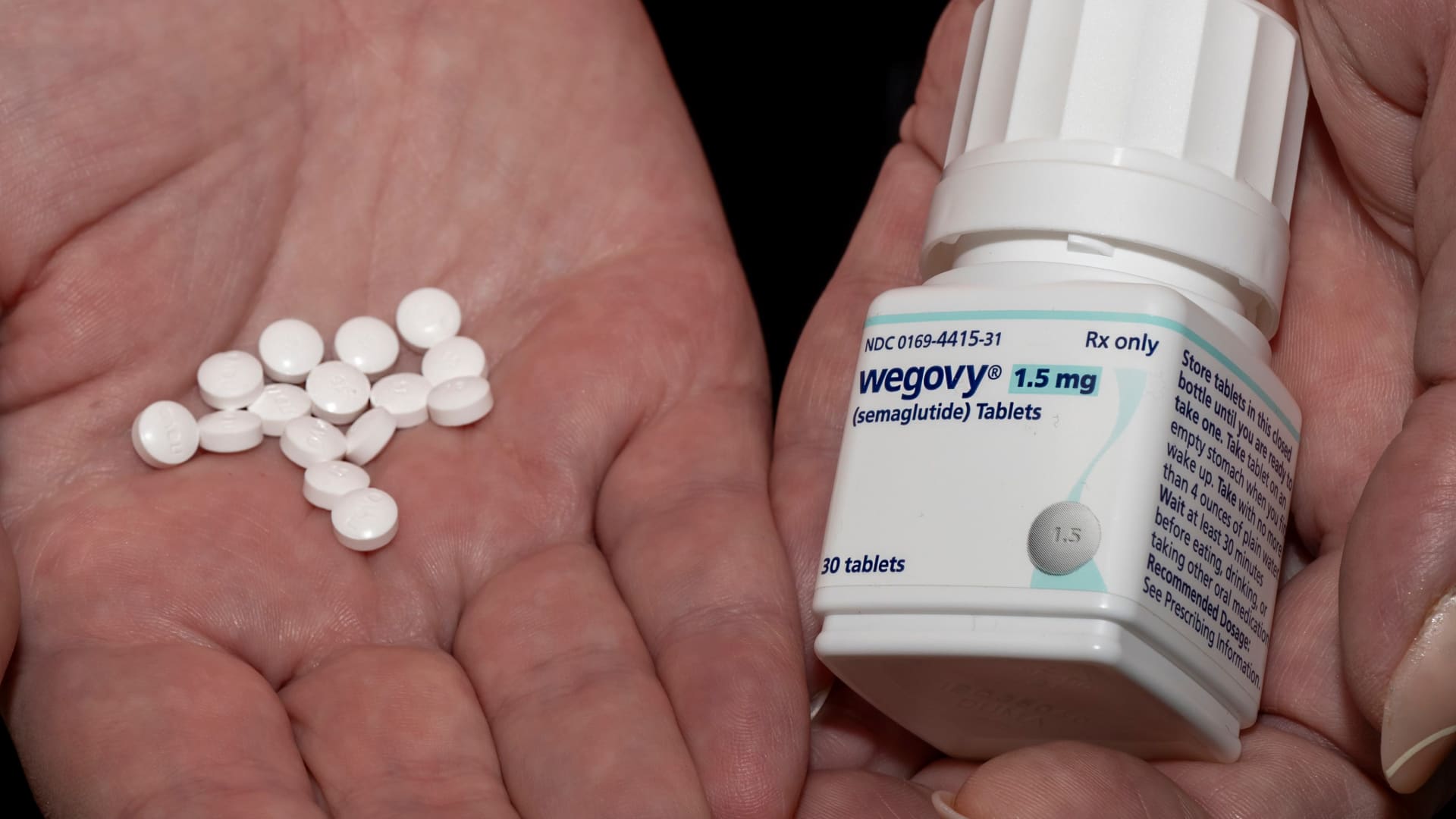
People who switched from obesity injections to Novo Nordisk’s Wegovy pill continued to lose weight over the following three months, according to an analysis of real-world data presented by the company.
Patients lost about 4% of their weight on average after changing treatment, equivalent to an additional 8.8lb based on an average starting weight of about 221lb. The findings suggest the tablet may extend the weight loss achieved with injections rather than simply maintain it.
The analysis covered 194 people who were overweight or living with obesity and receiving care through Ro’s telehealth platform. About 56% were women, with half having initially used Novo’s Wegovy injection and the remainder having taken Eli Lilly’s rival Zepbound injection.
Among those who switched to the Wegovy pill and remained on treatment for three months, two in five achieved at least 5% further weight loss. The proportion of participants with a body mass index of 30 or above also fell by more than 21% during that period.
Martin Holst Lange, Novo’s chief scientific officer, said patients could move between the injection and tablet while expecting “the same tolerability profile, the same safety profile, and actually a little bit more weight loss, which is what a lot of them want”.
About 82% of participants with available information reported at least one improvement while taking the pill. Almost 70% said their clothes fitted better, while roughly 51% reported pursuing healthier eating. Around three quarters said they were satisfied with switching to a tablet.
Mr Lange said the company was now seeing a clear preference for oral treatments, including among people who travelled frequently and did not want to consider how to refrigerate injections.
Real-world Wegovy pill data has limitations
The analysis is among the first real-world assessments of weight-loss outcomes for people moving from Wegovy or Zepbound injections to the Wegovy pill. However, Novo said the data had limitations, including differences in when information was collected and how complete it was during routine telehealth care.
Some information was self-reported, making it vulnerable to bias, and the company said the results might not apply to the wider population. Real-world studies can identify associations but cannot establish that a treatment directly caused the observed changes.
The findings were among several datasets on Novo’s obesity and diabetes pipeline presented this week at the European Association for the Study of Diabetes meeting in Milan.
