


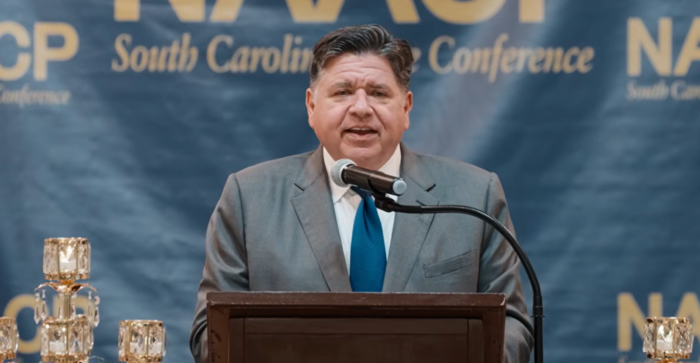
JB Pritzker is spending at least $38 million of his personal fortune on Black and Hispanic candidates in key US midterm races, a strategy that could strengthen the Illinois governor’s prospects among crucial Democratic voters if he seeks the presidency in 2028.
Much of the money is being directed towards candidates who have received limited support from national Democrats, including contenders in Republican-leaning districts that have become competitive. Pritzker is also backing campaigns in all six early states on the Democratic presidential nomination calendar.
The calendar was rearranged earlier this year to give prominent places to South Carolina, Nevada, New Mexico, Virginia and Michigan, states with significant Black or Hispanic communities.
Pritzker, a billionaire and potential 2028 presidential contender, has insisted that his priority is the 2026 election. Asked how his spending might prepare the ground for a White House campaign, he said he was “focused on winning in 2026”.
But some of the candidates receiving his support believe the effort should earn him serious consideration for the Democratic nomination.
Pritzker backs candidates in difficult races
His newly formed super PAC, Ready for the Fight, is supporting Representative Shomari Figures, a Black Democrat defending his seat in Alabama after Republicans redrew the district to reduce its Black population.
Figures said Pritzker was among the first people to contact him after the Supreme Court decision that affected the district, offering financial and political support.
“The fact that he reached out and engaged us through that lens with that level of knowledge about what was happening in Alabama meant a lot to us,” Figures said.
Pritzker has committed $1.6 million to Figures’ campaign. He is also spending $1.9 million to support Tennessee state representative Justin Pearson, a Black candidate running in a newly redrawn district that includes part of Memphis.
In Arkansas, Pritzker has put $1.3 million behind Democrat Chris Jones in his challenge to Republican Representative French Hill in Little Rock. The spending makes Pritzker the biggest Democratic donor in all three districts, apart from the Democratic Congressional Campaign Committee.
“Governor Pritzker is playing a very important role,” Figures said. “He actually cares and is… willing to invest in districts where minority candidates have a good shot if they have the right type of support. I think that’s an important element of any leadership.”
Pritzker said Ready for the Fight was concentrating on Republican-leaning seats that would normally be “out of sight for Democrats”, but which had become winnable in a favourable midterm environment.
Black and Hispanic voters central to 2028 strategy
The governor has also spent $2.8 million supporting New Mexico Representative Gabe Vasquez. In Nevada, he personally gave $400,000 to a super PAC backing Aaron Ford, a Black candidate running for governor in a heavily Hispanic state that holds an early primary.
In Texas, Pritzker is the largest individual donor to Gina Hinojosa’s campaign for governor. He gave $200,000 before pledging a further $1 million earlier this month, with the second contribution matched by the Democratic Governors Association.
“The opportunity for her to win and for Democrats to win as a result of her winning is tremendous,” Pritzker said. “From my perspective, we all ought to be helping somebody like that to overcome the odds.”
He said he was attempting to compensate for a lack of national funding in some difficult contests, where Democratic candidates could be outspent by Republicans by three or four to one.
“If I were running in one of those districts, and I’m not getting dollars that I see going to other districts, I would feel frustrated,” he said. “There’s only so much you can do when you’re being outspent three to one or four to one nationally, and so I’m trying to do my best to fill in some of that wherever I can.”
South Carolina Representative Jim Clyburn, one of the Democratic Party’s most senior Black leaders, said Pritzker should be taken seriously as a potential presidential candidate. But he warned that financial support alone would not determine how Black voters and organisers assessed contenders.
“People tend to take notice of the people who take notice of them,” Clyburn said.
He added: “We are going to take measure of candidates, not based upon how deep their pockets are, but we’re going to take measure of how deep their commitments are to those things deemed important in the African American community.”
Pritzker’s most substantial investment this cycle has been in Illinois Lieutenant Governor Julianna Stratton, whom he chose as his running mate in 2018. He spent $10 million helping her win the Democratic primary for the US Senate this spring.
Stratton’s campaign had been boosted over two other candidates, including Representative Robin Kelly, another Black woman whose relationship with Pritzker has been strained. The contest caused frustration among members of the Congressional Black Caucus, although Pritzker has since sought to repair those relationships.
Clyburn, who backed and campaigned for Kelly, said the dispute would not “dictate future relationships when it comes to putting our party in the best position to win the elections in 2028”.
Stratton’s expected election would make her only the sixth Black woman to serve in the US Senate. She could also become an important national surrogate for Pritzker should he decide to run for president.
“He really does have a platform to raise awareness of critical races that people might not otherwise pay attention to,” Stratton said. “I’m really grateful for that.”
