


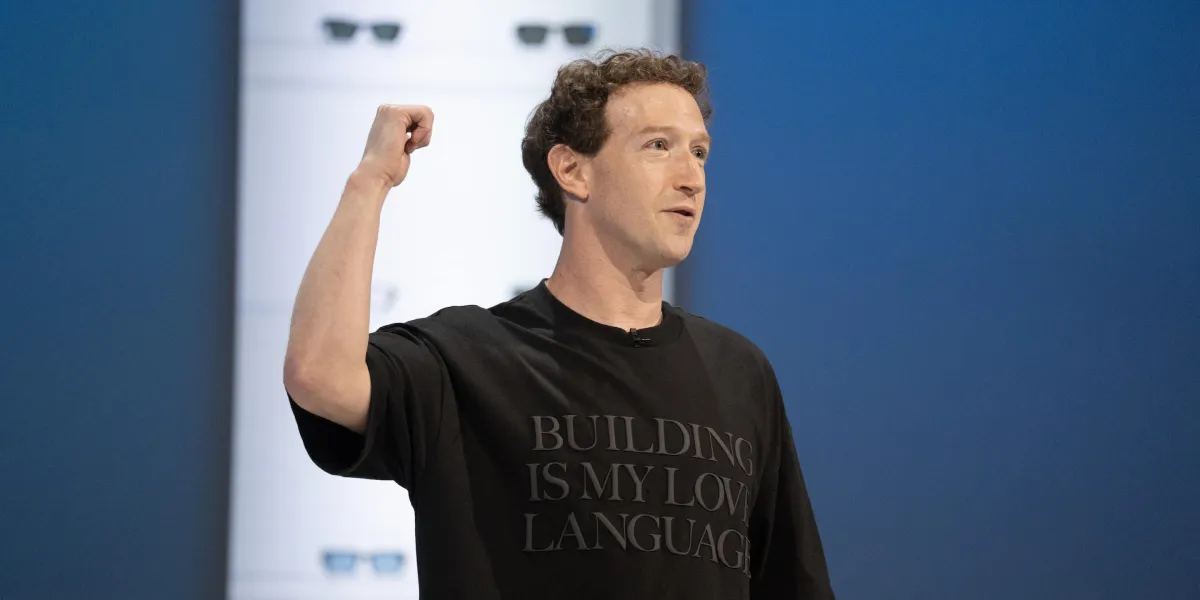
Mark Zuckerberg has acknowledged that Meta’s AI bet involved committing as much as $200 billion before there was evidence that the strategy would work, as the company accelerates spending on data centres, chips and artificial-intelligence infrastructure.
Speaking on Stripe co-founder John Collison’s Cheeky Pint podcast, Meta’s chief executive described the scale of the decision and said he had questioned Alexandr Wang, the company’s chief AI officer, over whether it would succeed.
“We’re going to write this check for, like, I don’t know, like $100 billion, $200 billion,” Zuckerberg said. “I’m like, ‘Alex, are you sure this is going to work?’”
Wang said decisions of that size were made “long before there’s proof points around whether or not even the thing is working”. He described the approach as “the opposite of Lean Startup”.
The podcast episode was released on October 12, the same day Meta launched Muse Wonder, the first frontier-class model from the superintelligence laboratory led by Wang. Meta has forecast capital expenditure of as much as $145 billion this year, much of it directed towards AI infrastructure.
Meta’s full-stack AI strategy
Zuckerberg said Meta was pursuing a “full-stack” operation, building its own data centres, chips and lower-level infrastructure rather than relying entirely on outside providers.
That strategy reflects the company’s experience with Apple and Google, which control the leading smartphone platforms. Meta’s Facebook app launched on the iPhone in 2008 and on Android in 2009, but the company later faced restrictions and disputes over how its services could operate.
In 2021, Apple introduced a measure allowing iPhone users to block apps from tracking them. Meta later said the change would cost it about $10 billion in 2022 alone.
Zuckerberg has previously said that building services within limits imposed by Apple had been one of his “formative experiences”. On the podcast, he said owning the technology stack was “less about wanting to own a platform for its own sake” and more about being able to build the best products.
Unlike Amazon, Microsoft and Google, Meta does not operate a cloud business that rents its data centres to external customers, leaving it to bear the infrastructure costs itself. Zuckerberg said a one-gigawatt AI data centre cost between $50 billion and $60 billion to build and around $15 billion a year to run.
Meta’s Hyperion campus in Louisiana is intended to scale to five gigawatts. The company is also developing a cloud business that would sell AI computing power, while Zuckerberg has presented the spare capacity as a form of protection if Meta’s own AI products fail to meet expectations.
He said that for the investment not to work, “it’s not just that we have to fail, AI overall has to fail”.
Meta looks beyond advertising
The company’s ambitions extend beyond infrastructure. Zuckerberg and Wang want Muse Wonder, and the more powerful Muse Wonder Full, to support Muse, a personal AI agent capable of acting on behalf of users.
Wang said the ideal personal agent should feel like “a team of experts in your corner”, including legal, financial and medical specialists. He said he had used Muse to find increasingly obscure teas, while Zuckerberg said he had used an Instacart account created for the service to order ingredients for baking with his three-year-old daughter.
The development could eventually challenge Meta’s dependence on advertising, which accounted for about 98 per cent of its revenue in the latest quarter. If AI agents compare prices, assess reviews and make purchasing decisions, businesses could have less need to influence consumers through conventional adverts.
Zuckerberg argued that companies were increasingly seeking deeper integration with agents and that the technology could expand commerce overall. He also identified subscriptions as a potential source of revenue, with Muse available free and paid plans priced at $20 and $100 a month for heavier users.
He said Meta could potentially take “a small cut of what you are saving or making for people”, while business agents could generate fees when they delivered results for companies. The impact of agents on the advertising model, which currently provides nearly all Meta’s revenue, remains unresolved.
