


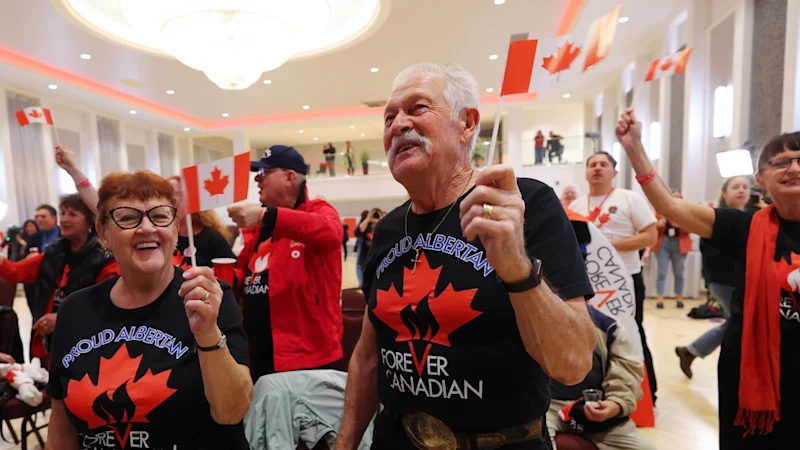
Alberta voters have overwhelmingly rejected a proposal to begin the process towards leaving Canada, delivering a significant boost to Prime Minister Mark Carney’s campaign for national unity.
With more than 1.4 million votes counted, unofficial results showed 76 per cent backing continued membership of Canada and almost 24 per cent supporting a move towards separation. The referendum was not a direct vote on independence; a victory for the separatist side would have paved the way for a future vote on leaving the country.
“Albertans made a clear choice,” Mr Carney said. “They chose unity, to build together, and to take care of each other. Above all, Albertans chose Canada.”
The prime minister said the result would enable the country to move forward together, with efforts to diversify trade, develop major infrastructure projects and make Canada a global energy powerhouse centred on Alberta.
Alberta Premier Danielle Smith, who called the referendum after facing pressure from separatists within her governing United Conservative Party despite opposing independence, said the result represented support for remaining in Canada.
“Albertans have voted for a stronger Alberta in a united Canada,” Ms Smith said in a social media post. She was due to address the province later on Tuesday about the result and Alberta’s future.
Results were delayed after more than 100 polling stations were forced to extend their opening hours because of late starts to voting on Monday.
Alberta separatists vow to continue campaign
Separatist campaigners acknowledged the apparent defeat but argued that the vote had established a lasting political movement. Keith Wilson, one of the movement’s leaders, said at least a quarter of Albertans believed the province needed to be treated better.
“We don’t have the final results. I think the numbers are going to fluctuate, but it is fair to say that at least a quarter of Albertans feel that Alberta needs to be treated better,” he said.
At a separatist gathering in Edmonton, Jeff Rath of the Alberta Prosperity Project said the campaign would continue. “We’re not going anywhere,” he said, adding that the movement had dominated the political conversation over the past year.
Mr Rath said he wanted Ms Smith removed as leader of the United Conservative Party and suggested the party could split, potentially giving rise to a new pro-independence organisation.
The referendum took place in Alberta, a conservative, oil-rich province where resentment towards the federal government in Ottawa is longstanding. Separatist parties have traditionally attracted only a small share of the vote, but anger over Covid restrictions helped mobilise activists who later joined the independence campaign.
Thomas Lukaszuk, a former Alberta deputy premier who led the Forever Canadian campaign, told supporters: “We are a solid country that’s united from coast to coast to coast.”
Mr Carney had urged Albertans to deliver a decisive vote for unity at a rally in Edmonton, where he grew up. His appeal came as US President Donald Trump pursued a trade war with Canada and threatened to make the country the 51st US state.
Some voters said the referendum had arrived at the wrong moment. Dave Malka, 59, from Edmonton, criticised spending money on what he called a “referendum on a referendum” rather than healthcare, while warning that Canada should be united in the face of Mr Trump’s threats.
Jake Graham, 35, from Calgary, said he hoped the result would end the debate. “I hope this squashes this for a long time to come and that it’s clear and decisive, that these grumblings disappear for a while and we can be a united Canada,” he said.
