


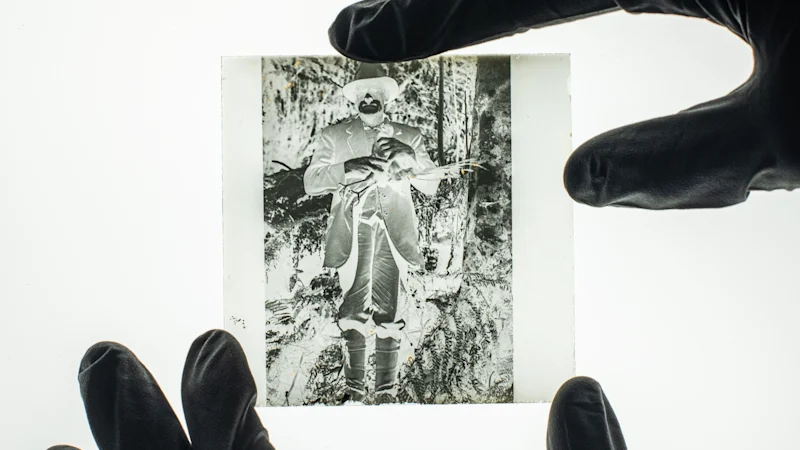
Students at the Australian Museum are digitising the notebooks, photographs and recordings of Michael Sharland, an influential Australian naturalist whose work included helping to make the first live recording of a lyrebird in 1931.
Sharland, who wrote under the name Peregrine, spent decades documenting birdlife across Tasmania, Melbourne, Sydney, Alice Springs, Lake Eyre and Lord Howe Island. His archive includes 30 field diaries, about 2,600 photographic negatives and 1,600 prints, donated to the museum before his death in 1987.
The project comes as Australians take part in the annual Aussie Bird Count, the country’s largest citizen science event. More than a million birds have been recorded this week, with participants carrying out 20-minute surveys in gardens, parks and from balconies.
Last year, 64,000 people took part, producing five million data points. The results help researchers follow bird population trends, identify threatened species and assess the condition of local ecosystems.
Michael Sharland’s bird records brought to life
Darcy Campbell, the museum’s engagement manager for archives, said Sharland’s records remained valuable to scientists. His observations of eggs and nests are still used to examine breeding patterns.
One handwritten entry from 1939 records birds seen around Kellyville in Sydney, including hooded robins, grass parakeets, golden whistlers and black ducks. A map marks black falcon nests and sightings of cuckoo-shrikes, red-backed parrots and striated pardalotes.
Sharland combined meticulous fieldwork with an instinct for storytelling. He would turn quick notes about a lyrebird display into newspaper descriptions of a “concert”, “performance” and “dance”, helping bring his observations to a wider audience.
Student Nidhi Dabadghav said Sharland’s work challenged the idea that naturalists were purely empirical. “He has this very romantic side to him,” she said. “You would think of a scientist and a naturalist as very empirical, but no, he is almost like a poet in the way he writes and even formats his work.”
Sharland wrote for newspapers including The Sydney Morning Herald, campaigning for the expansion of national parks and reporting on subjects ranging from moorhen breeding to the different song “dialects” of grey thrushes in Sydney and Tasmania.
The mile-long wire used to record a lyrebird
His most enduring interest was the lyrebird. Sharland was friends with Tom Tregellas, who lived in a log in the Dandenong Ranges to study the elusive birds at close range.
In 1931, the pair ran a microphone wire more than a mile into the bush to capture the bird’s remarkable call. The recording, broadcast across Australia, included imitations of cockatoos, kookaburras, shrike-thrushes, boobooks, foxes and a nearby quarry.
Lyrebirds had been hunted for their tail feathers and pushed towards extinction by land-clearing. Sharland’s efforts to publicise the species and its extraordinary vocal ability helped build support for its protection.
“He kind of fixated on the lyrebird, I guess because it could represent so many different birds and so many different sounds,” said student Jasmine Digges. “In our work, we’ve said Sharland is a bit of a lyrebird himself because he translates the sounds of the bush to the public.”
The archive work has involved students studying medicine, health and computer science, many of whom had not expected to spend time examining the records of a naturalist from a previous era.
Digges, who is studying medical science, said Sharland’s approach had influenced how she thought about healthcare. “It’s not just a person with a disease you’re dealing with,” she said. “It’s a person who has a whole life, like a bird does, and you should acknowledge that whole lifespan and the way they operate in different facets of that life when you’re thinking about how to treat them.”
