


Last week, in a German town most people couldn’t find on a map, Chancellor Friedrich Merz visited a high school. He spent some of his time with the students talking about the war in Iran. He said the Americans had no exit plan. He said the Iranians were running circles around them. He said an entire country was being humiliated.
Four days later, the Pentagon announced it was pulling 5,000 American soldiers out of Germany.
If that sequence sounds too direct to be coincidence, that’s because it is.
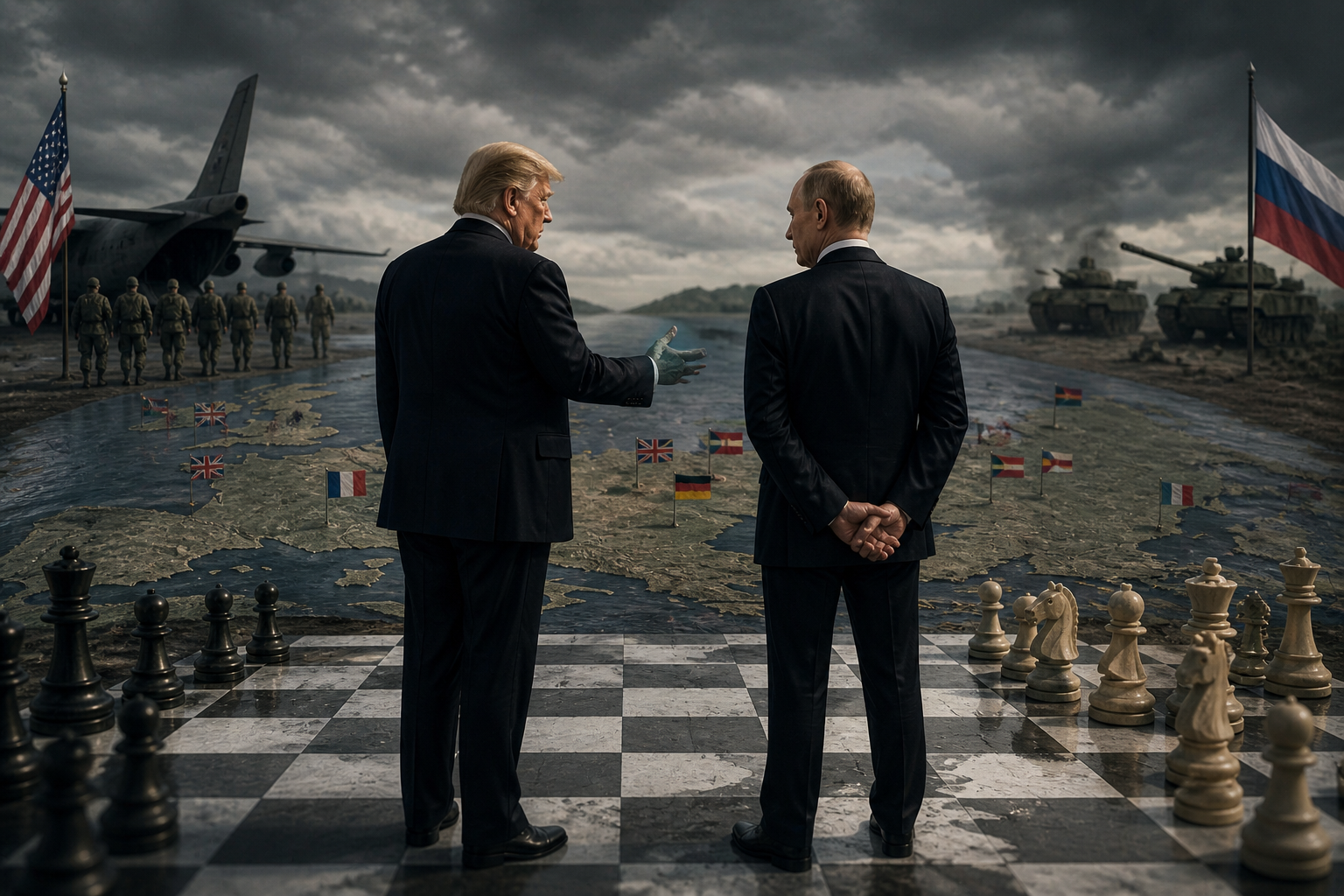
Most of the news coverage you’ll read calls this a “Trump-Merz feud over the Iran war.” Technically that’s correct. Practically it’s missing the point. The personal fight isn’t really the story, and the Iran war isn’t really the story either. The story is that something Europe quietly bet its security on for the last 75 years just got broken in public, on a Friday evening, by a Pentagon press release.
The Bet Nobody Wrote Down
Since World War II, Europe has been running an experiment that nobody actually called an experiment. The deal was understood without ever quite being spoken: European countries would build their economies and their welfare states and their industries, and the Americans would handle the hard part. Defense. Deterrence. The fact that Russia was sitting right there, with a long historical habit of marching west whenever it felt strong enough.
It’s been a very good deal for Europe. Germany rebuilt. France got rich. The Cold War ended without anyone having to fight it. By the 1990s most European armies had quietly shrunk to the point of being almost decorative, and why wouldn’t they? The Americans were never going to leave.
Until now.
The 5,000 soldiers leaving Germany are not, by themselves, a strategic disaster. The US still has around 30,000 troops there after the cut. Logistically, Europe will be fine. But the troops were never really the point of having them. They were the proof of the deal. They were the physical evidence that, however much Trump complained about NATO and however much Americans grumbled about paying for European security, the foundation underneath was still there.
This week the foundation became conditional. That’s the part that matters.
What Iran Has to Do With Troops in Germany (Almost Nothing, and That’s the Problem)
The US and Israel started bombing Iran on February 28. The war has gone badly. Two months in, oil prices are everywhere, the Strait of Hormuz is a mess, and Trump has cancelled at least one round of negotiations. Most European leaders have been saying privately, and a few publicly, that Washington has no exit plan and is being outmaneuvered by Tehran. Merz finally said it out loud, in a high school in Marsberg.
What Trump did next is the thing worth paying attention to. He didn’t argue with Merz on the substance. He didn’t push back on Iran policy. He reached for Germany’s defense and used it as a punishment lever.
That’s new. For 75 years, the United States treated European security as something close to sacred. Tariffs were a tool. Trade deals were a tool. Energy policy was a tool. Soldiers in Germany were not, because everyone understood, on both sides of the Atlantic, that you don’t put your alliance’s foundation up for negotiation. Now it’s a tool. And once a thing becomes a tool, it stays a tool.
A senior Pentagon official told reporters that German rhetoric had been “inappropriate and unhelpful.” If you read between the lines, what that actually means is: criticize American policy in the Middle East, and we’ll quietly reduce your defense against Russia. There isn’t a name for that doctrine yet. Europeans are scrambling to invent one.
Why Putin Is Probably Smiling, Even Though He Isn’t Invading Anyone
Let’s get something out of the way first, because it matters. Putin is not about to invade Poland. He is almost certainly not invading any new country in 2026. The Russians have lost something close to 1.2 million people in Ukraine since 2022. Half a million dead. Their army is being rebuilt because it has to be, not because they want to. Dutch military intelligence, which has been one of the more accurate voices on Russia through this whole mess, said it plainly a couple of weeks ago: as long as Ukraine fights, a conventional Russian war on NATO is essentially impossible.
So no, no tanks rolling toward Warsaw next year. Sleep easy on that.
There’s a more interesting scenario, though. European intelligence services have been quietly converging on it for months, and it’s the one that keeps people awake in Tallinn and Warsaw and the smaller capitals near Russia’s borders.
It goes something like this. Sometime in the next three or four years, the Ukraine war ends, somehow. Russia takes a year or so to catch its breath and rebuild what it can. Then, instead of attempting another big invasion, Moscow does something small. A handful of square kilometers of Estonian territory near the city of Narva, taken by unmarked troops and drones nobody can quite identify. Or a Russian “scientific expedition” that lands on Norway’s Svalbard archipelago and somehow forgets to leave. Something just symbolic enough to demand a NATO response, and just small enough that nobody really wants to die for it.
Then Russia waits. Sits back. Watches whether 32 NATO countries can actually agree, in real time and under pressure, on what Article 5 means.
If they manage it, NATO holds and Putin has wasted his move. If they can’t, NATO is over. Not on paper. Functionally. As a thing anyone is afraid of.
Now picture trying to get 32 countries to agree on something hard, three years from now, after watching the Americans cut their troop presence in Germany as punishment for the German chancellor’s classroom remarks. Picture the calculations being made right now, this weekend, in Berlin and Paris and Rome, about how reliable American backup actually is when push comes to shove.
That’s the calculation Putin has been working toward for years. He didn’t get there this week. But he got closer.
The War That Already Started
There’s a question that keeps showing up in headlines: “Is war coming to Europe?” It’s the wrong question, because the war is already here. It just doesn’t look like the wars in our history books.
Russian sabotage operations in Europe roughly quadrupled between 2023 and 2024, and got worse through 2025. Undersea cables in the Baltic getting cut, with no one ever quite identified as responsible. Warehouses going up in flames in Germany and the UK. GPS signals jamming routinely over Poland and the Nordic countries. Russian fighter jets and drones violating European airspace so often it barely makes the news anymore. Belarus weaponizing migrants at Polish and Lithuanian borders. Cyberattacks on hospitals. Politicians being courted, blackmailed, and very occasionally killed.
This is what experts call hybrid warfare. The more honest description is war that doesn’t look like war. It works because every time Europe doesn’t respond, or responds weakly, Moscow learns the red line was paint and not concrete. Moscow has been learning a lot.
Pulling American troops out of Germany doesn’t start any of this. But it tells everyone watching, in Moscow especially, that the cost of pushing further just dropped.
Germany’s Reaction Is the Most Revealing Part
The thing that should tell you the most about where Europe is going is what Germany did this weekend. Or rather, what it didn’t do.
Defence Minister Boris Pistorius didn’t beg the Americans to reverse the decision. He didn’t go on TV looking shocked or betrayed. He gave a quiet, almost matter-of-fact statement on Saturday morning saying Europeans needed to take more responsibility for their own security, and noted that Germany is on track to grow the Bundeswehr from 185,000 active troops to 260,000. Critics inside Germany were already saying, by Saturday afternoon, that even those numbers are not enough.
That’s not the response of a country that just got blindsided. That’s the response of a country that has been preparing for this moment for at least three years, and is now, in some quiet way, relieved to stop pretending.
Germany has been rearming since 2022, when Olaf Scholz called it a Zeitenwende, a turning point. Poland is now spending more than 4% of GDP on defense, which is more than the United States itself. The Nordics, the Baltics, France, the UK, even Italy are all opening their wallets. The European Defence Fund, the joint procurement initiatives, the restarted munitions production lines: all the things that were considered fantasy bureaucracy five years ago are suddenly serious.
The problem is the timeline. Realistically, Europe needs another four or five years to close the gap on the capabilities only the Americans really provide at scale. Long-range fires. Integrated air defense. Satellite intelligence. Strategic airlift. The unglamorous stuff that wins or loses modern wars. Russia is rebuilding faster than expected. And the United States, which was supposed to be the constant in this equation for the rest of the century, has just demonstrated that it is not constant at all.
Is Trump Helping Putin?
Honestly, the question of whether Trump is deliberately doing Putin’s work for him is one I don’t think anyone outside a very small room can answer, and I’m not sure it matters as much as people want it to. Op-ed writers will argue about it for years. Historians will argue about it longer.
Here is what is just true, regardless of intent. The largest American troop presence in Europe is shrinking. The most important transatlantic relationship is publicly cracked. Patriot missile batteries have already been moved out of Germany to support the Iran war. American security guarantees are now openly conditional on whether your government stays politically friendly with the White House. Every European intelligence service is independently warning that Russia is preparing for something. Hybrid attacks across Europe are getting worse, not better.
You don’t have to believe Trump is working for Putin to notice that the world Putin has been trying to build is closer this Friday than it was last Sunday.
The 5,000 troops will leave Germany over the next year. There’s no particular reason to think they’ll be the last. The American era in European security didn’t end with a treaty signing or a press conference or any of the dramatic things you’d expect from a turning point in history. It ended with a chancellor’s offhand school visit, a Truth Social post written in capital letters, and a Pentagon statement released late on a Friday so it wouldn’t dominate the morning news cycle.
What comes next is going to be decided by Europe, alone, faster than Europeans ever wanted to decide it. Whether that’s a war or just a long, expensive, lonely cold peace, nobody can really say yet. The honest answer is: it depends on whether Europe can stand up faster than the Americans finish walking away.
Putin Doesn’t Need to Invade Europe. Trump Is Doing Half the Work for Him.

Henry
Henry Caldwell is a publisher and news editor dedicated to delivering accurate, timely, and balanced reporting across a wide range of topics. He covers breaking news, world affairs, politics, business, technology, science, health, entertainment, sports, and lifestyle. Committed to responsible journalism and high editorial standards, Henry provides readers with reliable information and clear insights into the stories shaping the world. Through Dispatch Times, he strives to keep audiences informed with comprehensive and trustworthy news coverage
Keep Reading
Add A Comment
Subscribe to Updates
Subscribe to our newsletter and stay updated with the latest news and exclusive offers.
© 2026 Dispatch Times. All rights Reserved.