


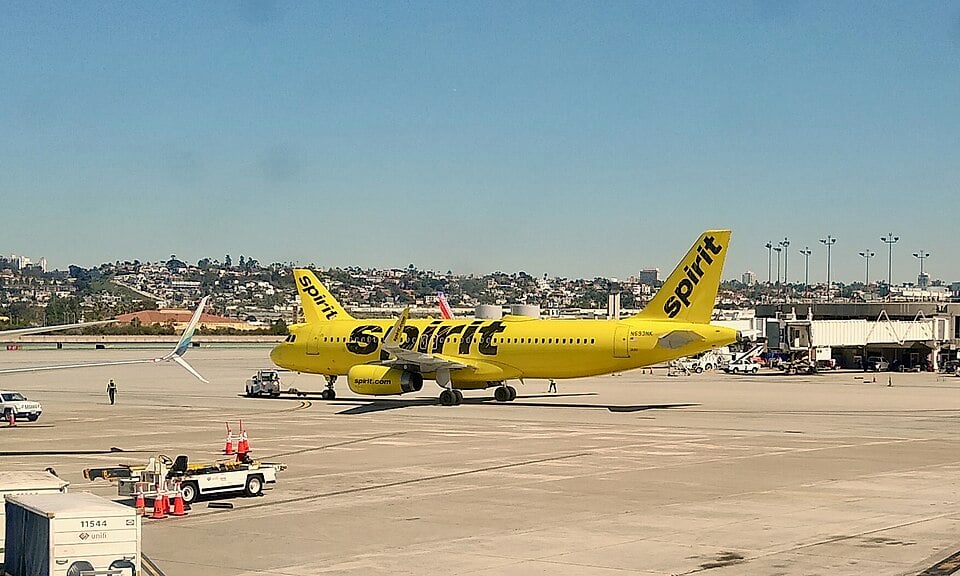
Spirit Airlines has ceased operations and grounded all of its flights, marking the first complete shutdown of a major US carrier since the days following the 9/11 attacks. The collapse will cost 17,000 employees their jobs and leave millions of ticket holders scrambling to rearrange their travel.
In a brief statement issued shortly after 2am Eastern Time on Saturday, the airline confirmed it had begun “an orderly wind-down of our operations, effective immediately”. The notice, posted on a website dedicated to the carrier’s failed bankruptcy proceedings, told customers: “All flights have been cancelled, and customer service is no longer available.” Passengers turning up at airports were warned the airline was “unable to provide service” and advised to “look to rebook your travel on a different airline”.
Closing its statement, the company said it was “proud of the impact of our ultra-low-cost model on the industry over the last 34 years and had hoped to serve our Guests for many years to come”.
The shutdown follows the collapse of last-ditch efforts to secure a rescue package with the Trump administration that would also satisfy a key group of creditors. According to a source familiar with the negotiations cited by CNN, those creditors refused to back a deal that would reportedly have handed the government control of the overwhelming majority of the airline’s shares.
President Donald Trump appeared to soften his earlier support for a bailout in remarks on Friday. “Well, we’re looking at it — but if we can’t make a good deal, no institution’s been able to do it,” he said. “I’d like to save the jobs, but we’ll have an announcement sometime today. We gave them a final proposal.” Just a week earlier, an attorney for Spirit had told a bankruptcy court the airline was in “very advanced discussions” with the administration. The notion of a single-airline bailout had drawn backlash from both rival carriers and Republican members of Congress.
The trigger for the collapse was the war in Iran. Spirit had reached a deal with creditors in February to emerge from its second bankruptcy with reduced debt, but three days later the conflict erupted, choking off roughly 20 per cent of global oil supply and sending jet fuel prices soaring. Fuel — the second largest cost for any airline after labour — has nearly doubled since the war began.
While the wider industry has responded by raising fares and adding fees on items such as checked baggage, fierce competition has prevented carriers from passing on the full cost. Discount operators like Spirit, whose model relies on bargain-hunting passengers, found it especially hard to lift prices. The carrier had been unprofitable since travel collapsed at the start of the Covid-19 pandemic, and had warned repeatedly of “substantial doubt” over its ability to keep flying.
The scale of disruption is significant. According to aviation analytics firm Cirium, Spirit had around 9,000 flights scheduled between Saturday and the end of May, totalling 1.8 million seats. That equates to roughly 300 flights and 60,000 passengers affected each day over the coming month. Industry analysts expect the disappearance of around 2 per cent of US domestic flights this summer to push fares higher across the board, building on increases already driven by the fuel spike.
Spirit has told customers it cannot help rebook flights with rival carriers, but said it would “automatically process refunds for any flights purchased through Spirit with a credit or debit card to the original form of payment”. Those who booked through travel agents have been directed back to those agents. Customers who paid by other means — including cash, vouchers, credits or Free Spirit points — face a longer wait, with their compensation to be “determined at a later date through the bankruptcy court process”. In effect, they now sit alongside other creditors in line for repayment. Travellers stranded mid-trip face the prospect of buying last-minute walk-up fares, the most expensive tickets in the market. The airline confirmed it was unable to reimburse incidental travel costs and advised passengers with travel insurance to contact their providers.
For staff, the news arrived shortly before the public announcement. The leadership of the Association of Flight Attendants sent a message to its 5,000 members at the airline at around 1am, telling them: “We are delivering the hardest news of our lives that Spirit will permanently cease operations at 3:00 AM Eastern Time on May 2.”
Spirit ranked as the eighth-largest US carrier in 2025 by number of seats offered. It was widely credited with pioneering the ultra-low base fare model in the United States, charging extra for items such as carry-on bags — an approach that pushed fares lower across the industry and prompted established carriers to roll out their own “basic economy” tickets.
Bankruptcies are common in the capital-intensive airline industry, with eight major US carriers having filed for Chapter 11 over the past 25 years. In most cases, struggling airlines are absorbed by solvent rivals, a pattern of consolidation that has left United, American, Delta and Southwest controlling around 80 per cent of available flights. A complete shutdown, however, is far rarer. As reported by CNN, Spirit’s closure is the first of a significant US airline since Midway Airlines went out of business in the immediate aftermath of the September 11, 2001 attacks.
