


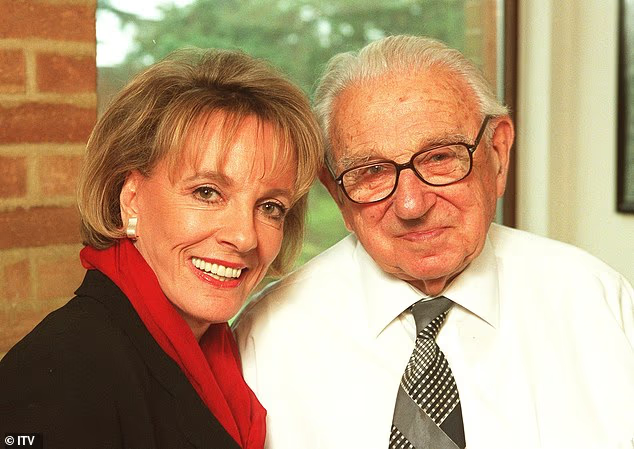
Dame Esther Rantzen’s television reunion between Sir Nicholas Winton and the children he helped rescue from Nazi-occupied Prague has become one of the defining moments of her career.
Rantzen, who died yesterday aged 86, used the BBC programme That’s Life! to reveal the wartime efforts of the previously unassuming stockbroker, who had kept his actions largely private for almost half a century.
Winton had helped 669 children, most of them Jewish, leave Czechoslovakia for Britain by train in 1939. He also helped arrange sponsorship and homes for them under legislation introduced after Kristallnacht.
His story came to light after his wife, Grete, discovered a scrapbook in the attic of their home in Maidenhead in 1987. It contained the names and photographs of hundreds of children connected to his rescue work.
Grete took the scrapbook to Holocaust historian Elizabeth Maxwell, hoping that some of those Winton had saved could be traced. His story was subsequently published in the Sunday Mirror, where the children were described as “The Lost Children”.
On February 28 1988, Rantzen invited Winton on to That’s Life!, without telling him the full reason for his appearance.
He recognised one man in the audience, Rudolf Wessely, a teacher who had travelled on one of the Kindertransport trains from Prague. But the woman sitting beside him was a far more significant figure from his past.
She was Vera Gissen, who had been 11-year-old Vera Diamant when Winton helped her escape Prague in 1939. She had been trying to identify the man who had saved her life.
“We did find her name, Vera Diamant, as she was then, on this list,” Rantzen told viewers. “Vera Gissen is here with us tonight. Hello Vera.”
As the camera turned towards her, Gissen took Winton’s hand and embraced him while the studio audience applauded. He appeared stunned and wiped his eyes as she told him: “Thank you.”
Rantzen then revealed that two more of the children he had helped, Hanusch Schnabl and Milena Fleischmann, were sitting nearby. Fleischmann later became known as Holocaust awareness campaigner Lady Milena Grenfell-Baines.
“Hang on to your handkerchief,” Rantzen warned before addressing Winton directly. “I know you don’t want thanks, but you’re certainly going to get them.”
The second That’s Life! reunion
Several months later, on July 3 1988, Winton returned to the programme. Rantzen asked the audience whether any of them “owes their life to Nicholas Winton”.
About two dozen people seated around him stood up. They were among the children evacuated from Prague through his efforts.
Winton briefly smiled before sitting down and wiping tears from both eyes. The broadcasts transformed the little-known organiser into a national hero, and he was later described as “Britain’s own Schindler”.
Rantzen and Winton remained in contact, reuniting for the ITV documentary Winton’s Children in 2003. He was knighted that year for services to humanity and died in 2015 aged 106.
Winton had travelled to Prague in 1938 at the request of his friend Martin Blake, who was working with Czech refugee groups. Although he spent only three weeks there, he helped establish a rescue effort that became part of the Kindertransport operation, which ultimately brought 10,000 children out of Nazi-occupied Europe.
He contributed towards costs, tackled the bureaucracy and organised the children’s passage. The first train left on March 14 1939, a day before the Nazis fully occupied Czechoslovakia, and eight trains eventually made the journey.
The final planned train, carrying 250 children, was stopped when the Nazis closed the borders on September 1. According to an interview Gissen gave in 2006, only two of those children are thought to have survived the war.
Rantzen later said Winton remained troubled by the train that never left. Recalling a telephone conversation before his first That’s Life! appearance, she said he told her he “hadn’t saved enough”.
“That moment is reconstructed in this feature film One Life,” she said in 2023. “It traumatised Nicky, and I think for him, the memory was of his failure.”
The 2023 film, starring Sir Anthony Hopkins as Winton in his later years and Johnny Flynn as the younger man, recreated the television reunions. Its epilogue said the audience in the reconstruction was made up entirely of people alive because of his actions.
Winton’s legacy is also marked by statues at Prague Main Station and Maidenhead railway station. In 2014, he received the Czech Republic’s highest honour, the Order of the White Lion.
For Rantzen, the discovery of one scrapbook led to a television moment that ensured Winton’s quiet wartime work would be remembered by generations of people whose lives, and whose families’ lives, it had changed.
