


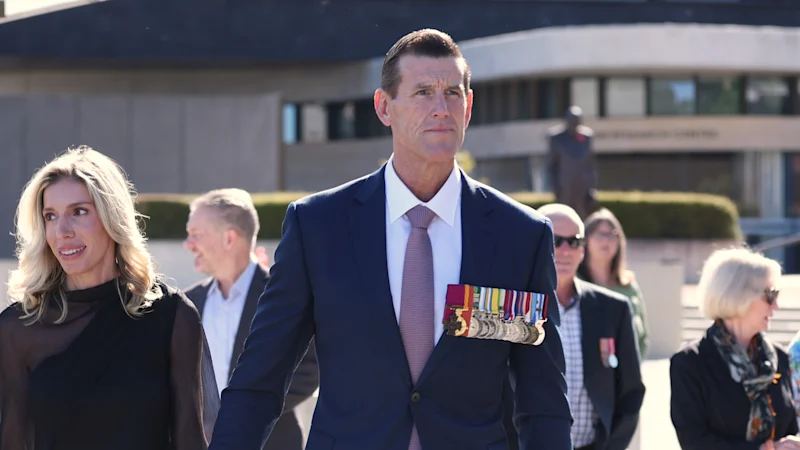
Anthony Albanese has paid tribute to Australian personnel who served in Afghanistan as about 800 veterans gathered in Canberra to mark 25 years since the beginning of the country’s longest war. Among those attending was Victoria Cross recipient Ben Roberts-Smith, who faces five charges of war-crime murder and strongly denies the allegations.
About 1,400 veterans, serving personnel, politicians and guests attended the national commemorative service at the Australian War Memorial on Sunday. The ceremony honoured the 47 Australian personnel who died as a result of their service, as well as wounded veterans and the families affected by the conflict.
Roberts-Smith, a former Special Air Service Regiment corporal, sat in the front row with his partner, Sarah Matulin. He had been granted permission by a judge last month to travel from Brisbane to Canberra under strict bail conditions.
The former soldier’s prosecution has become a focus of the debate over alleged unlawful killings by Australian special forces and the investigation of veterans accused of war crimes. No trial date has been set.
In his address, the prime minister recalled the dangers faced by troops deployed to a conflict where roadside explosives, suicide bombers and attacks from within allied forces were constant threats.
“It was an environment in which vigilance had to be as relentless as the dust,” Mr Albanese said. “Where every footstep could feel heavy in a landscape sown with explosives, where any crowd might hold a suicide bomber, and where the threats came from without, and sometimes devastatingly from within.”
He also recognised Afghan soldiers and interpreters who assisted Australian forces, many of whom attended the service.
“What shone brightly amid all of this was the courage of so many Afghans, the soldiers, the interpreters, all who stood against their oppressors and put their own safety on the line to help,” he said.
Afghanistan veterans reflect on the conflict
Australian forces were deployed to Afghanistan after the September 11, 2001 terrorist attacks in the United States. Between 26,000 and 30,000 Australians served under Operations Slipper and Highroad, with 263 wounded.
The campaign included operations against al-Qaida and the Taliban, counter-insurgency missions and training for Afghan security forces. The Taliban’s return to power in August 2021, after the withdrawal of international forces, left many veterans questioning the outcome of the two-decade operation.
Kahlil Fegan, who served on several operational deployments and led multinational teams in Afghanistan, including Mentoring Task Force 4, spoke of the questions raised by the fall of Kabul.
“Was it worth it? What did we achieve, and how will we be remembered?” he said.
Mr Fegan said the value of military service could not be judged only by the way a war ended, but also by the duty, courage and sacrifice of those who served.
Janny Poate, whose 23-year-old son Robert was killed in a “green on blue” attack, paid tribute to the families who waited, worried and endured separation and loss.
“Most of all, we remember this: their strength and resilience,” she said.
Roberts-Smith remained at the memorial for more than 30 minutes after the service, signing autographs and posing for photographs with veterans, families and members of the public. He said the event was not about him.
“I’m here because tens of thousands of Australians contributed to the campaign in Afghanistan, and they did fantastic work, and that should never be forgotten,” he told reporters.
“There wouldn’t be a single one of those veterans that went to Afghanistan that doesn’t carry that war with them.”
Former prime minister John Howard, who attended the service alongside Tony Abbott and Scott Morrison, defended the decision to commit Australian forces despite the Taliban’s return to power.
“It’s always worth putting your hand up to defend freedom and greater opportunities for democracy and greater opportunities for women,” he said.
Mr Albanese said the contribution of Australian personnel remained significant regardless of the conflict’s eventual outcome, and paid tribute to those who returned with physical or psychological injuries.
