


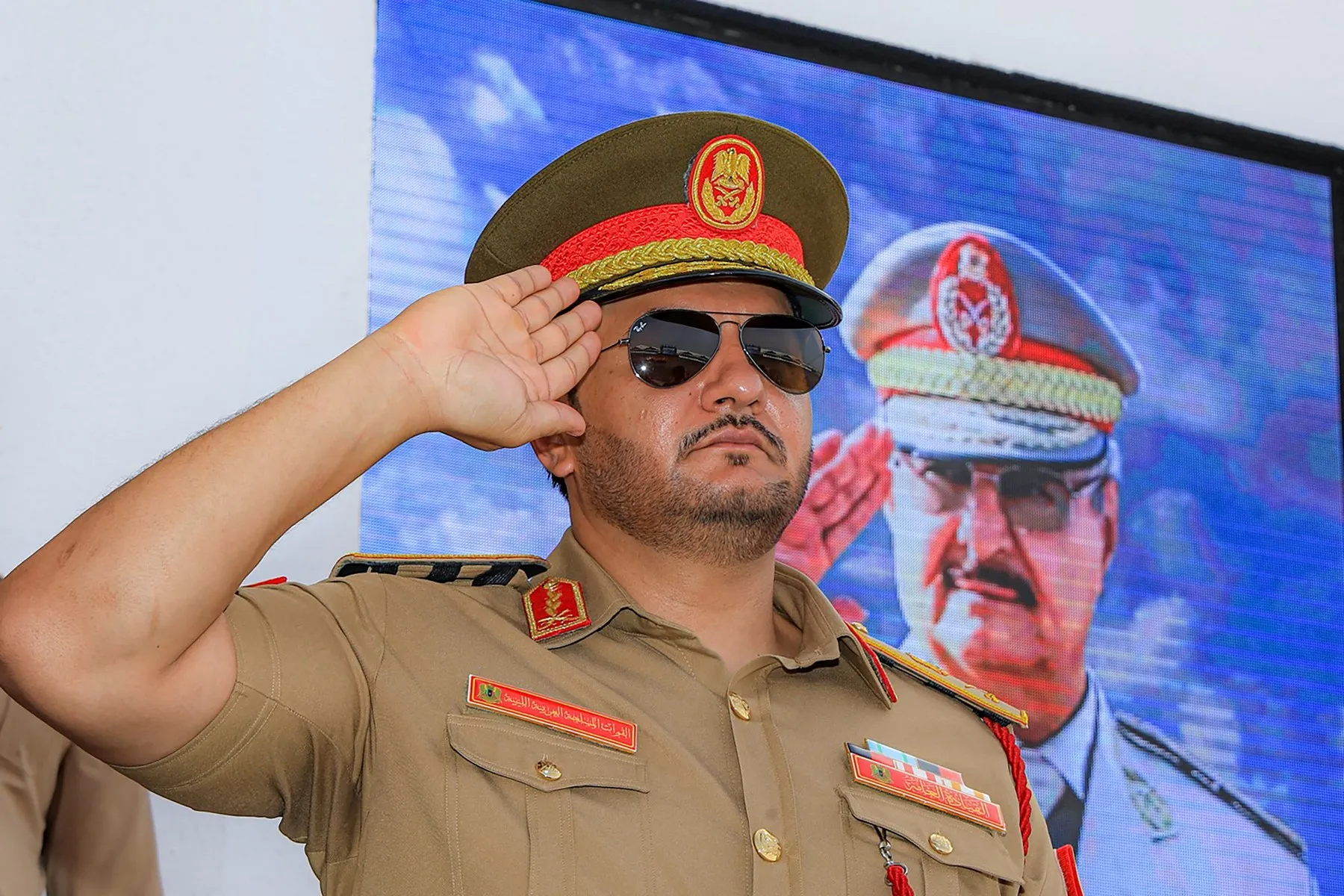
Saddam Haftar has positioned himself as a potential successor to his father and candidate for the Libyan presidency after eastern Libya’s parliament ratified a controversial maritime agreement with Türkiye.
The House of Representatives in Benghazi approved the memorandum on October 20, reversing years of opposition to the deal signed by Türkiye and the rival administration based in Tripoli. The vote prompted condemnation from the European Union, Greece, Israel and Egypt.
But the decision appears to have been part of a broader political manoeuvre by Saddam Haftar, whose father, Khalifa Haftar, controls eastern Libya. The younger Haftar is seeking Ankara’s support as Washington tries to broker a power-sharing arrangement between the authorities in Tripoli and Benghazi.
The proposed settlement is being championed by Massad Boulos, Donald Trump’s senior adviser for Arab and African affairs, and could lead to Saddam Haftar becoming president. Türkiye’s influence in western Libya gives Ankara a decisive role in any agreement.
Ratifying the maritime memorandum is therefore seen as an attempt to secure Turkish backing. The move came after the House of Representatives removed its long-serving speaker, Aguila Saleh, in what amounted to a major reshaping of the eastern political establishment.
Saleh had held the post for 12 years and was regarded as Egypt’s principal ally in eastern Libya. He was also a significant obstacle to approval of the memorandum.
His removal carried implications beyond relations with Cairo. As speaker and nominal supreme commander, Saleh represented the legal authority from which Khalifa Haftar’s military command derives. His influence among the Obeidat tribe also gave him the capacity to complicate or mediate any succession process.
His replacement, Al-Salhin Abdulnabi, is also an Obeidi and had chaired the House of Representatives’ Libyan-Turkish friendship committee. His appointment may help limit tribal opposition while indicating the direction in which the chamber is now moving.
Washington holds the deciding influence
Saddam Haftar’s strategy ultimately depends on Washington supporting a deal acceptable to Ankara. He is relying on the Trump administration’s interest in reaching a settlement, as well as lobbying by Türkiye and the United Arab Emirates and the relationship between Recep Tayyip Erdogan and Mr Trump.
Such an arrangement would face opposition from Athens and Nicosia, while Israel is uneasy about the expansion of Turkish influence. The dispute places the US president’s transactional approach to the Libyan crisis against a longstanding American partnership involving Greece, Cyprus and Israel.
The confrontation with Israel could also help Saddam Haftar domestically by allowing him to present himself as resisting Israeli interests and countering perceptions of a covert channel between the two sides.
The European Union has meanwhile weakened its own influence in Libya by concentrating heavily on migration. European governments responded meekly when Benghazi expelled the EU’s migration commissioner and three ministers from member states during a visit in July 2025.
Less than a year later, Greece hosted Saddam Haftar, who avoided committing himself to an alternative maritime agreement. The EU’s dependence on eastern Libya to police migration routes has limited its ability to oppose changes to the disputed maritime arrangements.
The UAE is also expected to favour Saddam Haftar’s ambitions. He is regarded as the most reliable of Khalifa Haftar’s sons from Abu Dhabi’s perspective, and his installation at the top of the Libyan state would represent the culmination of years of support for the Haftar project.
Egypt’s position is less certain. Cairo’s objection to the memorandum focused mainly on its claimed encroachment into Egypt’s exclusive economic zone and was expressed in legal rather than explicitly political terms.
Relations between Egypt and Türkiye have improved, with the two countries aligned on Sudan and the Red Sea and sharing concerns about Israel’s expansionist ambitions. Commercial concessions could help ease Egyptian opposition, although Cairo may instead use its relationship with Ankara to promote another Haftar family candidate.
Saddam’s brother Khaled, chief of staff of the Libyan Arab Armed Forces, is considered closer to Egypt and publicly criticised the US initiative in April. If Cairo backs him, Saddam may have limited leverage after offering Ankara the maritime agreement it wanted.
His remaining potential concession would be highly sensitive. Cutting support for Sudan’s Rapid Support Forces could improve relations with both Türkiye and Egypt, which support Sudan’s army, but would risk alienating Abu Dhabi.
Saddam Haftar is consequently attempting to keep the UAE and Türkiye onside long enough for Washington to complete a political deal. The strategy reflects both the opportunities created by the planned succession and the risks of a contested transfer of power within the Haftar family and among groups excluded from the emerging order.
The maritime memorandum has acquired particular significance because it once symbolised the defeat of Khalifa Haftar’s forces. The agreement formed part of the Turkish intervention that helped stop his offensive against Tripoli in 2020.
Saddam Haftar now hopes the same agreement will help bring him to power. If Washington backs the arrangement, the document could become the foundation of the Haftar family’s political succession; if it withdraws support, it could instead mark the failure of his presidential ambitions.
