


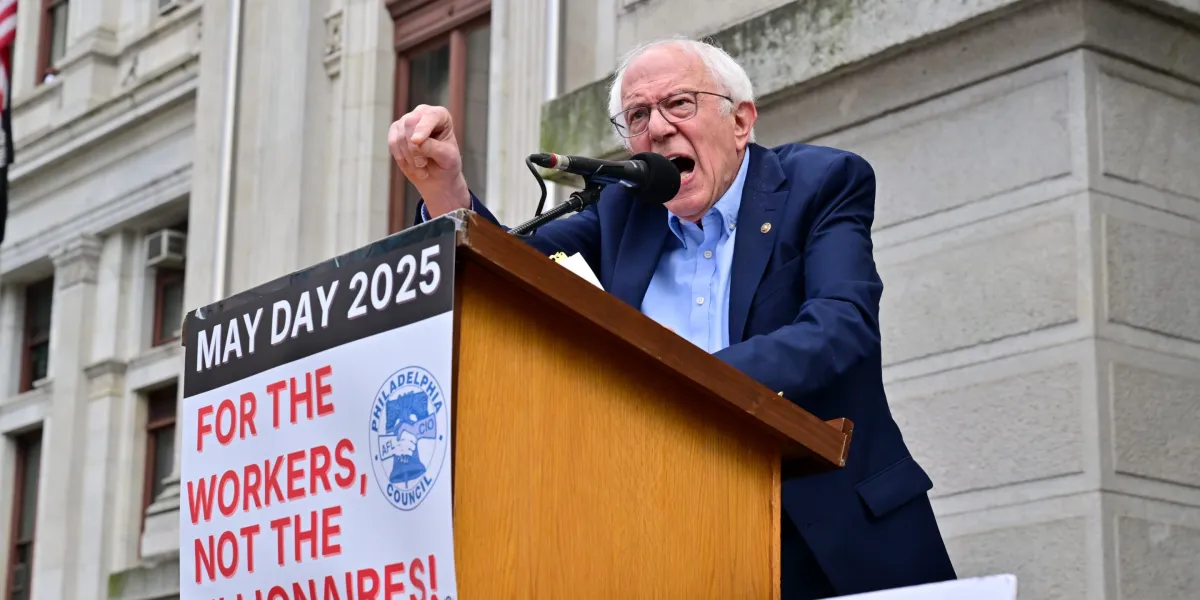
Bernie Sanders and California congressman Mark Takano have reintroduced a 32-hour workweek bill that would make employers pay overtime when covered workers exceed four days or 32 hours a week.
The proposal is being presented as a response to the rapid advance of artificial intelligence and robotics, with Sanders arguing that productivity gains should give working families more time rather than primarily increasing the wealth of corporate executives and billionaires.
“At a time when artificial intelligence and robotics will radically transform our economy, it is imperative that the financial gains from this new technology benefit working families, not just a handful of billionaires and corporate CEOs,” Sanders said.
The Thirty-Two Hour Workweek Act would not automatically give every American a three-day weekend. Instead, it would gradually reduce the overtime threshold for covered non-exempt employees, beginning at least six months after the legislation became law and reaching 32 hours after four years.
Employers would still be able to schedule longer working weeks, but would have to pay overtime for hours above the threshold. They would also be barred from reducing affected employees’ weekly pay or benefits because of the change.
The bill would introduce overtime after eight hours in a single day and double pay after 12 hours. Under current federal rules, covered workers generally receive time-and-a-half only after working more than 40 hours in a week, with no federal requirement for daily overtime.
Takano, who first introduced the legislation in 2021, said labour standards had failed to keep pace with technological change. “Since then, cell phones, the internet, and now AI have increased worker productivity,” he said. “Work has fundamentally changed. It’s time that labor standards caught up.”
Could technology shorten the working week?
The proposal comes as companies compete to use generative artificial intelligence to produce more work with fewer employees. A 2026 analysis by Boston College sociologist Juliet Schor for the University of Massachusetts Amherst’s Political Economy Research Institute estimated that productivity gains driven by the technology could allow 35 million US workers, or 28% of the workforce, to move to a 32-hour week within a decade.
Sanders introduced a Senate version of the bill in 2024 and has argued that reducing working hours represents the next stage of a labour movement that has continued for more than a century.
The campaign for shorter working hours was once associated with Eugene V Debs, who supported an eight-hour working day when many Americans were working 12-hour shifts six or seven days a week. Ford Motor Company introduced a five-day, 40-hour week for factory workers in 1926, while Congress later established the 40-hour standard through the Fair Labor Standards Act, signed in 1938.
Supporters of a shorter week point to a widening gap between productivity and pay. Since 1979, net productivity has risen by roughly 90%, while typical workers’ hourly pay has increased by about 33%, according to Economic Policy Institute data.
A separate six-country study involving nearly 2,900 workers at 141 companies found that employees who reduced their schedules by about five hours a week reported lower burnout, improved physical and mental health, greater job satisfaction and better work ability after six months.
However, supporters would face a substantially larger test in moving from voluntary company trials to a federal labour standard. At a 2024 hearing on an earlier version of Sanders’s bill, Louisiana senator Bill Cassidy said higher labour costs could push up prices and threaten businesses operating on thin margins.
Cassidy now chairs the Senate’s Health, Education, Labor, and Pensions Committee, which would consider a Senate version of the legislation.
“A 32-hour workweek is not a radical idea,” Sanders said. “It’s time to reduce the stress level in our country.”
