


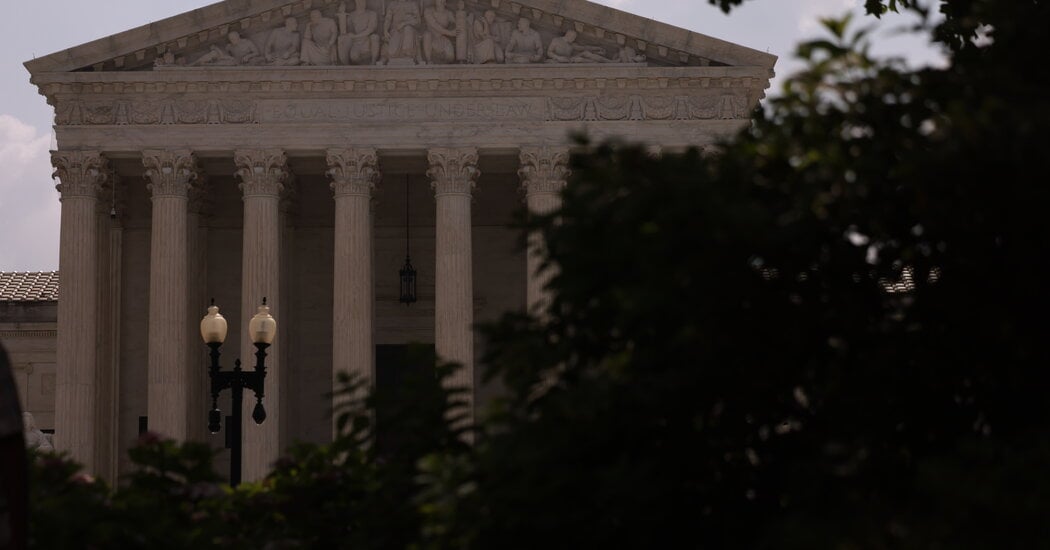
The US Supreme Court has blocked Donald Trump’s plan to give the Postal Service power to screen mail-in ballots and decide which ones would be delivered, saying the administration was likely to lose a legal challenge to the policy.
The unsigned ruling came after election officials from both parties warned that the proposal could disenfranchise millions of voters. The justices had declined to intervene three weeks earlier, saying the case was not yet ready for a decision, but made clear that the delay did not amount to approval.
The court’s brief order did not disclose the vote count. Justices Clarence Thomas and Samuel Alito publicly dissented, while none of Mr Trump’s three appointees recorded a dissent.
Mr Trump responded angrily, accusing the Supreme Court of being influenced by the left and directing his criticism at the justices he selected.
“This Supreme Court is bullied and cajoled by the Radical Left into making decisions that have set America back at least a hundred years,” he wrote on social media. “These are not the people I interviewed to serve on the United States Supreme Court, they are merely a shell of their original selves.”
A fresh check on presidential power
The decision represents a significant break from a pattern established during much of Mr Trump’s second term, when the court frequently granted the administration success in emergency applications brought before it on an expedited basis.
Those rulings were formally provisional but often produced lasting victories for the president. They were also more likely to divide the justices along ideological lines than cases receiving full briefing and oral argument.
In recent months, however, the court has rejected several important parts of the administration’s programme. It refused to allow the deployment of the National Guard in Illinois over the objections of local officials, struck down the centrepiece of Mr Trump’s tariffs programme and rejected his attempt to dismiss a Federal Reserve governor.
The justices also disagreed with his interpretation of a law concerning ballots received after Election Day. In a separate ruling this summer, the court found that an executive order seeking to limit automatic citizenship for babies born in the United States violated the Constitution.
Monday’s mail-in ballot ruling went beyond saying that the postal regulation had been introduced too close to the November election. The majority indicated that the policy itself was probably unlawful, making it less likely that the administration could revive the measure at a later stage.
That approach contrasted with Chief Justice John Roberts’s stated preference for deciding no more of a case than necessary. Josh Blackman, a law professor at South Texas College of Law Houston, said the chief justice appeared not to want the dispute to return to the court.
The practical effect of the ruling was welcomed by election administrators, although officials said confusion among voters could persist. Marybeth Kuznik, elections director in Fayette County, Pennsylvania, said the relief among officials was “palpable”, but added that many voters feared their postal votes might not be counted despite the court’s decision.
The ruling followed another election-related setback for the administration, when the court rejected a proposed redraw of Missouri’s voting map that would have favoured Republicans in the midterm elections.
A further administration application remains before the justices. It seeks permission to use a government database containing Social Security information to help establish whether potential voters are citizens.
Justin Levitt, a law professor at Loyola Marymount University in Los Angeles, said the Missouri decision and the ruling on postal regulations indicated that the court was no longer prepared to accept major last-minute changes to election rules.
“The rules are now what they are, and the election is going to be — as it should be — up to the voters,” he said.
