


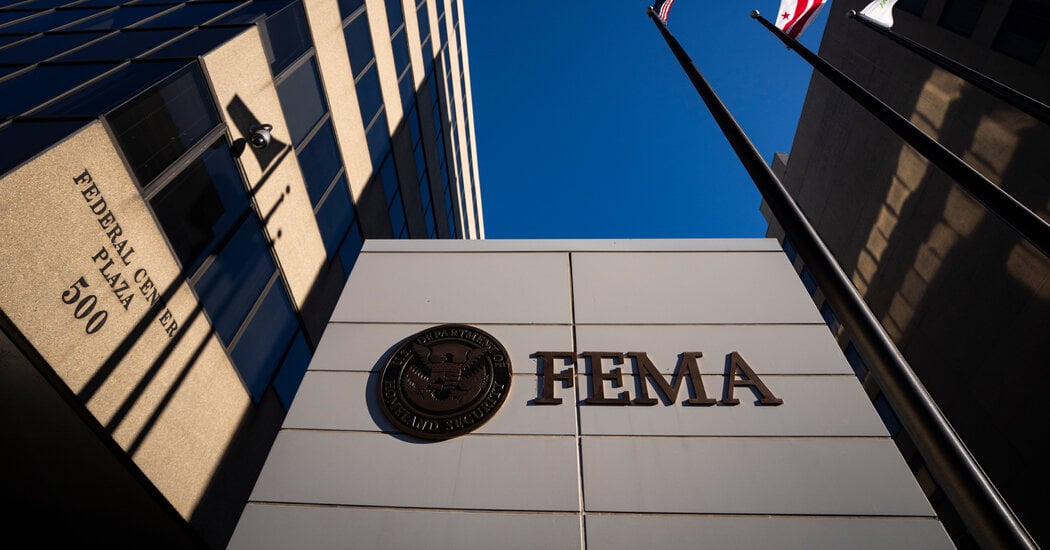
A federal court ruling has found that plans to cut the Federal Emergency Management Agency’s workforce violated the law, but the decision is unlikely to halt the Trump administration’s push to shift more disaster relief responsibilities to states and local authorities.
Judge Susan Illston, of the US District Court for the Northern District of California, ruled that officials breached protections introduced after Hurricane Katrina in 2005. The legislation is intended to safeguard FEMA’s independence from political decisions made by officials at the Department of Homeland Security, its parent agency.
The case centred on plans drawn up under then-Homeland Security Secretary Kristi Noem to eliminate half of FEMA’s staff. The cuts were never carried out in full, but the judge ruled that preparing the plans was itself unlawful.
The judgment does not require the government to reinstate the thousands of FEMA employees pushed out in cuts led by Elon Musk’s Department of Government Efficiency. Those dismissals were not part of the lawsuit.
It also leaves open the administration’s wider plans to reduce FEMA’s role in disaster response, according to Andrew Rumbach, a senior fellow at the Urban Institute who studies disaster policy.
“This doesn’t restore people’s jobs,” Mr Rumbach said. “It just continues to highlight the severity of the problem, and the need to make sure FEMA has the work force it needs to be effective.”
FEMA staffing cuts leave agency short-handed
FEMA had 18,862 deployable employees on Monday, almost 4,000 fewer than on January 1, 2024, according to daily figures issued by the agency.
A Government Accountability Office report last month said the cuts had left FEMA seriously short-handed, even though the proposed 50 per cent reduction was not implemented. More than half of the agency’s most senior and experienced leaders departed during the first year of President Donald Trump’s second term, the report found.
The court ordered FEMA to reverse a small number of terminations carried out in January which it deemed illegal. It did not, however, direct the agency to hire or rehire additional staff.
Judge Illston also ruled that officials had broken government record-keeping rules by deliberately deleting messages about the staffing proposals. FEMA and Homeland Security officials had discussed the plans using self-deleting encrypted messages on Signal, and the agencies and officials were ordered to pay part of the plaintiffs’ legal fees.
A Homeland Security spokesman, Charles Wollenhaupt, said FEMA retained “experienced leadership” and “a strong, deployable” workforce during hurricane and wildfire seasons. FEMA officials said they would not comment on ongoing litigation.
The lawsuit was brought by unions representing government workers, local authorities including Baltimore, Chicago and Harris County in Texas, and scientific organisations including the American Geophysical Union. Democracy Forward, a Washington-based legal and advocacy group, led the case.
Skye Perryman, the organisation’s chief executive, said the plaintiffs hoped the ruling would “protect the American people so that FEMA can do the job Congress created it to do and that our brave civil servants are protected.”
Mr Rumbach said the judgment could nevertheless give Cameron Hamilton, FEMA’s newly confirmed administrator, a route to reduce the agency more gradually, using policies aimed at limiting the federal role in disaster response.
A Trump administration panel approved an overhaul of FEMA in May which proposed possible staffing reductions as the agency reduces its role after disasters, although it did not set a specific number. Earlier unpublished versions of the report had called for the workforce to be halved, matching the proposal at the centre of the lawsuit.
