


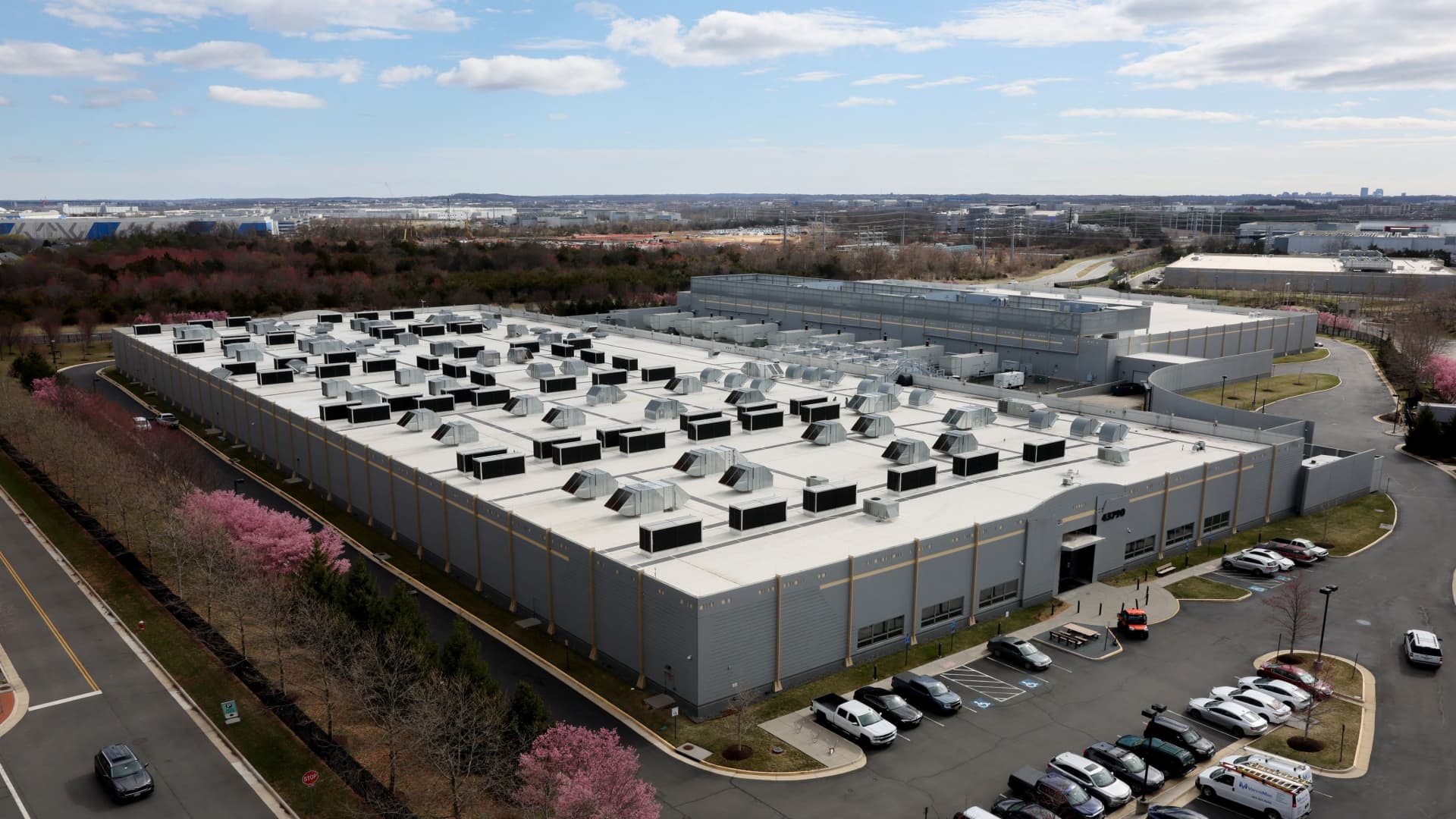
Digital Realty chief executive Andrew Power has rejected fears that warnings of a slowdown in artificial intelligence development will undermine data centre demand, arguing that cloud computing and wider digital transformation continue to require substantial infrastructure.
Shares in Digital Realty and Equinix, two of the largest data centre real estate investment trusts, fell on Monday after Anthropic, OpenAI and xAI issued pledges pointing to a slower pace of AI advances.
But Mr Power said the warnings did not amount to a halt in investment by the companies and infrastructure providers supporting the technology.
“There’s tremendous digital transformation happening that is not connected to AI,” he said. “There is tremendous cloud computing growth. Frankly, from my business lens, my seat, I think those demand trends, which are massive drivers of our business, have been stifled in these days of AI.”
He said hyperscalers had been forced to decide whether to expand their commercial cloud operations or allocate capacity to AI laboratories. The impact of any change in pace would also vary between markets, he added.
Data centre demand remains ahead of supply
Digital Realty operates in major markets including Northern Virginia, Dallas, Chicago, Singapore, Tokyo, Frankfurt and Amsterdam. Mr Power said customers in those locations were competing for the same limited space.
“Our markets’ demand has been outpacing supply now for several years. There’s pent-up need for infrastructure in those markets. There’s locational sensitivity. Those workloads can’t choose any one of the 50 states,” he said.
He added that Digital Realty’s international portfolio also supported customers facing data sovereignty requirements in different countries.
Analysts said a slowdown in AI development would not necessarily reduce the physical infrastructure required by the industry, particularly if it mainly affected the training of new models.
Andrew Batson, global head of data centre research and strategy at JLL, said the stronger growth over the next few years was likely to come from inference — the use of AI tools by businesses and individuals in their everyday work.
“Only 1 in 4 Americans use AI daily, so even if models are slow to be released, there is significant runway for adoption to grow and data centre demand to increase,” he said.
Mr Batson also pointed to the continued commitment of institutional investors including Blackstone, BlackRock and KKR, which he said had “high conviction in this space”.
McKinsey has estimated that AI could account for about 70% of global data centre capacity demand by 2030. Meeting total demand by then could require nearly seven trillion dollars in capital spending, while JLL has estimated that the real estate element could represent three trillion dollars of investment over the next five years.
Digital Realty’s development pipeline currently includes 20 billion dollars of projects under construction, up from 10 billion dollars at the end of 2023.
Mr Power said the company had changed its funding model because data centres were highly capital-intensive. It has been raising private capital and entering individual joint ventures, while positioning its balance sheet with what he described as its strongest liquidity and lowest leverage.
“The first, most important part is, make sure that the daily gyrations, our stock price, don’t affect our strategy, our business,” he said.
