


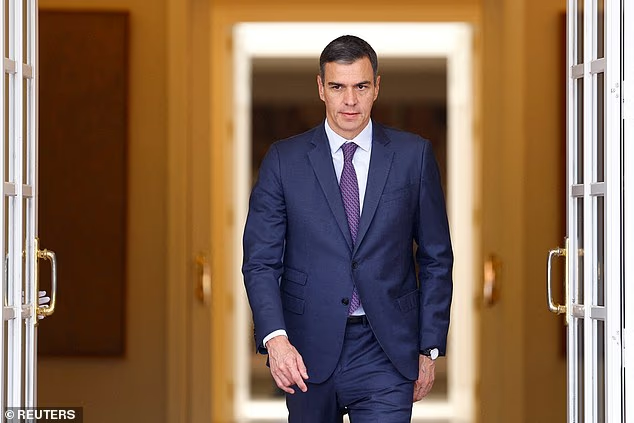
Spain’s Prime Minister Pedro Sánchez has called an early general election for November 29 after his minority government suffered a major parliamentary defeat over emergency measures aimed at tackling the country’s housing crisis.
The decision follows weeks of protests over soaring rents, a shortage of affordable homes and the eviction of an 87-year-old woman from her Madrid flat. The measures rejected in Parliament included stronger safeguards for vulnerable tenants and the automatic renewal of rental agreements.
Announcing the election, Mr Sánchez asked voters to decide whether Spain wanted to “regress or keep moving forward”. He accused the opposition of forming “a far-right coalition that offers no proposals”.
Spain’s main opposition party, the conservative People’s Party, welcomed the announcement in a video posted with the caption: “At last.”
Housing crisis drives political confrontation
The parliamentary setback came after right-wing parties joined forces to defeat two emergency decrees containing measures to reduce evictions and curb property speculation.
Anger over the housing crisis intensified after footage showed riot police forcing their way through a barricade of chairs, shelves and a lamp during the court-ordered eviction of Maricarmen Abascal in Madrid.
Ms Abascal had lived in the Retiro district flat for 70 years. Her family first rented the property in 1956, and she remained there after her parents died under an old agreement that capped the rent.
The apartment was bought in 2018 by Urbagestión Desarrollo e Inversión SL, run by investment brothers Ricardo Alonso Fernández and Fernando Alonso Fuentes. The company later proposed increasing her monthly rent from about €440 to €1,650, according to Spanish reports. Ms Abascal’s pension is €1,350 a month.
Three previous attempts to remove her had been blocked by the courts. Her eviction prompted demonstrations across Spain, including a march by tens of thousands of people in Madrid demanding greater protection for tenants.
Protests over short-term rentals and housing also turned violent in Valencia, where demonstrators charged at riot police with fences and officers used batons.
The Bank of Spain estimates that the country is short of 700,000 homes, while rents have continued to rise amid the shortage.
Risky election for Sánchez
Mr Sánchez, 54, has been prime minister since 2018 and is one of Europe’s longest-serving leaders. His Socialist Party is trailing in opinion polls, making the decision to go to the electorate a significant political risk.
Polls suggest the People’s Party could lead the next government with support from Vox. Such an outcome would bring the far-right party into central government for the first time since Spain returned to democracy after the death of dictator Francisco Franco.
Mr Sánchez has repeatedly defied expectations, assembling fragile alliances ranging from the far left to Catalan separatists to remain in power. He secured a second four-year term in 2023 after negotiating support from a loose group of parliamentary parties.
However, divisions among his allies have limited the government’s ability to pass legislation, and it has not approved a budget since 2023. Members of Mr Sánchez’s Socialist Party have also faced allegations of corruption in the past year, further weakening its standing.
The prime minister’s housing proposals had offered him an opportunity to present himself as the leader of a mobilised left while shifting attention away from corruption allegations and the migrant crisis in Ceuta.
Mr Sánchez has led Spain’s government through policies including an amnesty for pro-independence Catalan leaders, the exhumation of Francisco Franco from a mausoleum outside Madrid and a labour law reform followed by a fall in unemployment.
He has also defended immigration as important to Spain’s economy, arguing that foreign workers help fill jobs in sectors including construction, agriculture and hospitality.
