


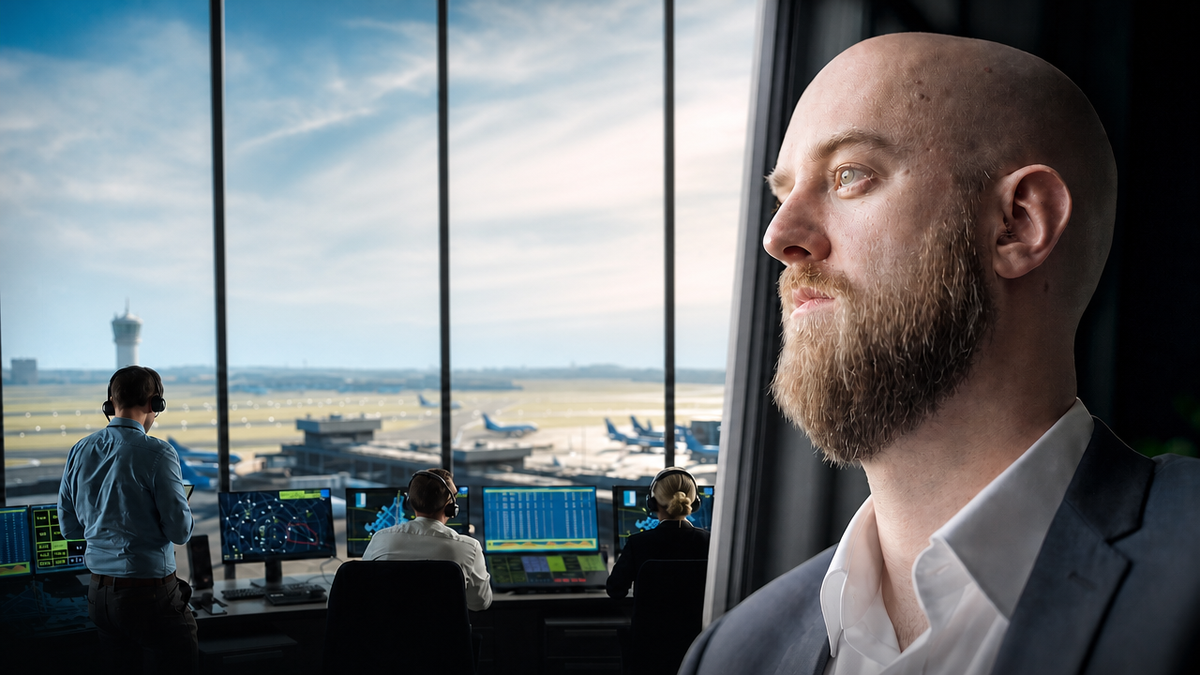
Australia’s air traffic control staffing crisis is placing controllers under mounting fatigue and overtime pressures, according to the president of the union representing them, after a series of near-misses at Sydney Airport.
Two airport employees were stood down after two aircraft almost collided on the tarmac in Sydney, bringing renewed scrutiny to the safety of the country’s aviation system.
Scott Nugent, who has worked as an air traffic controller for eight years and currently directs aircraft in Sydney, said staffing shortages had been building for years.
“Air traffic controllers are critical. They’re absolutely critical assets to the system that we have. And without them, things start to fall apart,” he said.
Air traffic control staffing pressures
Mr Nugent said some controllers were working 10 consecutive days, followed by a single day off, before completing another 10-day stretch. Such schedules, he said, created a serious risk of fatigue.
Asked whether fatigue could contribute to mistakes, he replied: “Of course it can.”
Some controllers were also undertaking what he described as extraordinary levels of overtime, with certain individuals working as many as 800 additional hours in a year.
“There is no world where any worker should be expected to work 800 hours of overtime per year,” Mr Nugent said. “Some people do. Some individuals are, yes. And that’s not right and it’s not safe.”
He attributed responsibility for the pressures to Airservices Australia management and decisions taken over several years, which he said had left the country struggling to maintain an adequate workforce.
Mr Nugent said about 140 controllers aged between 56 and 65 had been encouraged to retire during the Covid-19 pandemic. He estimated that around 15 per cent of Australia’s air traffic control workforce had been lost and not replaced.
In his view, stabilising staffing levels could take months or years, with the wider shortage potentially requiring as long as five years to resolve.
Controllers can also face pressure to cover additional shifts when staffing is tight. Mr Nugent described cases in which a controller finishing a late shift was asked to return early the following morning to avoid flight cancellations.
“When you go home at 10 o’clock and your boss has asked you to come back at 6am in the morning and put the hard word on you and said, ‘If you don’t do that, there’s going to be cancellations’ — that’s stressful,” he said.
Although controllers could technically refuse, Mr Nugent said that was more difficult “when you’re in the hot seat”.
“You cannot keep pressuring controllers to do more and more and more instead of just giving them the resources they need to do their job,” he said.
Western Sydney Airport adds to the challenge
The staffing concerns come as the aviation network prepares for the opening of Western Sydney International Airport, which will introduce passenger services and increase the complexity of air traffic in the region.
The airport will use a digital air traffic control tower, with cameras and other technology providing views of the site from a remote centre about 17 kilometres away at Eastern Creek.
Mr Nugent said the system was new to a major passenger airport in Australia and would present different demands from those associated with a conventional tower.
“That’s a new technology. It’s the first time in Australia that that has been used,” he said. “It’s certainly not the same as a traditional physical tower.”
He said the arrival of passenger aircraft during the day would make the work more complex and create a significant challenge for controllers.
Dave Riley, a United States air traffic controller with more than 30 years’ experience, said the mental health impact of staffing shortages and excessive overtime had become increasingly prominent. At least 12 US air traffic controllers died by suicide in 2024, he said.
Mr Nugent said aviation professionals in control towers and cockpits needed to be able to seek mental health treatment without fearing for their careers or livelihoods.
“If we actually want to stop aviation professionals in cockpits and in control towers from having these mental health concerns, we need to find a way that we can let them approach it and seek treatment without putting their career, their livelihood in jeopardy,” he said.
He urged greater recognition of the people working behind the scenes to direct aircraft.
“Don’t forget about us,” Mr Nugent said. “We are invisible.”
He added: “We’re highly trained, expert, dedicated professionals.”
However, he said that expertise could not indefinitely compensate for insufficient staffing as Australia introduced new infrastructure, technology and demands on its airspace.
Airservices Australia and the Civil Aviation Safety Authority declined requests for an interview.
