


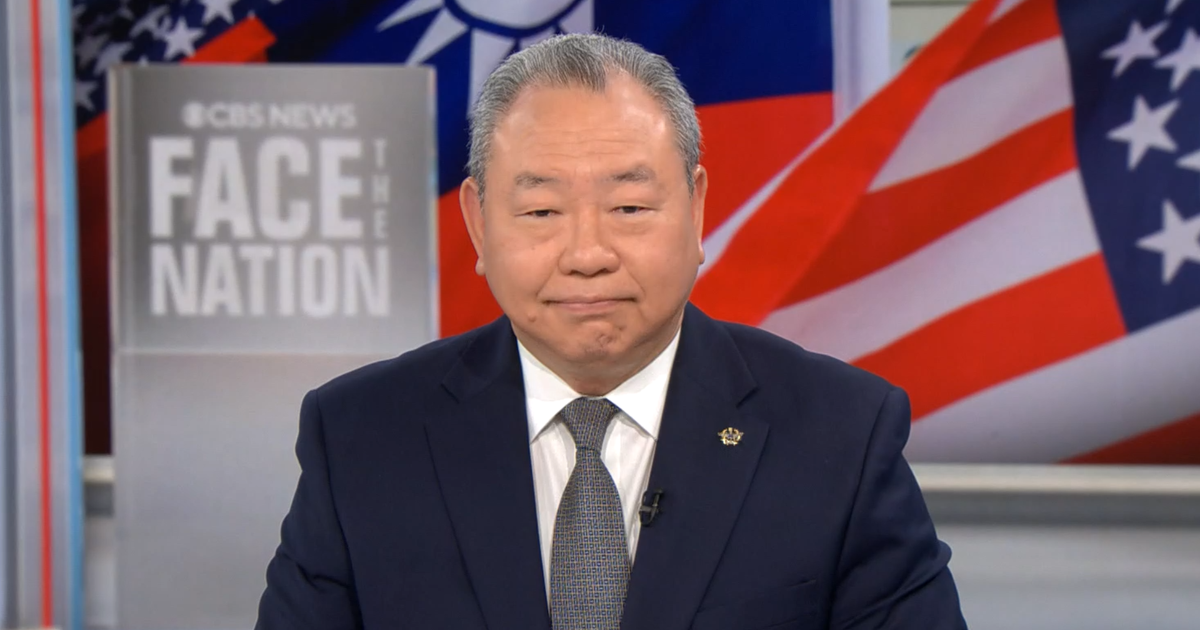
Taiwan’s representative to the United States, Alexander Yui, has urged Washington to deliver a delayed $14 billion weapons package, arguing that strengthening the island’s defences is essential to deterring Chinese aggression.
Mr Yui said US communications with Taiwan remained “quite regular and quite open” but declined to confirm whether President Donald Trump had held the call with Taiwan’s President Lai Ching-te that he had previously said he wanted.
His comments came after Mr Trump met Chinese President Xi Jinping and said Taiwan had been mentioned but had not been a major subject of discussion. Mr Yui said Taiwan was absent from the published statements outlining the results of the meeting, despite China describing the issue as foundational.
He said the US had made clear before, during and after the meeting that its position on Taiwan had not changed, including its support for peace and stability in the Taiwan Strait and opposition to coercion or unilateral changes to the status quo.
“There’s no change in Taiwan’s position for the United States,” Mr Yui said.
Asked what Taiwan needed from Washington to deter Beijing, Mr Yui said the answer was greater military preparedness. “Peace through strength is the best way to avoid any conflict,” he said, adding that the assumption China would not attack Taiwan rested on the island being strong and ready to defend itself.
He said Taiwan was increasing its defence budget and wanted to share more of the burden of its own security, while also seeking the weapons it needed from the United States, its main arms supplier.
The representative’s comments came as the status of the proposed weapons sale remained unresolved. The package, valued at $14 billion, had not been delivered, while Republican senators had also called for explanations over more than $1 billion in additional aid that had not reached Taiwan.
Mr Yui also challenged remarks attributed to Mr Xi about China’s role in the Second World War. He said the Chinese Communist Party did not govern China during the conflict and argued that the Republic of China government, which is now based in Taiwan, fought alongside the United States.
He said the People’s Republic of China was not established until 1949, and accused Beijing of twisting historical facts in an effort to portray Taiwan, Japan and other countries as aggressors while driving a wedge between the United States and its partners.
“It is the People’s Republic of China who is being the aggressor,” Mr Yui said, referring to tensions in the region.
He also stressed Taiwan’s importance to the global technology industry, saying the island’s semiconductor manufacturing made it a critical partner for the United States as artificial intelligence development expanded.
Describing Taiwan as the producer of the semiconductors, servers and other components needed to support the AI industry, Mr Yui said the relationship between Taiwan and the US was “interdependency” and “symbiotic”. That, he argued, was another reason the island should be protected.
