


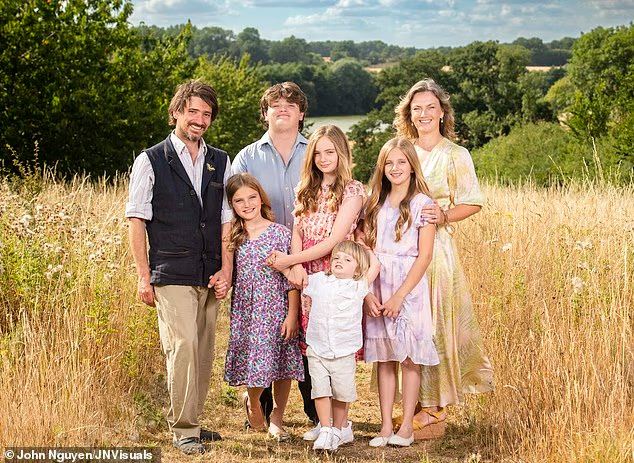
Sybilla Hart has offered a tongue-in-cheek guide to what she regards as Britain’s “posh” names, arguing that animal names such as Bear, Badger, Panda and Mouse are now more likely to signal aristocratic circles than traditional choices such as Amelia or Luca.
Hart, who says her own first name immediately identifies her as a “posho”, was born Sybilla Rufus Isaacs. She could theoretically use the prefix Lady because her father was the Marquess of Reading.
She recalled arriving at a Cotswolds boarding school at the age of 13, where pupils assumed she was a princess, possibly of Greek origin, because of her name. Their disappointment was considerable when they discovered she came from nearby.
Hart said her background had nevertheless given her an insight into the naming habits of the aristocracy, which she described as having a particular fondness for unusual names and elaborate nicknames.
Animal names and aristocratic nicknames
Her own five children, whom she sent to state schools, are called Beatrice, Florence, Celestia, Isaac and Benjamin. She said the names no longer set them apart because choices once considered rarefied have become increasingly common.
Oscar, Theodore, Arthur, Poppy, Freya and Florence are now familiar names in state primary schools, she suggested, while names including Luca and Amelia have lost much of their former rarity.
In Hart’s view, the more distinctive trend among wealthy families is the use of animal names as first names. She said she had recently heard Badger, Bear, Hen, Panda and Mouse used as genuine names rather than pet names or nicknames.
She also pointed to the tendency to shorten almost every name. Cordelia may become Cords, Rupert may be reduced to Rupe and Nicholas to Nico, while Tatty is, in her estimation, more socially elevated than Tatiana.
Hart’s own children have acquired similarly unconventional diminutives. Celestia is sometimes called Kay or Kestrel, while Florence has progressed from Smudge to Splodge and now Boj.
She said names such as Tizz and Tiggs were likely to belong to people from particularly grand backgrounds, adding that “Twinkle will own half of Marylebone”.
The names regarded as more conventional
Hart argued that short, uncomplicated names such as Rory, Iris, Frances and Sholto were better suited to modern life than longer choices including Aloysius and Thomasina.
She said some families continued to favour traditional names including Hugo, Henry, William, Charlotte, Isabel and Georgina because they were unlikely to attract ridicule and could suit their bearers in any profession.
By contrast, she said Tarquin, Lysander and Araminta remained choices associated with the upper classes but were likely to prompt immediate judgements. Araminta is often shortened to Minty, she noted.
More restrained names such as Alex, Jo, Abbi and Clare, Hart added, were favoured by parents who did not want to draw attention to themselves or their children.
She reserved particular criticism for names including Chardonnay, Chanel, Venice, Jackson and Riley, saying they could suggest a company, a wine or a holiday destination. She also argued that surnames such as Kennedy, Madison and Harper should not be promoted to first names.
Hart said she was grateful her parents had chosen Sybilla rather than Thomasina, a name she felt sounded like something that might be given to a field mouse in a picture book. Her husband’s surname, Hart, was one of its attractions, she added, because it was short, simple and suited almost anything.
