


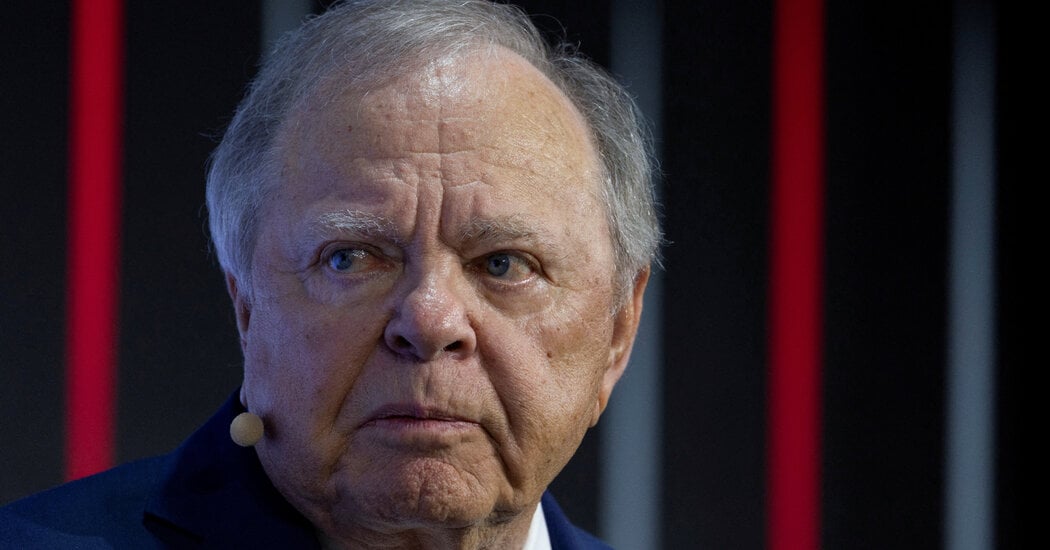
Continental Resources has announced a preliminary deal to drill for oil in Venezuela, making Harold Hamm’s company the latest American producer to pursue opportunities in the country’s vast reserves.
The Oklahoma City-based company signed an agreement with Venezuela’s state oil company, Petróleos de Venezuela, to develop and operate the 126,000-acre Ayacucho 2 Block in the oil-rich Orinoco Belt.
The deal was announced in Houston during a meeting of energy ministers from the Group of 20 nations hosted by the US government. It is separate from an agreement announced by the Trump administration last month.
Chevron, which already operates in Venezuela, has said it plans to more than double its production in the country over the next five years. President Trump has been encouraging US oil companies to invest there since American forces captured Venezuela’s leader, Nicolás Maduro, in January.
For Continental, the proposed project would represent its first move into Venezuela. The company has expanded overseas in recent years with agreements to produce oil in Turkey and Argentina, as drilling opportunities in the United States have become more limited.
Venezuela’s oil industry has been weakened by years of mismanagement, underinvestment, corruption and US sanctions. Much of the country’s crude is extremely heavy, with a consistency comparable to asphalt, and relatively few American producers have extensive experience handling it.
Continental has not disclosed how much it would invest or how much oil it hopes eventually to produce. The preliminary agreement must still be followed by a final contract with Petróleos de Venezuela.
Doug Lawler, Continental’s chief executive, said operations could start six months after a contract was signed, although he cautioned that the timetable for production remained uncertain because the site was undeveloped.
“We know it’s going to be a significant amount of capital that will have to be deployed into wells and new infrastructure,” Mr Lawler told reporters in Houston. He said the company needed seismic, technical and initial drilling data before it could determine the development programme.
Mr Lawler acknowledged that Continental did not have extensive experience with Venezuela’s heavy oil, but said it had worked on limited heavy-oil projects in the United States. “We don’t consider it to be a technical challenge that we couldn’t pursue completely on our own,” he said.
Some energy experts have questioned whether Venezuela’s reserves can be developed quickly or easily. Mr Hamm said Continental’s experience helping to pioneer fracking in shale rock showed that his team was prepared to take on difficult projects.
“This is a huge resource in Venezuela,” Mr Hamm said. “We know this is a great opportunity.”
Mr Hamm, who has advised Mr Trump on energy issues and contributed to his political campaigns, said he believed Venezuela would honour oil agreements even if its government changed.
Energy Secretary Chris Wright and Interior Secretary Doug Burgum attended the announcement alongside senior Venezuelan officials. Mr Wright described the agreement as “a milestone deal in making the Western Hemisphere the center of the global energy system”.
