


European Commission president Ursula von der Leyen has proposed opening the way for Canada to become the European Union’s first associate member, as the bloc seeks stronger alliances in an “openly hostile world”.
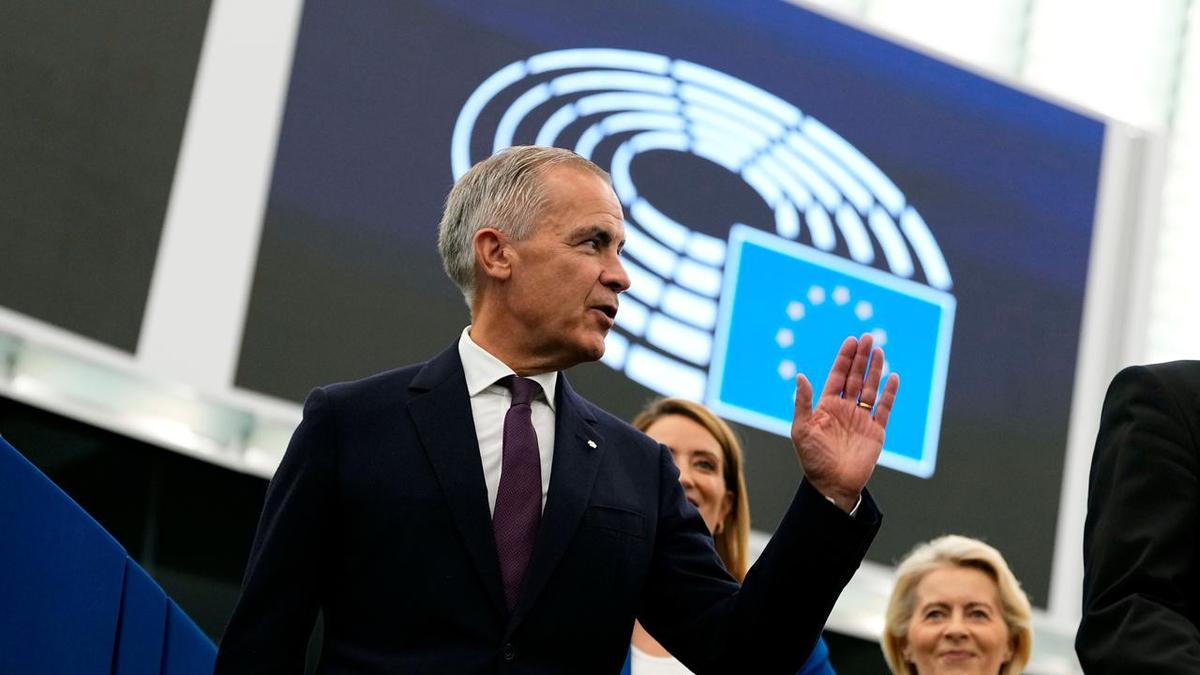
Her announcement prompted a standing ovation from members of the European Parliament and was followed by an embrace with Canadian Prime Minister Mark Carney, who was attending her annual State of the Union address in Strasbourg.
“I said we must urgently reimagine our partnerships. So, I would like to work with you on opening the door for Canada to be the first associate member of the EU,” Ms von der Leyen told the assembly.
She did not set out what associate membership would involve, and the proposal would require the backing of the EU’s 27 member states rather than being decided by the Commission president alone.
Ms von der Leyen said the EU and Canada shared a common outlook on artificial intelligence, climate change, the Arctic and geopolitics. She also pointed to their cooperation on Ukraine, defence, raw materials and supply chains.
“But above all … Europe and Canada believe in democracy,” she said.
Mr Carney welcomed the prospect of a closer relationship, describing Ms von der Leyen’s proposal as a basis for “a far stronger, more ambitious alliance in the future”. His office said: “Canada and Europe should secure our strategic autonomy through deep cooperation in the full range of strategic capabilities.”
However, the Canadian prime minister did not refer specifically to associate membership. One EU diplomat said the proposal had come as a surprise, adding that “nobody really knows what it means”.
The diplomat also raised concerns that the Commission president was “overpromising and won’t be able to deliver”. The EU has historically been reluctant to establish flexible alliances without a legal status, while member states reacted cautiously to an earlier German proposal for Ukraine to gain associate membership as a step towards full accession.
Ms von der Leyen said the EU and Canada would pursue cooperation in intelligent manufacturing, technology and defence, while making the Arctic a joint flagship project.
“Partnerships are a strategic choice for Europe. But they also respond to the fracture in the international rules-based system,” she said.
The proposal comes during Mr Carney’s European trip after Canada-US trade talks collapsed last month, followed by a series of reciprocal tariff measures. He has pledged to double Canada’s non-US trade over the next decade as the country shifts away from its southern neighbour amid an increasingly acrimonious trade dispute.
Ukraine’s Foreign Ministry spokesman Heorhii Tykhyi said Kyiv welcomed closer ties between the EU and Canada and would follow the next steps closely.
