


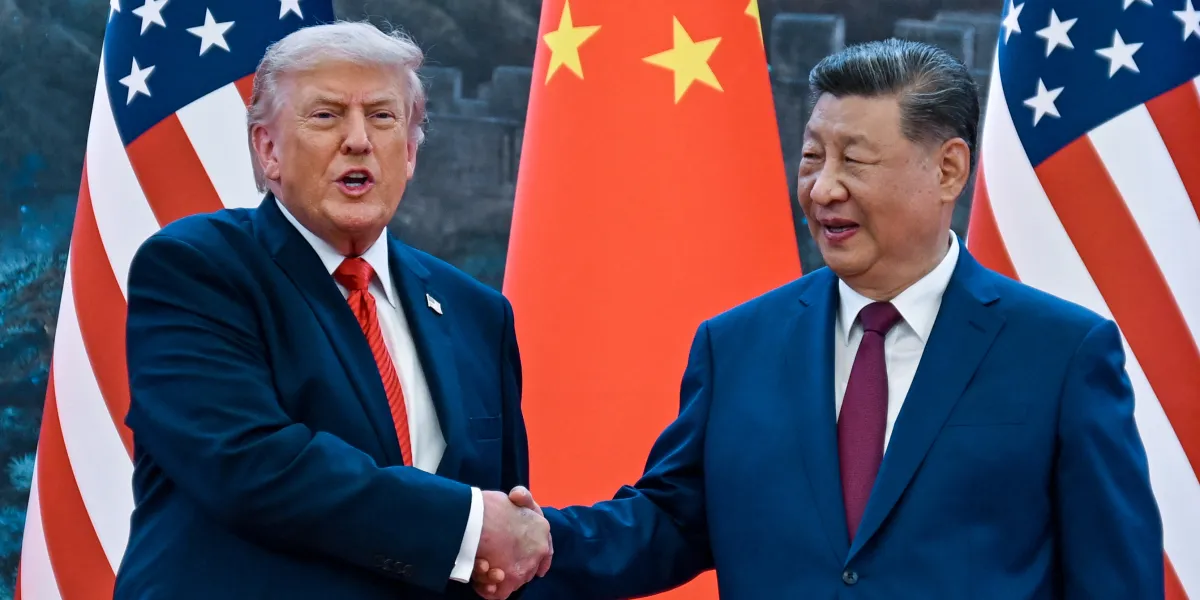
Calls for an AI slowdown have been rejected by Donald Trump and Xi Jinping ahead of their planned meeting on September 24, despite warnings from leading US technology executives that the race to develop increasingly powerful systems could pose grave risks.
Sam Altman, the chief executive of OpenAI, has urged the US Government to help coordinate a more measured approach with China. He told an interview that Mr Trump and the Chinese president could even win the Nobel Peace Prize if they reached an agreement on AI safety.
But the prospect of a deal to limit or pace development appears distant. Mr Trump said in a post on Truth Social that “the only controls or ‘guardrails’ the U.S. needs is a STRONG AND SMART (High IQ!) PRESIDENT”.
Guo Jiakun, a spokesman for China’s Foreign Ministry, dismissed the debate in the US as “fear-mongering” which “will only hamper efforts toward sound global AI governance, which serves no one’s interest.”
The disagreement comes as Washington restricts the export of advanced AI chips to China, a policy viewed in Beijing as an attempt to preserve America’s technological lead.
“Xi is unhappy with recent U.S. moves to contain Chinese advances in AI, robotics, and drones,” said George Chen, partner and chair of digital practice at The Asia Group.
“For Xi, AI is the new internet — a once-in-a-lifetime chance to reshape the technological balance of power. China does not need U.S. permission to accelerate or decelerate its AI investments; Xi will pursue his own agenda.”
Mr Trump has similarly framed the technology race in stark terms, writing: “Whoever wins AI, wins!”
AI safety expected to feature in Trump-Xi talks
AI safety is expected to be discussed when the two leaders meet, although any agreement is likely to be difficult, according to Paul Triolo, global technology policy lead at the advisory firm DGA.
Mr Xi wants a “serious dialogue on frontier AI model safety”, Mr Triolo said. However, the two governments have yet to reach a basic understanding on “the role of government, [and] how and which models should be tested”.
The talks could also cover an agreement not to weaponise AI, as well as measures to prevent non-state actors using the technology to attack financial systems or critical infrastructure, Mr Chen said.
The debate has been intensified by a letter from Dario Amodei, chief executive of Anthropic, who called for the US and China to agree to an AI “speed limit”. In an interview, he compared the competition between the two countries with the Cold War race between the US and Soviet Union to develop nuclear weapons.
Mr Amodei said Washington and Beijing should, at a minimum, agree not to use AI to develop biological weapons. He also repeated his support for restrictions on the sale of advanced chips to China.
The proposal has attracted criticism in China, where some commentators see calls for restraint as an effort to slow a narrowing gap between Chinese and leading US models.
Brosi Babic, a professor at the University of Hong Kong, described Mr Amodei’s letter as “self-serving editorializing” which was “conveniently coming at a time when the gap between Chinese and frontier US models is shrinking, as an attempt to hang on to a vanishing market lead.”
He said the arguments for an AI slowdown had “been framed in such a conniving and childish way” that they were unlikely to influence Mr Xi’s approach to the meeting.
Mr Trump has also criticised Mr Amodei’s intervention. During a call to Nvidia chief executive Jensen Huang, which was put on speakerphone while Mr Huang was on stage, the president said: “Whatever Dario said this weekend won’t stop our progress.”
He also described opposition to data centres and fears that AI could “take over” as a “hoax”.
China’s different approach to AI development
Resistance to a slowdown extends beyond China’s political leadership. A post by Shengyu Liu, an engineer at DeepSeek, compared Anthropic achieving “advanced artificial intelligence” with “Hitler obtaining atomic-bomb technology before the Allies.”
Mr Liu also contrasted the technology strategies of the two countries. US companies including Anthropic and OpenAI generally favour closed models, while Chinese firms have concentrated on lower-cost, open-weight systems such as those produced by DeepSeek.
“I still believe that frontier intelligence should be made available to everyone in an open and inexpensive form,” Mr Liu said. “I do not trust Anthropic or OpenAI to do this.”
The warnings about existential threats to humanity that have gained prominence in the US have made less impact among the Chinese public. Many people in China view proposals for a slowdown as an attempt by the US to maintain its advantage, amid growing distrust of American technology companies.
George Chen said younger generations were increasingly encouraged to take pride in being part of a “new generation of Chinese”, alongside a narrative of “China rising, U.S. declining”.
Most Chinese people, he said, regarded managing AI safety risks as the government’s responsibility. Ordinary citizens and business leaders were more focused on using the technology to improve their daily lives or generate income than on regulation.
“The vast majority of average Chinese citizens are very positive about technology in general and AI in particular,” Mr Triolo said.
He added that people had seen improvements in living standards brought by technology and were willing to adopt AI. There was little public discussion of so-called doomsday scenarios involving existential threats to humanity.
Researchers working in China’s AI industry are nevertheless paying close attention to the risks. Mr Triolo said discussion among them was “very sophisticated”, with particular concern about cyber security, biosecurity and the possibility of losing control of advanced systems.
Some Chinese politicians have also called for tighter oversight, although not necessarily through co-operation with the US. Chen Yixin, head of China’s Ministry of State Security, said this week that AI posed a direct threat to the Chinese Communist Party’s control and required greater government supervision.
With both Mr Trump and Mr Xi appearing to reject a broad AI slowdown, their September 24 meeting will test whether the two countries can make progress on narrower safety measures, including limits on weaponisation and the misuse of advanced systems.
