


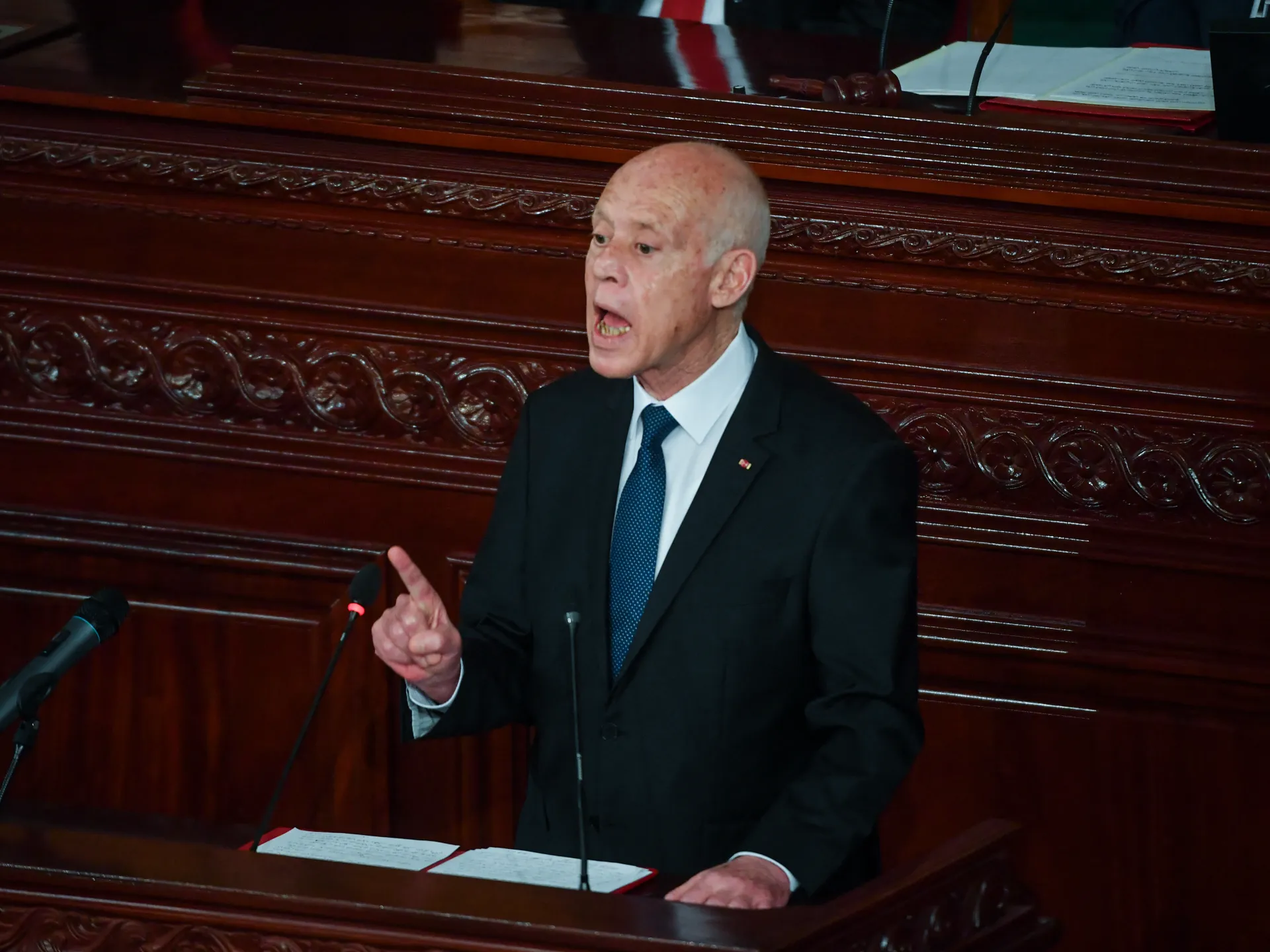
Tunisia has amended Decree 54 to replace a five-year prison sentence with a fine for people convicted for the first time of spreading “false news” online, in a limited easing of a law used against journalists, activists and political opponents.
The amendment, which took effect on Wednesday, sets fines of between 10,000 and 20,000 Tunisian dinars for a first offence involving false information and related violations. Repeat offenders can still be sent to prison.
The decree, introduced by President Kais Saied in September 2022, criminalises the electronic distribution of falsehoods considered a threat to public security or other people’s rights.
It also covers allegedly doctored material, personal data and untrue allegations said to encourage hatred, incite attacks, defame people, damage reputations or cause material or moral harm.
Before the change, a conviction could result in up to five years in prison. Where the target was a public official or someone of equivalent status, the maximum sentence rose to ten years, alongside a fine of 100,000 dinars.
People convicted of reoffending faced a further six months in prison and a 50,000-dinar fine, with penalties doubled when the alleged offence involved a public official.
How Tunisia’s Decree 54 has been used
Freedom of expression campaigners have long argued that Decree 54 has been used to suppress criticism of Mr Saied’s government and restrict civic activity.
The National Syndicate of Tunisian Journalists recorded 14 prosecutions of journalists between April 2025 and April 2026, six of them under the decree. It has said hundreds of journalists, bloggers, opposition politicians, lawyers and activists have faced proceedings since the law came into force.
Lawyer and columnist Sonia Dahmani was sentenced to two years in prison after criticising conditions in Tunisian prisons during a radio interview in May. She has faced five cases under the decree relating to comments made in media appearances and had previously received an 18-month sentence after criticising Mr Saied’s policies.
In another case, Saber Ben Chouchane was sentenced to death after being prosecuted under several censorship laws, including Decree 54, over Facebook posts. He was later granted a presidential pardon.
Amnesty International, Human Rights Watch and the European Parliament are among those to have criticised the decree. The European Parliament has described it as a tool that interferes with fundamental freedoms and called for its repeal.
The Tunisian government says the legislation is needed to protect individuals and public order, and to combat online crime and disinformation.
Mr Saied rejects accusations that he rules autocratically, saying his actions are lawful and necessary to tackle disorder and alleged corruption.
Why has Tunisia changed the penalties now?
The amendment came as pressure mounted inside and outside Tunisia. Hours before it took effect, civil society groups backed by the country’s largest labour union announced plans for a nationwide march over restrictions on civil liberties.
Demonstrations have increased over the past year amid complaints about abuses of power, political repression and worsening living standards. Hundreds protested in Tunis in June for press freedom and the release of detained critics, while thousands gathered in July to call for the president to leave.
Mr Saied has also faced pressure from abroad. In July, US congressman Joe Wilson said he would continue pursuing a bill imposing sanctions on the president and those closest to him over anti-democratic policies.
Rafik Abdessalem, a former foreign minister and senior figure in the opposition Ennahdha party, credited marches and other public gatherings with forcing the government to retreat.
Critics say, however, that replacing imprisonment with a fine for first-time offenders does not resolve the wider freedom of speech concerns surrounding Decree 54.
Said Benarbia, the International Commission of Jurists’ Middle East and North Africa director, described the reduction in penalties as a “positive development”, but said abusive prosecutions should end and people arbitrarily detained under the decree should be released.
Mr Abdessalem said: “In short, the punishment has been reduced, but its repressive and punitive character remains unchanged.”
Journalists’ groups and civil society organisations are calling for the decree to be scrapped altogether, arguing that cases involving the media should instead be handled under Tunisia’s 2011 press freedom law.
