


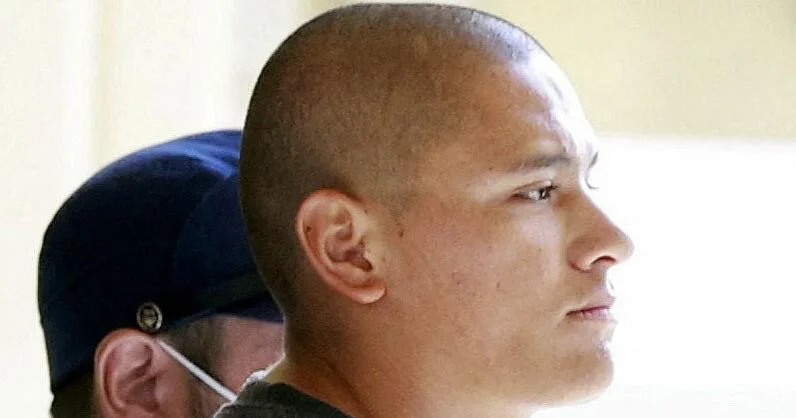
The arrest of a US Marine over the alleged killing of a woman in Okinawa has reignited anger over the heavy American military presence on the Japanese island.
Lance Cpl Devin Jacob Ballard, 20, who is stationed at Futenma Air Station, was detained on suspicion of strangling Anna Yagi, 39, in a hotel in Naha early on Saturday and stealing her wallet and backpack. He has denied the allegations, according to Japanese media.
Security camera footage showed a man entering the hotel with Ms Yagi before leaving alone, police said. Ballard was later seen walking in an entertainment district in Okinawa City, about 15 miles north-east of Naha.
A patrolling officer detained him after noting that his shaved head and arm tattoos matched the man shown in the footage, Kyodo News reported.
Why the Okinawa case has caused outrage
The case has prompted condemnation from Japan’s prime minister, who described the alleged killing as a “heinous crime”. Okinawa’s governor, Genta Koja, also handed a letter of protest to a senior US Marine Corps officer.
Kenji Higa, a resident of Okinawa City, told the Okinawa Times: “I’m outraged and flabbergasted to hear that a suspect came to the (entertainment area) after committing a murder.”
The incident has renewed debate over the concentration of US military facilities on Okinawa. The island accounts for only 0.6% of Japan’s landmass, but hosts 70% of America’s military facilities in the country and most of the roughly 50,000 US troops stationed there.
Okinawa remained under US control after the Second World War and was returned to Japan in 1972. The handover did little to reduce the number of bases, leaving the island with what residents describe as a disproportionate burden.
Prefectural police figures show that the number of criminal cases involving the US military rose to 101 last year, from about 40 in 2020. Residents have also raised concerns over aircraft crashes, noise pollution and previous crimes involving servicemen.
Among the most serious incidents was the 1995 gang rape of a 12-year-old local girl by three US soldiers. The attack led to widespread calls for a review of the agreement governing the legal status of US military personnel in Japan.
Opposition to the bases remains strong, although some Okinawans believe the US military presence has strategic value in view of what is widely regarded as a growing threat from China. The bases also provide jobs and are estimated to account for about 5% of the region’s annual income.
What happens next in the Okinawa Marine case?
Japan’s 1960 Status of Forces Agreement has long been criticised over the limits it places on Japanese authorities. The agreement is also contentious because Japan does not have primary jurisdiction over crimes allegedly committed by US military personnel while they are on duty.
Even in cases involving personnel who are off duty, an individual held on a US base is not handed over to Japan until they have been indicted, according to the Japan Federation of Bar Associations.
In this case, the suspect was questioned and detained by a Japanese police officer while walking alone in Naha’s entertainment district. Japanese prosecutors began examining the case on Monday to decide whether to bring formal charges in the coming weeks.
If convicted, Ballard could face life imprisonment or the death penalty.
Japan relies on US military strength as a deterrent against a possible attack, despite its pacifist constitution. Okinawa is regarded by both countries as a strategically important base for monitoring China, the Taiwan Strait and the Korean peninsula, and US forces have previously been deployed from the island to conflicts including the Gulf War and the Iraq War.
