


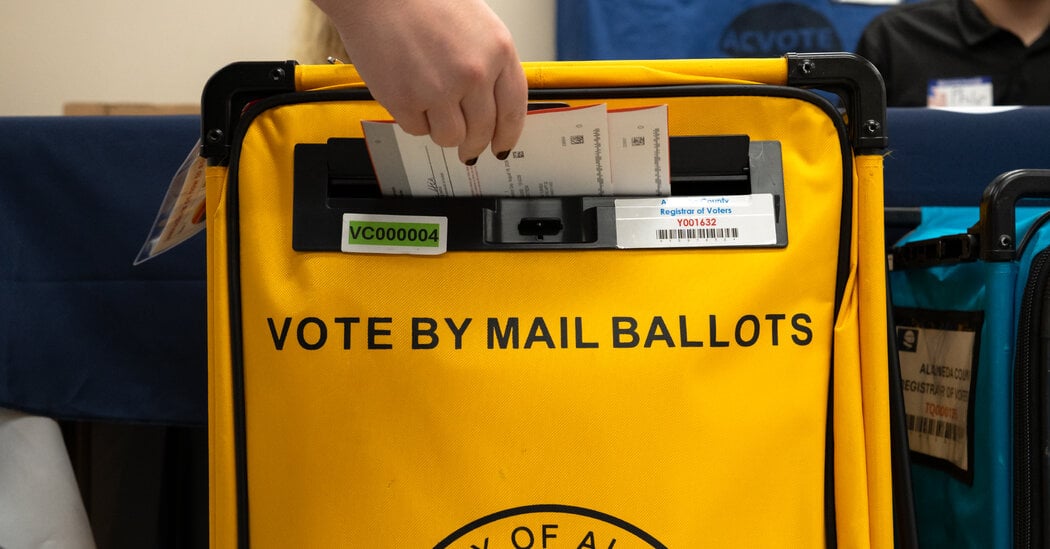
The US Supreme Court has blocked the Trump administration’s plan to impose new requirements on mail-in voting ahead of the midterm elections, preventing the Postal Service from screening ballot envelopes against state-approved voter lists.
The unsigned emergency order said the government was “unlikely to succeed on the merits” as the wider legal challenge continues. The court did not disclose how its justices voted.
The decision is a setback for Donald Trump, who has repeatedly alleged without evidence that mail-in voting is vulnerable to widespread fraud. Democratic-led states and voting rights groups had argued that the proposed changes were unconstitutional and risked disrupting the electoral process.
The administration had asked the justices to allow the Postal Service to deliver mail ballots only to voters whose names appeared on lists submitted by state election officials. States would also have been required to use Postal Service-approved envelopes carrying a unique barcode for each voter.
Several states said they could not redesign and issue ballots under the new system in time for the elections. Alabama, Delaware and North Carolina had already sent ballots to voters, while challengers also said a required Postal Service web portal for uploading voter data was still being built.
The administration described the measures as “only modest envelope-design and addressee-information requirements”, arguing that federal law gave the Postal Service authority to introduce them.
But states and voting rights organisations warned that the changes could cause delays, confusion and mistakes, with millions of voters potentially at risk of being unable to cast their ballots. Election chiefs from several Republican-controlled states also urged the court to reject the plan, saying its implementation so close to the midterms would “almost certainly lead to mistakes, delays and confusion for both voters and election officials”.
Supreme Court blocks Trump mail voting plan
Justice Brett Kavanaugh, a conservative member of the court, agreed with the outcome but wrote separately that there was “at least a fair prospect” that the Postal Service had the legal power to issue the rules. However, he said introducing them so close to the elections would be “arbitrary and capricious” because local officials would not have enough time to put them into effect properly.
Justice Samuel Alito, joined by Justice Clarence Thomas, dissented. He said the legal challenge was a “Hail Mary” pass that was unlikely to succeed and argued that the administration would ultimately prevail because the Postal Service had “broad authority to regulate the mail”.
The dispute followed an executive order signed by Mr Trump in late March directing the Postal Service to draw up new mail-voting guidance. Democratic state attorneys general, voting rights groups and national Democratic leaders then challenged the order, arguing that it breached constitutional responsibilities given to states and Congress over elections.
The Supreme Court had previously allowed the Postal Service to continue planning for the changes, while making clear that the decision was not a final ruling on their legality. The latest order prevents the proposed system from taking effect for the midterm elections while the remaining litigation proceeds.
