


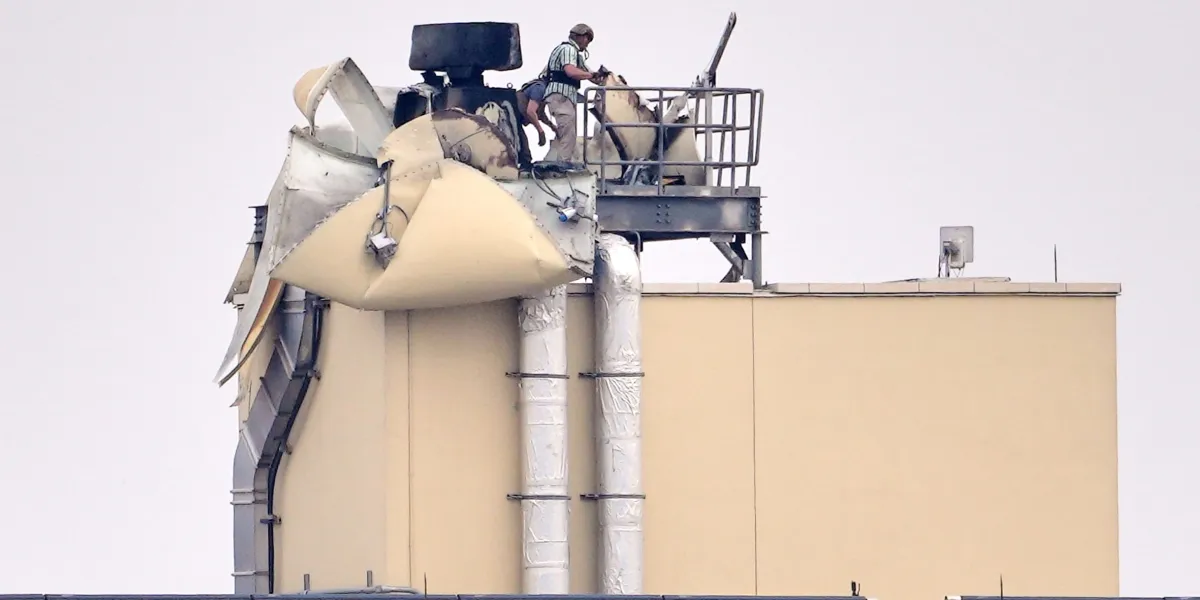
A Pentagon report on Iran war damage has detailed the toll on US military bases, aircraft and diplomatic facilities across the Middle East, while acknowledging shortages of advanced weapons and delays in replenishing supplies.
The report, covering April 1 to June 30, is the first public assessment by a US government watchdog of the conflict’s impact. It draws on work by inspectors general from the Defence and State departments and the US Agency for International Development.
Iranian strikes damaged or destroyed hundreds of buildings and other structures at American bases in Kuwait, Bahrain, Qatar, the United Arab Emirates, Saudi Arabia, Iraq, Oman and Jordan. Dozens of US aircraft and drones were also destroyed or damaged.
The report said the war had “resulted in strategic inventory shortfalls and revealed industrial base bottlenecks for munitions resupply” involving advanced weapons.
Experts have previously estimated that military contractors could need about three years to restore supplies of advanced missiles and defensive interceptors to pre-war levels. Defence Secretary Pete Hegseth told Congress in late July that the conflict had cost $37.5 billion by that point.
Damage to US diplomatic facilities
The report also disclosed the cost of damage to US diplomatic facilities, figures which had not previously been made public. Outposts in Iraq, Kuwait, Saudi Arabia and the UAE suffered most of the physical damage, estimated at $184 million.
The State Department said its wider costs from the conflict had reached $113 million by early June. Almost $80 million of that sum was used for contingency measures, including the evacuation of US personnel, their families, American citizens and eligible nationals from other countries.
About 9,000 US citizens were evacuated from countries in the Middle East and Europe in the weeks and months after the US and Israel first struck Iran on February 28. The operation, involving private and commercial flights as well as land and sea travel, cost more than $11 million by late June.
Most of those evacuated came from Israel, followed by Iraq and Jordan. Although only 1,200 Americans were evacuated from the United Arab Emirates, journeys to Istanbul, Athens and Washington accounted for more than $4 million of the total cost.
The report said the State Department decided it would be impractical to seek repayment from evacuees because consular officers could not fully document the travel itineraries needed to claim reimbursement.
During the same period, more than $44 billion in emergency and non-emergency military sales were recorded, mainly to Saudi Arabia. The deals included helicopters, munitions, munitions support and advanced precision weapons systems.
Qatar, Kuwait, the UAE and Israel also received billions of dollars in military sales as Iran retaliated against countries across the region that hosted US military bases.
