


Melbourne Fringe 2026 has opened with a programme spanning anarchic comedy, personal theatre, cabaret, dance, magic and interactive art, with performances ranging from deliberately chaotic late-night entertainment to intimate stories about migration, family, identity and grief.
Among the most highly rated shows was SLUGS, the Canadian comedy by S.E. Grummett and Sam Kruger. The production combines nudity, puppetry, audience interaction and existential dread in a deliberately unruly performance that one reviewer described as both “breathtakingly stupid” and “ingeniously clever”.
There is a more tender tone to Kauboj, Mara Knezevic’s cabaret about Jakov, a chef and cowboy living in a fictional Dalmatian town. Through original songs, traditional folk music and spoken word, Knezevic explores migration, ambition, love and disillusionment, accompanied by electric guitarist Daniel Potaczala.
The festival’s theatrical offerings include Philosophy of the World, in which British company In Bed With My Brother revisits the legacy of The Shaggs, the New Hampshire sisters whose music was later embraced by figures including Kurt Cobain and Frank Zappa. Rather than mock the trio, the production examines the pressure placed on women who never sought fame and uses sudden shifts into violence, music and comedy to challenge conventional ideas about artistic merit.
Hayley Edwards’ The Carrot Show approaches exhaustion and despair through puppetry. Drawing on a family history of entertaining sick children in hospitals, Edwards presents Carrot Man, a figure carrying an oversized papier-mâché carrot as an antidote to bleakness. The show’s message of finding joy in ordinary life is supported by a performance praised for its warmth, comic timing and detailed visual work.
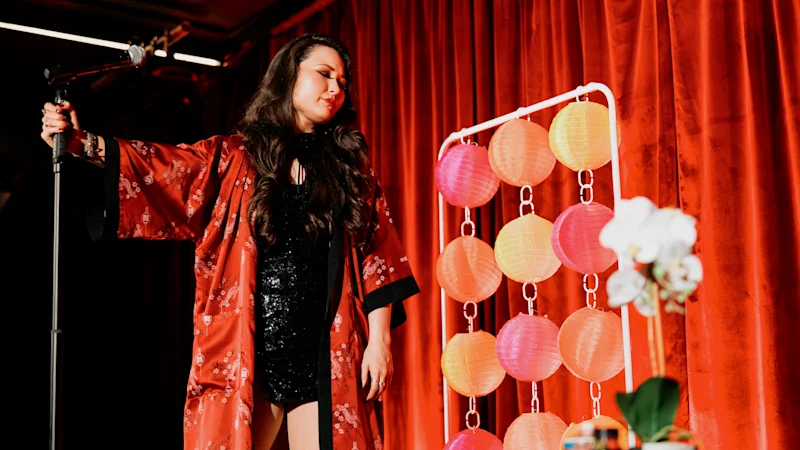
Several productions use humour to confront difficult subjects. In Yellow Fever: An Original Musical Cabaret, New Zealand-born performer Kelly Lim Harris combines dating experiences with cultural theory, literature and pop culture to examine the sexual stereotyping of Asian women. Her classically trained vocals sit alongside pop-rock songs, including one about the expectation that Asian performers should be suited to roles such as those in Miss Saigon.
Steph Crothers’ Daddy Daycare adopts the setting of a children’s playgroup to explore consent and sexual boundaries. Crothers, who has worked as both a children’s entertainer and a stripper, plays a hypersexual daycare teacher delivering lessons to adult men seeking their Working With Women’s Check. The production uses puppets, singalongs and audience participation, while making clear that participation is voluntary.
Elsewhere, Bron Batten’s Waterloo turns an unlikely relationship into a study of political division. Batten recounts falling for a conservative military figure while identifying as a left-wing, Greens-voting artist. What begins as a comic account of dating across the political divide develops into a more vulnerable examination of love, war and the dangers of quick judgement.
Stories of displacement and survival are at the centre of Bahaa Dabbagh’s A Lucky Refugee?. The Syrian performer recounts fleeing a war zone, surviving arrests and psychological torture, and travelling to Australia via Turkey with Sasha, his adopted cat. The review noted that Dabbagh draws humour from experiences of extraordinary danger while resisting the idea that he should speak for every refugee.
Comedy, magic and the darker side of Fringe
Comedy remains a major presence in Melbourne Fringe 2026. Clare Rankine’s Inner City Glam Girl sends up the wellness world through a pilates instructor and content creator on the verge of physical and emotional collapse, while Caitlin Duff’s Freidah Will See You Now places audiences in the afterlife, where a sharply dressed guide presides over an improvised passage towards eternal damnation.
At the more absurd end of the programme, Dune but Worse brings Frank Herbert’s science-fiction saga to the stage with audience members enlisted in an interstellar battle. The Kentucky Meat Shower, meanwhile, takes a real-sounding historical premise and turns it into a cardboard-built farce involving cannibalism, murder and a talking meat grinder.
For audiences seeking illusion rather than satire, Best of Fringe Magic combines mind reading, card tricks and sleight of hand. Host Liam “LJ” Jumpertz is joined by a changing group of magicians and is praised for creating an inclusive atmosphere in which audience members are not pressured to take part.
The cabaret show Briefs: The Works brings together drag, circus, striptease, aerial performance and full-frontal nudity. Hosted by Fez Faanana’s alter ego Shivannah, it features aerialist Dylan Rodriguez and hula-hoop and trapeze performer Jess Love, alongside audience confessions and the possibility of clothing being thrown into the crowd.
Dance works offer a quieter counterpoint. Estuary, choreographed by Ngioka Bunda-Heath, follows two dancers through changing patterns of water, moving from the coast inland. Video projected on to the floor marks the narrowing river, while the performers shift from rolling wave-like movements to faster sequences suggesting the life surrounding it.
Caroline Meaden’s solo Immacolata is a more unsettling meditation, performed in a dim space with only a clothes rack, a stool and scattered biscuit crumbs. Meaden’s hesitant, bird-like movements and repeated retreat towards the edges of the stage create a sense of an unseen force preventing her from entering its centre.
Experimental work is also represented by Chamber Made’s The Enormous Radio, in which a small audience is surrounded by vintage radios producing animal sounds, electronic noise and eventually fragments of speech. The installation examines the boundary between the natural world, human language and technology without following a conventional narrative.
Among the lower-rated productions, reviewers still found elements to recommend. Tegan Higginbotham’s return to stand-up in Follow That Turtle! addresses sexual harassment in the workplace, though the review found parts of the storytelling muddled. Smoko, a one-woman drama set around an Alice Springs dump, was praised for its handmade design and puppets despite concerns that its many voices weakened the emotional focus.
The range of responses reflects the festival’s broad ambitions: some shows aim for polished musical or theatrical storytelling, while others deliberately embrace awkwardness, risk and disorder. Across the programme, Melbourne Fringe presents artists using comedy and performance to examine consent, gender, migration, grief, politics and the pressures of contemporary life.
