


A museum in Evanston, Illinois, has marked Indigenous Peoples Day by offering free admission as it unveiled exhibitions exploring Chicago’s longstanding connections with 12 Native nations.
The Gichigamiin Indigenous Nations Museum reopened on 1 October following renovations, with a new presentation of Indigenous Chicago, a children’s gallery and an exhibition examining the history and cultural significance of hula.
The museum, formerly known as the Mitchell Museum of the American Indian, says it is Native-led and among the few institutions in the Chicago area dedicated exclusively to Indigenous peoples of the Great Lakes region.
Indigenous Chicago exhibition moves to Evanston museum
Indigenous Chicago was developed by the Newberry Library in partnership with members of the Chicago Native community and representatives of tribal nations with historic ties to the area. The project explores more than five centuries of Indigenous history, from the period before European contact to the present day.
The exhibition focuses on the Potawatomi, Odawa, Ojibwe, Peoria, Kaskaskia, Myaamia, Wea, Sauk, Meskwaki, Ho-Chunk, Kickapoo and Mascouten peoples, whose homelands include what is now Chicago.
Madison Bastress, director of the Newberry’s D’Arcy McNickle Center for American Indian and Indigenous Studies, said the project was intended to challenge the idea that Chicago is not an enduring Indigenous place.
“So Chicago has always been an Indigenous place,” she said.
Displays examine land and the environment, education and activism. Rather than presenting Native activism solely as a 20th-century development, the exhibition traces resistance and community organising across generations.
The exhibition was first displayed at the Newberry Library in 2024 and is expected to remain at the Gichigamiin museum for three years. It includes commissioned works such as regalia by Camille Billie, a graphic novel by Jim Terry and teaching blankets by Jason Wesaw.
The museum’s official plans describe the exhibition as a collaboration centred on Indigenous voices, tribal nations with historical connections to the land and Chicago’s contemporary urban Native community.
Children’s gallery and hula history
A new children’s area, The Gifts of Our World, has been created with Kohl Children’s Museum and Menominee tribal youth artists. Aimed at children aged three to 10, it includes 14 interactive stations introducing ideas of respect, gratitude and reciprocity through a Great Lakes Indigenous perspective.
Visitors can activate the sun, moon, wind and rain on a weather wall, while another activity requires children to exchange puzzle pieces with other participants. A separate station introduces the Seven Grandfather teachings of the Anishinaabe people.
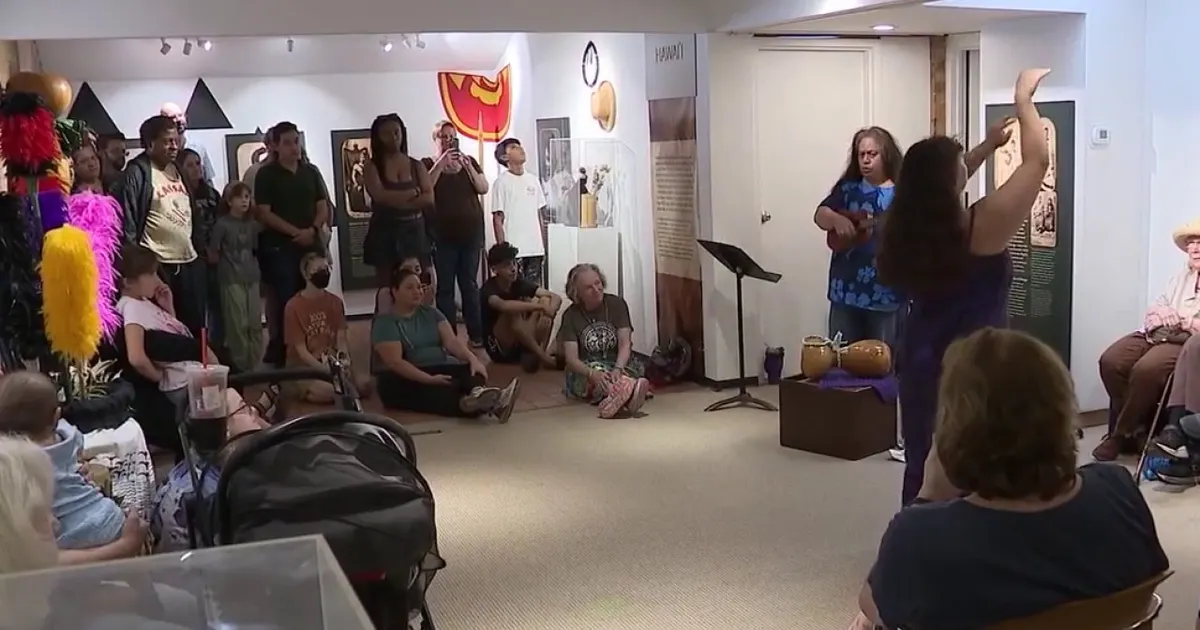
The hula display, developed with the Aloha Center Chicago, examines the dance’s arrival in the city in 1893, when a royal chorus performed at the World’s Fair.
Carole Lanialoha Lee, the centre’s executive director, said hula had traditionally been regarded as sacred and was not always intended for public viewing.
“Hula was a sacred thing,” she said. “It was not always something open for public viewing.”
A further installation explains the museum’s repatriation work, including how objects are assessed, discussed with tribal representatives and returned to their communities. Collections and repatriation manager Teagan Harris said some artefacts are tested for arsenic because items were treated with the substance between 1870 and 1970.
The Gichigamiin Indigenous Nations Museum is at 3001 Central Street in Evanston. Its wider redevelopment programme includes expanded learning experiences, garden activities and plans for a teaching kitchen focused on Indigenous food traditions.
