


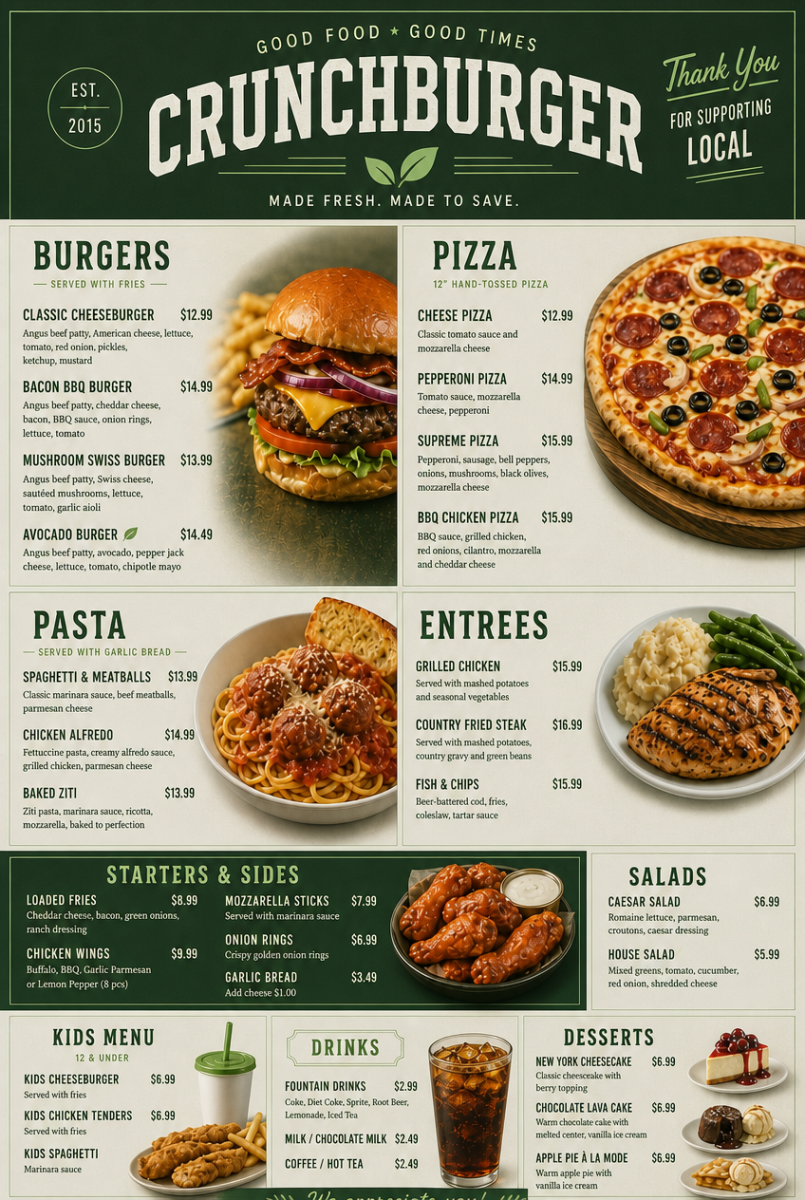
AI-generated restaurant menus are producing food images that look polished but subtly wrong, as repeated editing and training on similar commercial designs push dishes towards an unnaturally smooth and uniform appearance.
The effect can be difficult to describe: ice-cream scoops appear perfectly round, fillings sit with improbable precision and seafood can seem to curl back into itself. In some cases, the images are so distorted that a burrito resembles abstract art rather than something intended to be eaten.
Alex Lisle, chief technology officer at Reality Defender, said the images could look as though they had been made by something that understood the appearance of food but not its purpose.
“It’s almost like an alien trying to make a pizza without understanding its core principles,” he said.
The problem stems partly from how image generators and large language models are trained. They analyse enormous collections of existing material and use the patterns they find to predict what is likely to satisfy a request, such as a menu for a burger restaurant.
That process tends to favour familiar commercial imagery. “A lot of this stuff looks like a Chili’s menu from 2015, and there’s a reason for that,” Mr Lisle said. “That was the corpus of work from which [the models] drew their function.”
Fast-food menus from major chains already share many visual conventions, including brightly lit food, carefully arranged ingredients and highly standardised layouts. An AI system asked to create a new version can reproduce those conventions, making the result look generic before further rounds of editing make the sameness more pronounced.
Why AI-generated food images look unnerving
Lee Rainie, director of the Imagining the Digital Future Center at Elon University, said AI systems were designed to produce material that appeared pleasing and avoided obvious problems.
“The optimization of the data sets is for pleasingness, or you know, not being offensive, and so there’s a way that turns into homogenization,” he said. “What AI is known to do both in images and language is to shave off the edges.”
That smoothing can occur when a restaurant repeatedly asks an image generator to make small changes to an existing menu, such as altering a price, dish name or colour scheme. Each revision may appear harmless, but the food can gradually become rounder, cleaner and less recognisable.
An online experiment by a user identified as Labtec demonstrated the effect by editing a menu generated in ChatGPT 100 times. “The end result actually makes me uncomfortable,” the user wrote. A similar test found that repeated changes could produce increasingly artificial-looking dishes.
Restaurants may unintentionally create the same effect while refining promotional material. Images that begin as plausible depictions can be repeatedly processed until the visual details no longer correspond to real food, even though the overall design remains professionally presented.
Mr Lisle distinguished this process from “model collapse”, a more serious failure that can occur when AI-generated material is repeatedly fed back into the data used to train future systems.
“Model collapse is almost like a mad cow disease… when you feed the outputs from one model back into itself, eventually the inbreeding becomes too much, and the whole thing collapses,” he said. “What we see here is convergence, which isn’t necessarily model collapse.”
Convergence does not make an AI system unusable, but can narrow the range and quality of what it produces. If synthetic menus and adverts are added to future training collections, they may reinforce the same limited aesthetic.
Food advertising already improves on reality. A burger used in a commercial is often arranged by specialists so that every layer looks as appetising as possible. AI-generated images can intensify that effect, creating food that is visually immaculate but lacks the irregularities people associate with something freshly prepared.
Research by scientists at the University of Duisburg-Essen in Germany found that AI-generated food images could trigger an “uncanny valley” response. Images that appeared almost real were associated with greater unease and disgust than pictures that were plainly artificial.
Lee Rainie said people often recognised the difference between authentic and generated imagery without being able to identify one particular flaw.
“People have an almost unexplainable sense about when they’re looking at something that’s AI-generated, compared with something that was real in the first place,” he said. “There’s just a sensibility that people sometimes find hard to articulate, but they kind of know it when they see it.”
The response to synthetic menus reflects a wider change in how images and recordings are treated. Mr Lisle said visual material could no longer automatically be regarded as reliable evidence, at a time when businesses and institutions are increasingly using generative tools to produce content.
“Seeing and hearing has always been believing, to the point where even our court systems are entirely tuned to the idea that the gold standard in evidence is taped confessions and videotaped evidence,” he said. “That’s no longer the case. The world has fundamentally shifted, for good or for ill.”
