


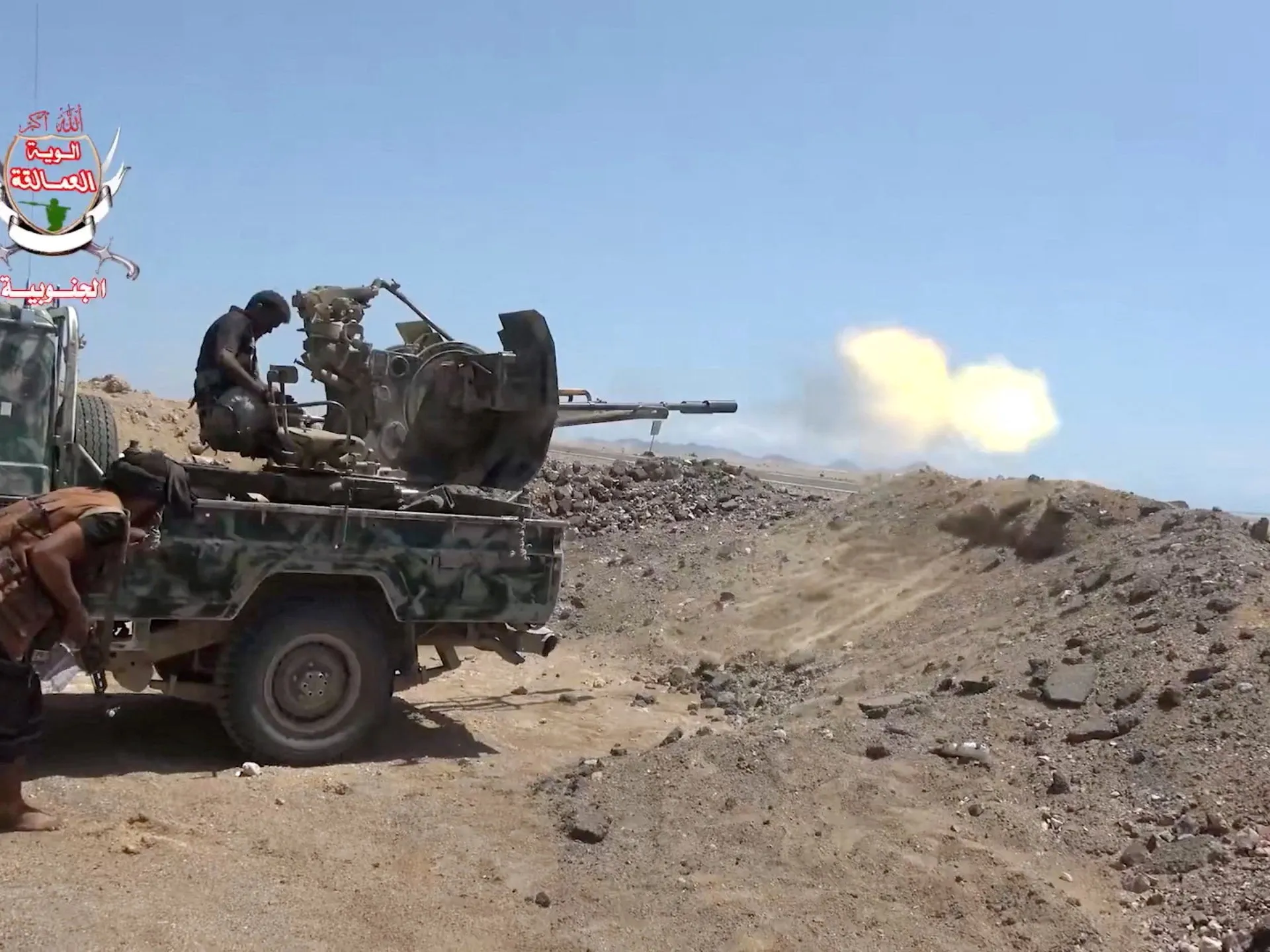
Yemen’s internationally recognised government has launched a new offensive against the Iran-backed Houthis, backed by intensified Saudi air strikes and what analysts describe as improved coordination between forces on the ground and in the air.
The campaign, named Operation Dawn of Yemen, was announced on Monday with the stated aim of restoring state authority across the country. Government forces then attacked Houthi positions along the southern Red Sea coast, seeking first to reverse the group’s recent gains around the Bab al-Mandeb Strait.
The longer-term objective is to retake territory held by the Houthis for more than a decade, including the capital, Sanaa, which the group seized in 2014. So far, however, the government’s advances have been limited, most notably around areas near the strategically important waterway.
The offensive follows the collapse of a fragile truce in July and the government’s losses on the Red Sea coast last month. Those setbacks exposed divisions among anti-Houthi forces, a lack of military preparedness and alleged infiltration of government communications by the Houthis.
It remains unclear whether all of those weaknesses have been resolved. But the Houthis’ failure to secure the highlands overlooking their recent gains in the south-west has left their positions vulnerable to a counteroffensive, according to analysts.
Saudi air power and ground forces
Saudi Arabia has emerged as the most significant external force behind the operation, providing heavy aerial support to government units fighting on several fronts, including Taiz, Marib and al-Jawf.
The Saudi-led coalition said 100 fighter jets took part in Monday’s offensive. It was the coalition’s first acknowledgement in four years that it had resumed air attacks against the Houthis, despite reports of strikes in September.
Maged al-Madhaji, chairman of the Sana’a Center for Strategic Studies, said the strikes were being carried out with greater speed and accuracy than previously, including during the opening phase of the Saudi-led bombing campaign in 2015.
US intelligence support has also contributed to the campaign. A US official said 200 American advisers were stationed in Saudi Arabia in support of the operation.
Retired Lebanese general Elias Hanna said the co-ordination pointed to a unified command structure. “There is a central leadership managing operations and coordination between the ground forces and the air forces,” he said. “The air force attacks, but ground forces then have to occupy the territory, remain there, and control it.”
Mr Hanna said US expertise had effectively created an “intelligence bank” of targets that could allow repeated attacks on Houthi positions.
Giants Brigades take leading role
The Giants Brigades, a force previously trained by the United Arab Emirates and now supported by Saudi Arabia, have taken a prominent role in the latest fighting.
The group was present during the government’s losses on the Red Sea coast, but with fewer troops. It is now leading operations in the area and in Taiz’s al-Waziyah district, which overlooks the port city of Mocha.
The brigades drove the Houthis from Shabwah in 2022 and pushed them out of parts of Marib and al-Bayda, east of Sanaa. Mr al-Madhaji said their experience across both flat and mountainous terrain made them the government side’s most capable force against the Houthis.
“In practice, this is the first time we have seen Saudi operational management, together with forces that had been under Emirati management, produce effective results,” he said. The development suggested that the different factions were now working through a more unified operations room, he added.
Government forces have also claimed advances in the largely desert governorates of Marib and al-Jawf, east of Sanaa. Progress there could prove important if the authorities attempt to mount a wider assault towards the capital, although such an operation remains distant.
The Houthis have nevertheless regrouped after losing ground around the south-western town of Dhubab and continue to advance towards the government-held city of Taiz. Their missile and drone capabilities have also grown, and they have stepped up attacks on government positions and Saudi Arabia.
Government morale remains fragile, and further setbacks, particularly around Taiz, could quickly alter the perception of the offensive. Reclaiming territory the Houthis have held for years, including the major port of Hodeidah, would be considerably harder than retaking recently captured ground.
The government and Saudi Arabia now have greater international backing than during previous escalations. Britain has said it will provide defensive support to Saudi Arabia, while a mutual-defence pact between the kingdom, Turkiye and Pakistan has been activated.
Turkiye has not confirmed any troop deployments, while Pakistan has said it is providing support including reconnaissance. The additional diplomatic and military assistance may prove important as the anti-Houthi campaign is expected to continue for many months.
