


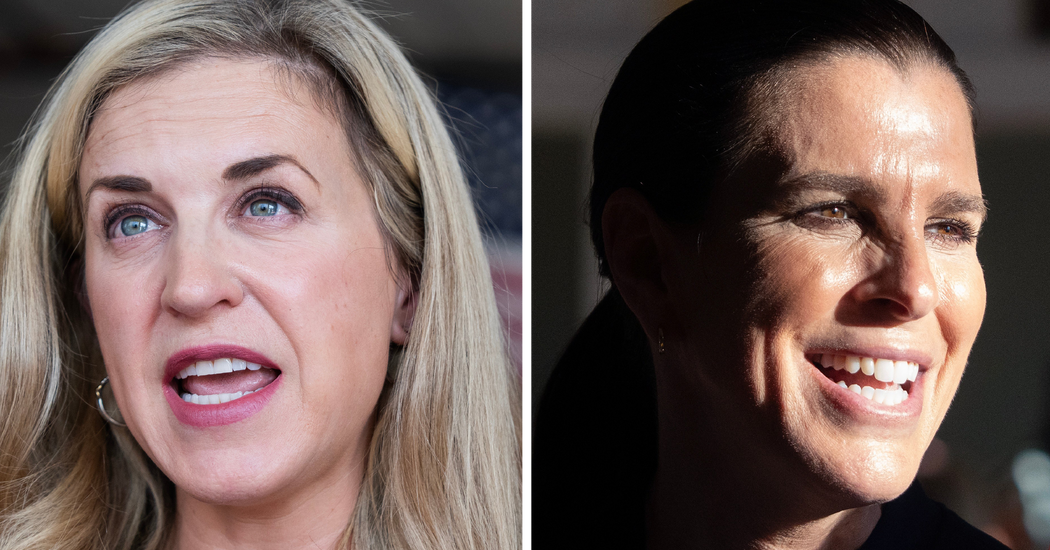
Stefany Shaheen is fighting to prove she can win a seat in Congress on her own merits as rival Maura Sullivan turns her famous family name into the central issue of New Hampshire’s Democratic primary.
Shaheen, a former Portsmouth city councillor and the daughter of retiring Senator Jeanne Shaheen, is competing for the open seat in the state’s First Congressional District. The contest has become a test of whether voters still welcome political dynasties — or are ready to reject candidates seen as beneficiaries of family connections.
Sullivan, a former Marine and one-time congressional candidate, has made the attack explicit in a television advert accusing her opponent of being “entitled” and declaring that voters deserve “a fighter, not a fancy last name”.
Shaheen has acknowledged that her surname brings both advantages and scrutiny. “I always knew I was going to have to earn every vote in my own right,” she said in an interview this weekend.
The latest polling suggests Sullivan’s strategy may be gaining traction. A University of New Hampshire survey published on August 26 put Sullivan and Shaheen in a statistical tie, with progressive candidate Carleigh Beriont close behind. It marked a sharp change from January, when Shaheen held a commanding lead over the crowded field.
New Hampshire voters will choose their candidates on September 8. The general election contest is expected to be closely watched because the district, which includes Manchester, the Seacoast and parts of the state’s southern and Lakes regions, has become a potential Republican target after four-term Democratic congressman Chris Pappas entered the Senate race.
New Hampshire primary becomes a referendum on political families
Shaheen’s family background is unusually prominent even by New England standards. Her mother served three terms as governor before becoming a three-term senator, and was the first woman in the United States to hold both offices in the same state.
Stefany Shaheen has attempted to put distance between her campaign and her mother’s political record while stressing her own ties to New Hampshire. She has spoken about raising her family in the state, building a small business and serving on the Portsmouth city council and police commission.
Healthcare is a central part of her platform. Shaheen supports Medicare for All and has drawn on her experience as a diabetes advocate, including work in health technology and nutrition.
She has also sought to demonstrate independence from her mother. Last autumn, she criticised a Senate agreement Jeanne Shaheen helped broker to reopen the federal government after a shutdown, a decision that angered many progressives.
Jeanne Shaheen has defended her daughter as an independent candidate, saying that quality would help make her an effective member of Congress. But the family connection remains difficult to avoid, particularly as the election takes place during a wider backlash against established political names.
Sullivan has portrayed herself as the alternative to that establishment. She moved to New Hampshire shortly before launching her first congressional bid in 2017 and lost the Democratic primary the following year to Pappas. Her campaign now presents the race as a choice between change and “more of the same”.
Her campaign manager, Natalie Silver, rejected suggestions that Sullivan was backed by the pro-Israel group AIPAC after Shaheen criticised around $300,000 in donations from people who had also contributed to the organisation. “Maura isn’t endorsed by AIPAC, and she hasn’t taken a dime from AIPAC or any corporate PAC,” Silver said.
Beriont, the third leading contender, has built a more explicitly grassroots campaign and gained ground in recent surveys. Her rise has added another layer of uncertainty to a primary in which name recognition, political experience and ideological divisions are competing for voters’ attention.
For Shaheen, the immediate challenge is to persuade Democrats that a well-known surname is not a substitute for a political record. For Sullivan, it is to convince them that rejecting a dynasty matters more than the familiarity and electoral strength that the Shaheen name may bring.
