


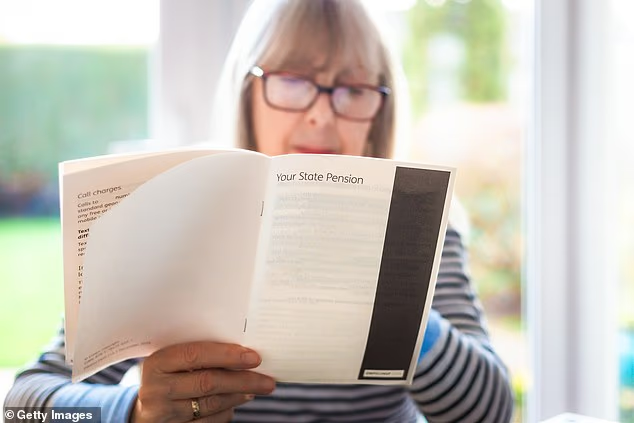
Women are expected to receive a larger state pension than men on average for the first time early next year, marking a reversal of a long-standing difference in retirement payments.
The gap has narrowed steadily since the new state pension was introduced in 2016. Women reaching state pension age for the first time this year receive an average of just 36p less a week than men, according to Department for Work and Pensions figures.
That amounts to a difference of £18.72 a year. Among people who retired a year ago, the gap is about £1 a week, while men who reached pension age five years ago receive £322 more each year than women of the same age.
Sir Steve Webb, the former pensions minister who helped design the new system, said he expected women to overtake men in the coming months.
“For generations, women have been the poor relations when it came to the state pension system,” he said. “A key aim of the new state pension was to remove this discrimination and treat men and women equally.”
Why women are set to overtake men in state pension payments
Under the system in place before April 6, 2016, pensioners received a basic state pension alongside any earnings-related entitlement they had built up during their working lives.
The additional payments, known as Serps, were generally more valuable to men because they were more likely to have earned higher salaries and worked for longer. Men were also more likely to have qualified for transitional protections when the new pension was introduced, allowing them to retain higher amounts accumulated under the previous rules.
Five years ago, more than one in four men reaching state pension age had such protection, compared with 14 per cent of women. This year, the figures have fallen to one in five men and one in ten women.
As fewer people with large pre-2016 earnings-related additions reach retirement, the advantage those protections gave men is diminishing. The new state pension pays a flat rate of £241 a week, or £12,547 a year, to someone with 35 qualifying years of National Insurance contributions.
More than eight million pensioners still receive the old state pension, which is being phased out. Women already receiving it will not benefit from the expected reversal: they receive £196 a week on average, £29 less than men, a difference of £1,515 a year.
The move towards equal payments has also been helped by changes covering time spent caring. Since 2010, a year spent at home with a child can count as a full qualifying year, while carers receiving Carer’s Allowance can also receive National Insurance credits.
However, pension amounts will continue to vary because people have different National Insurance records. Anyone with fewer than 35 qualifying years will generally receive less than the full new state pension.
The wider gender pension gap remains
The expected change in state pension payments does not mean women have achieved equality across retirement income. Women aged between 55 and 59 have around half the pension wealth of men of the same age, according to the Pensions Policy Institute.
Women are more likely to work part-time or take time away from employment to care for children, reducing their earnings and workplace pension contributions. Kate Smith of Aegon said the largest gaps often emerged in the decade or two after women returned to work part-time following childbirth.
Women working full time in the UK were paid 6.9 per cent less than men on average in 2025, according to figures cited in the report. John Adams, its author, said the gender pension gap had become “a severe inequality within the pensions landscape”, leaving women at significant risk of pensioner poverty.
Private pensions can also be affected by divorce, particularly where a woman has taken on caring responsibilities and built up a smaller pension pot. Although pensions can be shared during divorce, this does not always happen when one spouse chooses to keep the family home.
Becky O’Connor of PensionBee said the equalisation of the state pension was positive but would not resolve the substantial gap in private pensions for women approaching retirement.
