


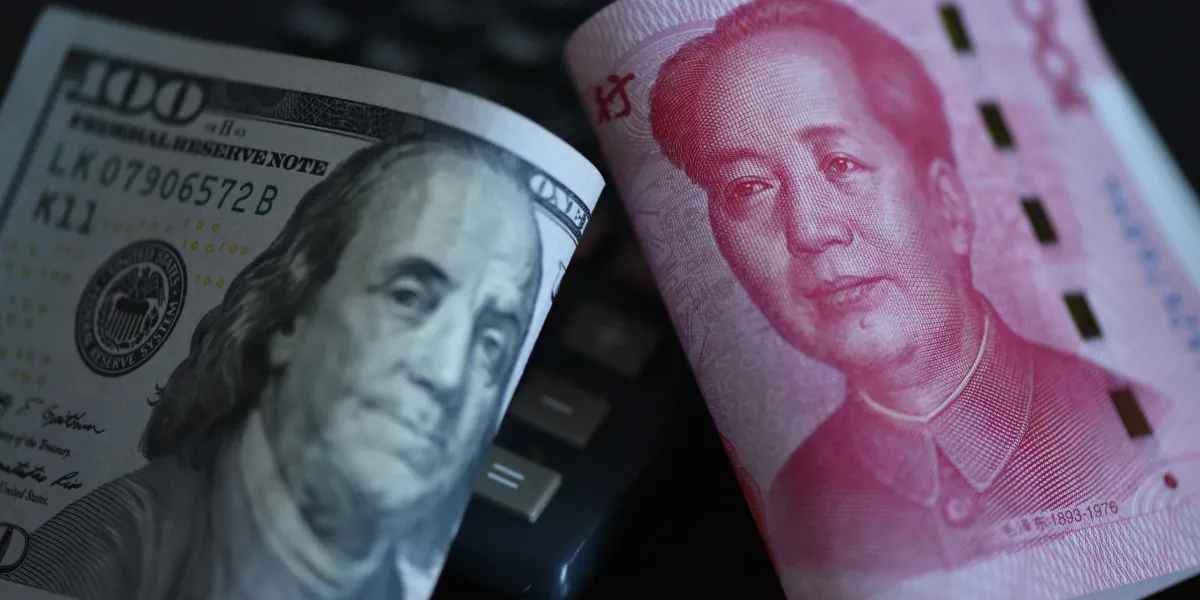
The yuan is unlikely to replace the US dollar as the world’s leading reserve currency in the near future, Standard Chartered China chief executive Jean Lu has said, despite growing use of China’s currency in trade and finance.
Speaking at a media roundtable in Singapore, Ms Lu said: “There is no way—at least in my career—for the RMB to challenge the USD.”
She suggested, however, that the renminbi could become a stronger rival to other major currencies, including the yen and the pound. “Compared to the yen or pound, the RMB may have a chance,” she said.
The dollar accounted for 57% of global foreign exchange reserves in the first quarter of 2026, according to the International Monetary Fund. The figure rose by one percentage point from the previous quarter, largely because the dollar appreciated slightly against other currencies.
By comparison, the yuan represented only 2% of global reserves, up from 1.95% in the previous quarter.
Why the yuan has struggled to gain ground
Ms Lu attributed the yuan’s limited progress overseas to a lack of liquidity in offshore markets. China’s capital controls also restrict how freely the currency can move through the global financial system.
“We’re talking about less than 2 trillion yuan, with almost half of it being in Hong Kong,” she said.
Beijing is nevertheless seeking to expand the currency’s international role. China’s latest five-year plan, released in March, set out proposals to encourage greater use of the renminbi through instruments including Panda bonds issued in mainland China and Dim Sum bonds sold in offshore markets.
The People’s Bank of China has also appointed major institutions, including Deutsche Bank, as offshore clearing banks to improve access to the currency in Europe. It has launched new repurchase facilities allowing foreign central banks to obtain yuan liquidity.
Demand for the yuan is growing particularly quickly in South-east Asia, one of China’s largest trading partners. Settlement volumes between China and the region reached 8.9 trillion yuan, or about 1.3 trillion US dollars, in 2025, a 50.7% increase, according to a March report from Standard Chartered.
Businesses in the Association of South-east Asian Nations are also increasingly using China’s capital markets for hedging and fundraising. Singapore Airlines entered the offshore yuan market in June with a 1.5 billion yuan Dim Sum bond.
Geopolitical tensions have further encouraged some countries to use the yuan. US sanctions imposed on Russia after its invasion of Ukraine prompted China, India and other trading partners to adopt the currency for some transactions. Following US strikes on Iran earlier this year, Tehran also asked ships crossing the Strait of Hormuz to pay tolls in yuan.
Trade between China and South-east Asia has reached record levels, helped by infrastructure projects such as the Pinglu Canal, which links south-western China with the Beibu Gulf and is intended to reduce logistics costs by as much as 30%.
Patrick Lee, Standard Chartered’s chief executive for ASEAN and Singapore, said Chinese companies viewed the region as an attractive base for investment and supply-chain development as geopolitical conditions changed.
But the expansion has also created tensions. More than 2,000 factories in Thailand closed in 2024 amid an influx of cheaper Chinese steel and other goods, while textile manufacturers in Indonesia have struggled to remain competitive.
Mr Lee and Ms Lu said China was not simply exporting excess industrial capacity, arguing that Chinese companies were investing in manufacturing operations and helping to develop local industries.
“China’s larger [state-owned enterprises] and [privately-owned enterprises] are definitely coming to Southeast Asia to lay down their roots and invest for the long term,” Mr Lee said.
